
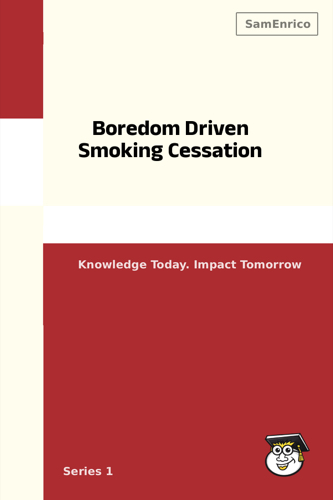
Non-FictionSelf-HelpBoredom Management
Boredom Driven Smoking Cessation eBook
Fill idle moments with fidget tools, quick puzzles
by Mixon Danuta
Fill idle moments with fidget tools, quick puzzles, or phone games instead of cigarettes.
Formats
Free sample
Chapter 1: The 47 Cigarettes You Don’t Remember--–- You are about to read something that will make you genuinely angry at every other quit-smoking book you have ever opened. Here it is: physical nicotine withdrawal is a lie. Not the sensation—that discomfort is real enough—but the assumption that it is your real problem. The烟草 industry, the pharmaceutical companies, and even well-meaning doctors have spent decades convincing you that you are a slave to a chemical. They want you to believe that your body is crying out for nicotine every thirty minutes, that your willpower is simply too weak to resist, and that quitting requires Herculean suffering.
None of that is true. The physical withdrawal from nicotine, for the vast majority of smokers, peaks within seventy-two hours and then largely disappears. The headaches fade. The irritability settles. The insomnia passes.
And yet, six months later, ninety percent of quitters have relapsed. Not because they craved nicotine—that chemical hunger has long since vanished—but because they were bored. They were waiting for a bus. They were standing awkwardly at a party. They had just finished dinner and did not know what to do with their hands for the next three minutes.
They did not relapse because their body needed a drug. They relapsed because their brain needed a script.This chapter will introduce you to a concept that every other cessation book has missed: the dopamine gap. Your brain has been trained, over thousands of repetitions, to expect a small, reliable hit of stimulation every twenty to forty minutes. That stimulation came from the ritual of smoking—the flick of the lighter, the draw of smoke, the exhale, the tap of ash. When you remove the cigarette, you do not simply remove nicotine.
You remove a punctuation mark from your day. You remove a familiar rhythm. And the resulting silence? That silence is not peace. It is panic.
Let us begin.The Myth of Chemical Slavery Every smoker has heard the same speech. Nicotine hooks you within seconds of your first inhale. It binds to receptors in your brain and floods your system with dopamine. Within hours, you develop tolerance. Within days, you experience withdrawal.
You are, in short, a drug addict. And like any drug addict, you must white-knuckle your way through withdrawal, suffering through the cravings until your brain eventually rewires itself. This narrative is not entirely false—nicotine is indeed addictive—but it is dangerously incomplete. It focuses on the chemical while ignoring the context. And that focus is precisely why most quit attempts fail.Consider the evidence.
When researchers place rats in cages with access to nicotine-laced water, the rats do indeed become dependent. They drink more. They show signs of withdrawal when the nicotine is removed. But here is the crucial detail that never makes it into the public health campaigns: rats who live in enriched cages—cages with wheels, tunnels, toys, and other rats to play with—consume far less nicotine than rats who live in barren, isolated cages. The difference is not biological.
It is environmental. A rat with something to do does not need a drug. A rat with nothing to do self-medicates with whatever is available. The same is true of human beings.Smokers are not weak-willed addicts. They are, by and large, people who have structured their days around a particular rhythm of stimulation.
The cigarette becomes not just a drug delivery device but a reliable companion during transitions. You smoke while walking to the train. You smoke while waiting for a meeting to start. You smoke while thinking through a problem. Remove the cigarette, and you do not merely remove nicotine.
You remove a familiar way of occupying your hands, your mouth, and your attention during the small gaps that punctuate every human day. Those gaps—the three minutes between finishing a task and starting the next one, the ninety seconds while coffee brews, the five minutes while you wait for a friend to arrive—are the true enemy. The nicotine is merely the excuse.The Dopamine Gap Explained Let us talk about dopamine. You have heard the word before, probably in the context of pleasure or reward. You have been told that nicotine floods your brain with dopamine, creating a sensation of pleasure that your brain then craves.
This is true as far as it goes, but it misses a more important truth: your brain releases dopamine in response to predicted rewards, not just actual ones. The famous neuroscientist Wolfram Schultz demonstrated this decades ago with monkeys and apple juice. He trained monkeys to expect a drop of apple juice after a light flashed. At first, the monkeys’ dopamine neurons fired when they received the juice. But after repeated trials, something fascinating happened.
The dopamine neurons stopped firing at the delivery of the juice and started firing at the flash of the light. The anticipation became the reward. The brain learned to crave the signal, not just the substance.Here is what that means for you, the smoker. Your brain no longer releases dopamine primarily at the moment you inhale nicotine. It releases dopamine when you reach for the pack.
When you tap out a cigarette. When you flick the lighter. When you bring the filter to your lips. The entire ritual—every single motion, every sound, every tactile sensation—has become a conditioned reward signal. Your brain has learned to crave the script of smoking, not merely the chemical payoff at the end.
And this is why quitting is so much harder than the chemical model suggests. You are not fighting a drug. You are fighting a deeply embedded sequence of actions that your brain has come to anticipate with genuine pleasure.This is the dopamine gap. When you stop smoking, you remove not only nicotine but every single one of those conditioned signals. The pack is no longer in your pocket.
The lighter is no longer on the table. The familiar hand-to-mouth motion is gone. The ninety seconds of structured activity that used to fill every transition in your day have suddenly become a void. And your brain, confronted with that void, panics. It does not panic because it needs nicotine.
It panics because it has no script for unstructured time. It has forgotten how to simply wait.The 48-Hour Experiment That Will Change Everything Before we go any further, I want you to do something. I want you to conduct a simple experiment for the next forty-eight hours. You do not need to quit smoking yet. You do not need to reduce your intake.
You do not need to make any changes to your behavior whatsoever. All you need to do is observe.Take out your phone or grab a small notebook. For the next two days, every time you find yourself with nothing to do—even for a moment—write it down. Be specific. Note the time of day, the location, what you were doing immediately before the idle moment, and what you did immediately after.
Here are some examples:10:15 AM – Waiting for coffee to brew in the kitchen. Stood there for about a minute. Scrolled through my phone. Then lit a…
This is the end of the free sample. Get the eBook to keep going. Buy now
About this book
Details
- Author
- Mixon Danuta
- Publisher
- SamEnrico
- Language
- English
- Genre
- Non-Fiction, Self-Help, Boredom Management
- Released
- 2026-06-06
- Pages (approx.)
- 147
- Available as
- eBook, Audiobook

Read better in the ZLOADR app
Your eBooks on your phone or tablet. Sign in with your SamEnrico account and start reading.
More by Mixon Danuta
 Francis and the EucharistMixon Danuta$11.99
 Audio Memoir GuideMixon Danuta$11.99
 Split Shift Sleep GuideMixon Danuta$11.99
 IBS Travel Survival HandbookMixon Danuta$11.99
 NVC for Disability AdvocacyMixon Danuta$11.99
 Expectation Adjustment TechniquesMixon Danuta$11.99
 Parent with ADHD Time ManagementMixon Danuta$11.99
 The Star Maps of Ancient Egypt: Astronomers of the NileMixon Danuta$11.99
 The Tudor Games: Henry VIII's Forgotten Olympic VisionMixon Danuta$11.99
 How to Become a Reaming-machine TenderMixon Danuta$11.99
 Service Providers Guide to Medical SpasMixon Danuta$11.99
 How to Produce a Toy VehicleMixon Danuta$11.99
You may also like
 Hong Kong Handover 1997Dunn Johnnie$11.99
 Zumba For Postnatal Recovery CourseNeal Christian$11.99
 Zumba for BeginnersLadner Nikia$11.99
 YouTube Comment Mining GuideHumes Pandora$12.99
 Worry Box MeditationCarlin Rudy$11.99
 Workplace Stress MeditationNguyen Lynn$11.99
 Workplace Stress and Sleep RepairHawley Ivory$11.99
 Workplace Perfectionism CureDelaney Jeffry$11.99
 Workplace Injustice Anger GuideWallen Isabelle$11.99
 Work Addiction and Burnout LinkGreenwood Ester$11.99
 Women in Yoga and WellnessBeattie Galina$11.99
 Women in Stand Up ComedyChun Evangeline$11.99