
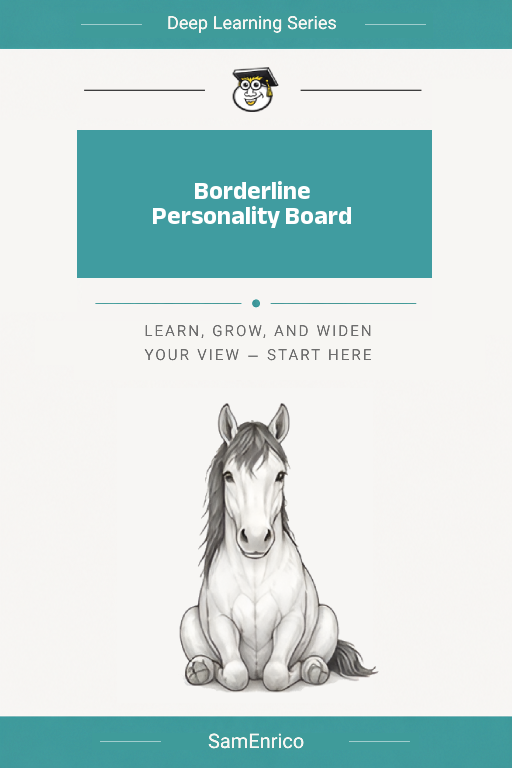
Borderline Personality Board eBook
Include a DBT skills coach, attachment therapist,
by Betz Rod
Include a DBT skills coach, attachment therapist, and peer who has recovered, focusing on emotional regulation and relationship stability.
Formats
Free sample
Chapter 1: The Boat and the Board...--The first time someone told me I had Borderline Personality Disorder, I heard a death sentence. I was twenty-three years old, sitting in a psychiatrist’s office that smelled like stale coffee and antiseptic, holding a prescription for a medication I would not fill. The psychiatrist used clinical words—“affective instability,” “identity disturbance,” “chronic emptiness”—and I translated each one into the only language I knew: broken, unfixable, dangerous to love. I walked out of that office and did not return to therapy for three years. I was not being stubborn.
I was being logical. Why would I seek treatment for a disorder that, according to everything I had read online, was the mental health equivalent of a terminal diagnosis?That was the lie I believed. It is the same lie that opens this book.Here is the truth that took me another decade to learn: Borderline Personality Disorder is not a death sentence. It is not a moral failure. It is not proof that you are manipulative, attention-seeking, or incapable of love.
It is, in the most literal sense, a disorder of the emotional regulation system—a brain that learned, through a combination of biology and environment, to sound the fire alarm at the slightest whiff of smoke. And like any learned pattern, it can be unlearned. Not erased, perhaps. But rewired. Reclaimed.
Reduced from a category-five hurricane to a manageable storm that you, as the captain of your own life, can learn to navigate.This book exists because no single resource currently gives you everything you need to make that journey. There are excellent DBT workbooks that teach skills but ignore the attachment wounds that make those skills so hard to use. There are brilliant attachment books that explain the “why” of BPD but leave you without the “how” of daily survival. There are moving memoirs that make you feel seen but offer no roadmap out of the pain. And there are books for the people who love you—Stop Walking on Eggshells and its kin—that are indispensable but were not written for the person actually living inside the storm.You need all three.
Not sequentially. Not in isolation. Together, in conversation, in the same room, sitting at the same table.That table is the Borderline Board.The Three Voices You Are About to Meet Imagine you are building a house. You would not hire only an electrician. You would not hire only a plumber.
You would hire a general contractor who coordinates multiple experts, each of whom brings a different kind of knowledge to the project. Healing from BPD is no different. You need more than one kind of expertise. You need more than one voice.This book gives you three. They will appear together in every chapter, each speaking from their own domain, each respecting the others’ territory.
They are your Inner Board—the three advisors who will guide you through every page that follows.The DBT Coach The first voice belongs to the DBT Coach. DBT stands for Dialectical Behavior Therapy, the gold-standard treatment for BPD, developed by Dr. Marsha Linehan—a woman who herself lived with the disorder and has spoken openly about her own hospitalization and recovery. The DBT Coach in this book is not a specific person but a composite voice representing everything the evidence-based literature has taught us about what works.The DBT Coach owns the “what to do right now.” When you are in crisis, the DBT Coach gives you the tool. When you cannot stop crying or cannot stop raging or cannot stop the urge to cut or call or run, the DBT Coach says: Here is the skill.
Use it now. We will figure out the rest later. The Coach teaches you the TIP skills for changing your body chemistry in the middle of a meltdown. The DEAR MAN script for asking for what you need without destroying the relationship. The Opposite Action for doing the opposite of what your flooded brain is screaming at you to do.The DBT Coach does not care, in the moment of crisis, why you are in pain.
That is not the Coach’s job. The Coach’s job is to keep you alive and out of the emergency room and not on the floor in a puddle of texts you will regret tomorrow. The Coach is pragmatic, repetitive, and ruthlessly focused on behavior. If you have ever been told that you are “too much” or “too dramatic” or “too sensitive,” the DBT Coach is the voice that says: Your emotions are real. Your reactions are learned.
And you can learn new ones.The Attachment Therapist The second voice belongs to the Attachment Therapist. This voice draws on decades of research into how early relationships shape the developing brain. The Attachment Therapist owns the “why it hurts so much.” When you find yourself spiraling because a partner did not text back quickly enough, the Attachment Therapist does not hand you a skill (that is the Coach’s job). Instead, the Therapist asks a different question: What is the oldest version of this feeling? Who first made you feel this way?The Attachment Therapist explains the concept of the invalidating environment—not necessarily a cruel or abusive childhood, but a childhood in which your emotional experiences were consistently dismissed, punished, or trivialized.
“You are too sensitive.” “Stop crying or I will give you something to cry about.” “You are fine.” “It is not that bad.” When a child receives these messages enough times, they learn a devastating lesson: My feelings are not real. I cannot trust myself. I need someone else to tell me how I should feel.That lesson becomes the architecture of BPD. The Attachment Therapist walks you through how that architecture was built—not to assign blame, but to free you from the unconscious belief that you are still that child, still powerless, still at the mercy of whoever holds the emotional keys. The Therapist introduces you to concepts like internal object constancy (why you cannot feel safe when your person is not in the room), anxious-preoccupied attachment (why abandonment feels like death), and reenactment (why you keep choosing partners who remind you of the people who first hurt you).The Attachment Therapist does not give you worksheets.
The Therapist gives you a story—a coherent, compassionate narrative of how you became who you are. And that story, once you can tell it to yourself without shame, is the foundation upon which all the skills are built.The Guide The third voice belongs to the Guide. This voice is not a composite. It is a specific person—the co-author of this book, someone who has lived through the nightmare you may be living through right now and come out the other side. The Guide is not a therapist.
The Guide is not a coach. The Guide is a peer who has walked the path and agreed to walk it again with you, one chapter at a time.The Guide owns the “bridge to hope.” When the DBT Coach gives you a skill that feels impossible, the Guide says: I tried that skill. Here is…
This is the end of the free sample. Get the eBook to keep going. Buy now
About this book
Details
- Author
- Betz Rod
- Publisher
- SamEnrico
- Language
- English
- Genre
- Non-Fiction, Mental Wealth
- Released
- 2026-05-30
- Pages (approx.)
- 145
- Available as
- eBook, Audiobook

Read better in the ZLOADR app
Your eBooks on your phone or tablet. Sign in with your SamEnrico account and start reading.
More by Betz Rod
 Binge Eating and Body DysmorphiaBetz Rod$11.99
 Beach Body Confidence GuideBetz Rod$11.99
 Icefall Leadership PrinciplesBetz Rod$11.99
 Caregiving For Parent With Kidney FailureBetz Rod$11.99
 The Empty Nest Anger GuideBetz Rod$11.99
 Western Front Generals CritiquedBetz Rod$11.99
 The Massage Parlor SurvivorBetz Rod$11.99
 Paper Bag MythBetz Rod$11.99
 Velvet & Vengeance: The Scandal That Toppled an EmpireBetz Rod$11.99
 Baba Yaga's Hollow: The Witch Who Walks the Bone RoadBetz Rod$11.99
 A Collector's Handbook to the Ford Cortina MkivBetz Rod$11.99
 Service Providers Guide to Real Estate AppraisalsBetz Rod$11.99
You may also like
 Hong Kong Handover 1997Dunn Johnnie$11.99
 Zumba For Postnatal Recovery CourseNeal Christian$11.99
 Zumba for BeginnersLadner Nikia$11.99
 YouTube Comment Mining GuideHumes Pandora$12.99
 Worry Box MeditationCarlin Rudy$11.99
 Workplace Stress MeditationNguyen Lynn$11.99
 Workplace Stress and Sleep RepairHawley Ivory$11.99
 Workplace Perfectionism CureDelaney Jeffry$11.99
 Workplace Injustice Anger GuideWallen Isabelle$11.99
 Work Addiction and Burnout LinkGreenwood Ester$11.99
 Women in Yoga and WellnessBeattie Galina$11.99
 Women in Stand Up ComedyChun Evangeline$11.99