
Non-FictionInformativeEducational
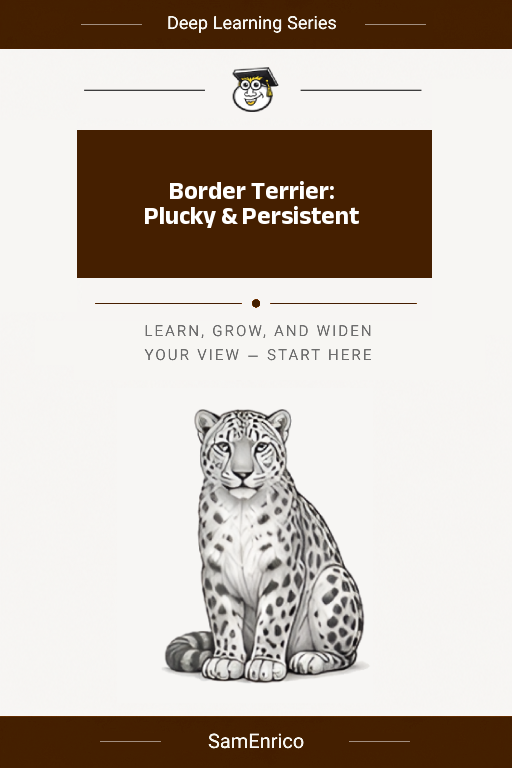
Border Terrier: Plucky & Persistent eBook
This publication, published by SamEnrico, covers B
This publication, published by SamEnrico, covers Border Terrier: Plucky & Persistent
Formats
Free sample
Chapter 1: The Fox Hunter's Secret--–- On a cold, damp morning in the Cheviot Hills, where the border between England and Scotland blurs into a landscape of heather, stone, and mist, a mounted fox hunter once watched his pack of long-legged hounds disappear over a ridge. Behind them, struggling to keep pace, ran a small, unremarkable terrier—nothing special to look at, with a rough, weather-beaten coat and a head shaped like an otter's. The hunter paid it no mind. Hours later, after the hounds had lost the scent and the fox had gone to ground in a rocky den too narrow for any dog to enter, that same scruffy terrier arrived. It paused at the den entrance, sniffed once, and then—without hesitation—squeezed its narrow body into the darkness.
Minutes passed in silence. Then, from deep underground, came the sound of barking, scrabbling, and finally, the fox bolting into the open. The terrier emerged, muddy and bleeding from a dozen small cuts, shook itself off, and looked up at the hunter as if to say, That is what I was born to do.This scene, repeated countless times across the border country of Britain in the 18th and 19th centuries, contains the secret of the Border Terrier. Not a secret hidden in pedigrees or breed standards, but a secret written in bone and instinct: this is a dog bred for one thing above all others. Not for beauty, not for companionship, not for obedience in the show ring.
The Border Terrier was bred to go to ground—to enter the darkness where the fox hides and to stay there, persistent and undaunted, until the job is done.Understanding this secret is not an optional piece of historical trivia. It is the key to everything that follows in this book. Every quirk of the Border Terrier's personality—the stubbornness that frustrates new owners, the prey drive that sends them bolting after squirrels, the digging that destroys gardens, the alertness that turns them into little watchdogs—every single one of these traits is a direct inheritance from those Cheviot Hills. When your Border Terrier ignores your recall command because it has caught the scent of a rabbit, it is not being defiant. It is being exactly what centuries of selective breeding created.
When it digs a hole under your fence, it is not destroying your property out of spite. It is following an instinct older than the American Kennel Club, older than the breed's name itself.This chapter tells the story of how that instinct was forged.The Landscape That Made the Dog To understand the Border Terrier, one must first understand the land that created it. The Cheviot Hills are not gentle. They are a rugged, windswept range of ancient volcanic rock, rising to just over 2,600 feet at their highest point. The climate is harsh—wet, cold, and foggy for much of the year.
The soil is thin and acidic, supporting rough grasses, heather, and scattered stands of hardy rowan and willow. This is not farmland in the pastoral sense. It is sheep country, and hard sheep country at that.For centuries, the farmers of this region—both English and Scottish, for the border has shifted many times—raised flocks of Cheviot sheep, a breed known for its hardiness and its ability to thrive on rough grazing. But the sheep had enemies. Foxes were the primary threat, and in the rocky hills, foxes had an endless supply of dens: natural crevices, abandoned badger sets, hollows beneath boulders.
A fox that went to ground was safe from any predator that could not follow it into the darkness.Enter the mounted fox hunt. By the 18th century, fox hunting had become a well-established tradition in the British countryside. Wealthy landowners rode to hounds, chasing foxes across their estates. But in the border country, the hunts faced a problem that their counterparts in the gentler landscapes of southern England did not: the terrain was too rough, the dens too numerous, and the foxes too clever. A pack of hounds could chase a fox all day, but the moment the fox found a den, the hunt ended.The solution was a small, specialized terrier that could do what the hounds could not.
Not a dog to run with the pack, but a dog to enter the den. Not a dog to chase above ground, but a dog to fight below it. The farmers and huntsmen of the border country began breeding for a very specific set of traits: a dog small enough to squeeze through tight openings, narrow-chested enough to maneuver in confined spaces, but long-legged enough to keep up with horses. A dog with a thick, wiry coat that would protect against bites, scratches, and the damp cold of underground dens. A dog with tremendous jaw strength and a grip that would not release.
And above all, a dog with the temperament to enter darkness, to face a cornered and dangerous fox, and to persist until the job was done.That dog had no formal name at first. It was simply the working terrier of the border country—a type rather than a breed, shaped by function rather than fashion. But it was already, in every meaningful sense, the Border Terrier.The Many Names of a Working Dog Before the breed acquired its official name, it was known by many informal titles, each reflecting a different aspect of its history or the region where it worked. Understanding these names helps to piece together the puzzle of the breed's development.The Reedwater Terrier. This is perhaps the oldest recorded name for the breed, and it points to a specific geographic origin.
The Reedwater is a river that flows through Northumberland, in the northernmost part of England, near the Scottish border. The Reedwater Valley was a center of terrier breeding, and the dogs from this area were prized for their working ability. The name suggests that the breed was recognized as a distinct type—at least locally—as early as the 1700s.The Coquetdale Terrier. The River Coquet also flows through Northumberland, and like the Reedwater, its valley was home to terrier breeders. Coquetdale terriers were known for their stamina and their ability to work in rocky terrain.
Some historical accounts suggest that the Coquetdale dogs were slightly larger and longer-legged than the Reedwater dogs, reflecting the different demands of the landscapes where they worked. But both were variations on the same basic type: narrow-bodied, rough-coated, and relentless.The Redesdale Terrier. Redesdale is another Northumbrian valley, and another center of terrier breeding. The dogs from this area were particularly known for their distinctive coat colors—reds, grizzles, and wheaten shades that remain in the breed standard today.The Border Terrier. The name that eventually stuck did not come into common use until the late 19th century.
It was a simple geographic descriptor: the terrier from the border country. But it carried an implicit acknowledgment that this was a breed distinct from the other terriers of Britain—the Fox Terrier, the Bedlington, the Dandie Dinmont. The Border Terrier was not a show dog. It was not a fashionable pet. It was a working dog's working dog…
This is the end of the free sample. Get the eBook to keep going. Buy now
About this book
Details
- Author
- Landry Tanisha
- Publisher
- SamEnrico
- Language
- English
- Genre
- Non-Fiction, Informative, Educational
- Released
- 2026-06-02
- Pages (approx.)
- 126
- Available as
- eBook, Audiobook

Read better in the ZLOADR app
Your eBooks on your phone or tablet. Sign in with your SamEnrico account and start reading.
More by Landry Tanisha
 The Analog Remote Time GuideLandry Tanisha$11.99
 Beauty Filter Self Esteem FixLandry Tanisha$11.99
 CPR for OverdoseLandry Tanisha$11.99
 Journaling Morning ProtocolLandry Tanisha$11.99
 EQ for ParentsLandry Tanisha$11.99
 Micro Persuasion At WorkLandry Tanisha$11.99
 Immigration Trauma TriggersLandry Tanisha$11.99
 Burn Itch Relief GuideLandry Tanisha$11.99
 The Hollow Hill: Secrets of the SidheLandry Tanisha$11.99
 The Great Gaelic Gold Heist: How Hurling Stole America's HeartLandry Tanisha$11.99
 How to Produce Fishing NetsLandry Tanisha$11.99
 Madrid Designation Later GuideLandry Tanisha$12.99
You may also like
 Hong Kong Handover 1997Dunn Johnnie$11.99
 Zumba For Postnatal Recovery CourseNeal Christian$11.99
 Zumba for BeginnersLadner Nikia$11.99
 YouTube Comment Mining GuideHumes Pandora$12.99
 Worry Box MeditationCarlin Rudy$11.99
 Workplace Stress MeditationNguyen Lynn$11.99
 Workplace Stress and Sleep RepairHawley Ivory$11.99
 Workplace Perfectionism CureDelaney Jeffry$11.99
 Workplace Injustice Anger GuideWallen Isabelle$11.99
 Work Addiction and Burnout LinkGreenwood Ester$11.99
 Women in Yoga and WellnessBeattie Galina$11.99
 Women in Stand Up ComedyChun Evangeline$11.99