
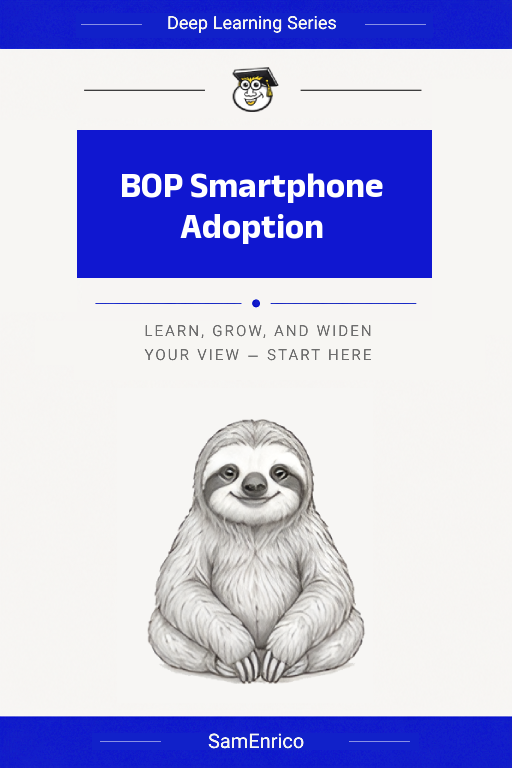
Non-FictionStartup GuideBOP Strategy
BOP Smartphone Adoption
Leverage smartphone growth in low-income markets.
by Cane Latanya
Leverage smartphone growth in low-income markets. Mobile-first product design.
Formats
About this book
Free sample
Chapter 1: The Broken Hype...--The smartphone was not supposed to work this way.In 2012, a parade of TED talks and Mc Kinsey reports promised a miracle. The "digital leapfrog," they called it. Just as landlines had been skipped for mobile phones across Africa and Asia, the smartphone would now vault the world's poorest communities directly into prosperity. A $35 Android device in the hand of a rural farmer would unlock banking, education, healthcare, and markets. Poverty would retreat.
Opportunity would bloom. The only thing standing in the way, the story went, was distribution. Get the phones into those hands, and the rest would take care of itself.By 2025, that promise had collided with an uncomfortable reality. Broadband penetration in Nigeria crossed 68 percent—a staggering number that would have seemed impossible a decade earlier. And yet, walk through the markets of Lagos, the farms of Kano, or the fishing villages of the Niger Delta, and you will find millions of smartphones functioning as little more than glorified feature phones.
Whats App. Mobile Money. Perhaps a music app. That is the universe. The other apps—the agricultural price tools, the job marketplaces, the educational platforms that were supposed to transform lives—sit dormant, taking up precious storage space on devices that cost their owners weeks of wages.This is the gap that this book exists to close.
Not the gap between phone ownership and phone access. That gap is shrinking. The real gap is between access and utility. Owning a smartphone and using it to reliably improve your economic or social condition are two entirely different things. And for the Base of the Pyramid—the four billion people living on less than $8 per day—that gap remains a chasm.The problem is not the users.
It has never been the users. The problem is the assumption that a smartphone designed in Cupertino, California, running software architected in Menlo Park, and sold through supply chains optimized for New York, London, and Shanghai, will somehow work the same way in a rural village in Uttar Pradesh, a hillside favela in Rio, or a crowded informal…
This is the end of the free sample. Get the eBook to keep going. Buy now
Contents
- Chapter 1
- Chapter 2
- Chapter 3
- Chapter 4
- Chapter 5
- Chapter 6
- Chapter 7
- Chapter 8
- Chapter 9
- Chapter 10
- Chapter 11
- Chapter 12
Details
- Author
- Cane Latanya
- Publisher
- SamEnrico
- Language
- English
- Genre
- Non-Fiction, Startup Guide, BOP Strategy
- Released
- 2026-06-01
- Pages (approx.)
- 144
- Available as
- eBook, Audiobook

Read better in the ZLOADR app
Your eBooks on your phone or tablet. Sign in with your SamEnrico account and start reading.
More by Cane Latanya
 Self Talk for Procrastination HandbookCane Latanya$11.99
 Teen Self Talk GuideCane Latanya$11.99
 Body Scan for Lower Back PainCane Latanya$11.99
 The Growth Hormone Decline GuideCane Latanya$11.99
 Singapore Business GuideCane Latanya$11.99
 The Great Mail Train Robbery: America's First Armored Car HeistCane Latanya$11.99
 Understanding Usher Syndrome, Type 2aCane Latanya$17.99
 Certification for Timber ExportCane Latanya$12.99
 Ultimate Handbook Guide to Akesu : (China) Travel GuideCane Latanya$11.99
 Home Health RNCane Latanya$11.99
You may also like
 Hong Kong Handover 1997Dunn Johnnie$11.99
 Zumba For Postnatal Recovery CourseNeal Christian$11.99
 Zumba for BeginnersLadner Nikia$11.99
 YouTube Comment Mining GuideHumes Pandora$12.99
 Worry Box MeditationCarlin Rudy$11.99
 Workplace Stress MeditationNguyen Lynn$11.99
 Workplace Stress and Sleep RepairHawley Ivory$11.99
 Workplace Perfectionism CureDelaney Jeffry$11.99
 Workplace Injustice Anger GuideWallen Isabelle$11.99
 Work Addiction and Burnout LinkGreenwood Ester$11.99
 Women in Yoga and WellnessBeattie Galina$11.99
 Women in Stand Up ComedyChun Evangeline$11.99