
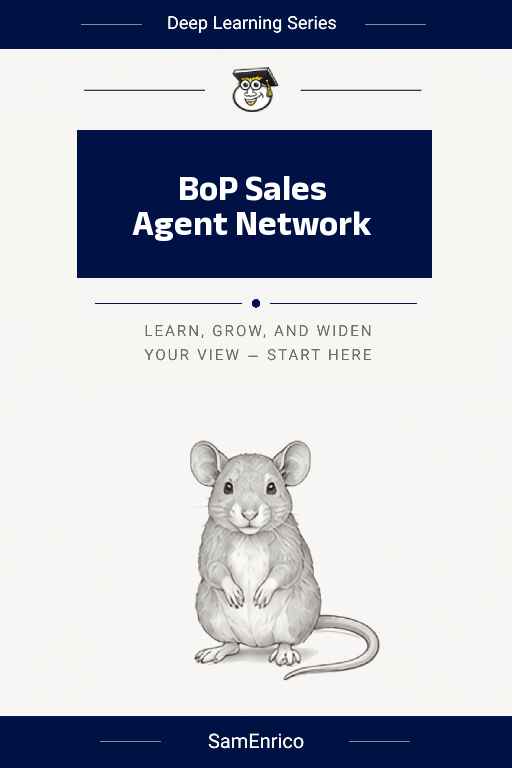
Non-FictionStartup GuideBOP StrategySales
BoP Sales Agent Network eBook
Build commission based sales agent network within
Build commission based sales agent network within low income communities to drive product adoption.
Formats
Free sample
Chapter 1: The Last Mile Problem–– In a village three hours from the nearest paved road in rural Tanzania, a mother watches her two-year-old son struggle with diarrhea that has persisted for three days. She knows that oral rehydration salts—a simple mixture of sugar, salt, and clean water—could save his life. She learned about ORS from a health worker who visited six months ago. She remembers that it costs less than a cup of rice. But the closest shop that sells ORS is a six-mile walk away.
She cannot leave her other children alone for that long. The journey passes through a stretch of forest where a woman walking alone is not safe. And even if she went, the shopkeeper told her last time that ORS had been out of stock for weeks. So she waits. She hopes.
And every hour, her son grows weaker.This is not a story about a lack of products. Oral rehydration salts have existed for decades. They cost pennies to manufacture. They are on the World Health Organization’s list of essential medicines. The problem is not that the product does not exist.
The problem is that the product cannot reach the people who need it most. This is the last mile problem. And it is the single greatest barrier to delivering life-changing products—health supplies, clean energy, financial services, consumer goods—to the four billion people living at the base of the economic pyramid.The base of the pyramid—or Bo P—is not a metaphor. It is a economic reality. Approximately four billion people live on less than five dollars per day.
Their total purchasing power exceeds five trillion dollars annually. They are not destitute victims. They are consumers, entrepreneurs, and parents who make rational choices with limited resources. They buy soap, cooking oil, medicine, phone credit, and school supplies. They save for emergencies.
They invest in their children’s futures. They represent one of the largest untapped markets in the world.Yet most businesses and social enterprises fail to reach them. Not because the products are wrong. Not because the pricing is wrong. Not because the people do not want what is being sold.
But because the distribution systems that work in wealthy countries—retail stores, e-commerce, door-to-door sales forces—collapse when applied to Bo P contexts. The roads are too poor. The population is too dispersed. The trust is too thin. The transaction sizes are too small.
The last mile is not just a distance. It is a chasm.This chapter is about that chasm. It is about understanding why traditional distribution models fail at the base of the pyramid. And it is about the foundation of the solution that the rest of this book will build: the commission-based sales agent network. By the end of this chapter, you will understand the four fundamental barriers that make Bo P distribution uniquely difficult.
You will see why well-intentioned efforts have failed. And you will be ready to learn how a different model—one that puts local agents at the center—can bridge the last mile.The Geography Problem: Too Few People, Too Far Apart The first barrier is simple arithmetic. Bo P consumers are not clustered in convenient urban centers. They are dispersed across millions of villages, hamlets, and informal urban settlements. The population density in rural Bo P areas can be as low as fifty people per square kilometer.
To put that in perspective, the density of Manhattan is over 27,000 people per square kilometer. A retail shop in Manhattan can serve thousands of customers within a five-minute walk. A retail shop in rural Tanzania might serve fifty customers within a five-mile walk.This dispersion makes traditional retail infrastructure economically impossible. A shop requires certain fixed costs: rent or construction, inventory, a shopkeeper’s time, security, and utilities. To cover these costs, the shop must generate a minimum level of revenue.
In a dense urban area, that revenue threshold is easily met. In a sparse rural area, it is not. The math simply does not work.Even where shops exist in Bo P communities—the “duka” in Kenya, the “spaza shop” in South Africa, the “sari-sari store” in the Philippines—they face their own structural limitations. These informal retailers operate on razor-thin margins, often less than 10%. They have limited working capital, typically less than one hundred dollars tied up in inventory at any time.
They carry only the fastest-moving consumer goods: soap, cooking oil, sugar, tea, salt, perhaps some batteries or phone credit. They rarely stock specialized products like water filters, insecticide-treated bed nets, fortified foods, or oral rehydration salts. These products take up space, tie up capital, and may sit on shelves for weeks or months before selling. The shopkeeper cannot afford that risk.The geography problem is not a failure of local entrepreneurship. It is a structural reality of low-density populations.
And it means that any solution that depends on fixed retail locations will leave millions of Bo P consumers unreachable. If the product is not within walking distance, the consumer cannot buy it. There is no Amazon drone coming to rural Tanzania. There is no same-day delivery service. There is only the distance a mother can walk while her other children wait at home.The Trust Deficit: Why Strangers Cannot Sell The second barrier is not physical.
It is social. In Bo P communities, trust is the currency of commerce—and it is in very short supply for outsiders.In wealthy countries, we rely on a dense web of formal institutions to verify quality, price, and reliability. We have brand reputation, government regulations, consumer protection laws, Better Business Bureau ratings, online reviews, and return policies. When we buy a product from a stranger, we trust that if something goes wrong, we have recourse. That trust is not abstract.
It is built into the legal and commercial infrastructure.Bo P communities have little or none of this infrastructure. Courts are distant and expensive. Regulations are poorly enforced. Brands may be unknown or counterfeited. Online reviews do not exist.
Return policies are unthinkable. In this environment, personal relationships become the primary mechanism for verifying trust. A product sold by a stranger is inherently suspect. A product sold by a neighbor, a friend, or a family member carries an implicit endorsement. That endorsement is not just social—it is economic.
If your neighbor sells you a bed net that falls apart, you will hold your neighbor accountable. Your neighbor’s reputation is on the line. That accountability is more powerful than any warranty.This trust deficit is particularly acute for health products. The stakes are highest when a product involves family planning, child health, or disease prevention. A woman considering a contraceptive implant is not going to buy it from a stranger who knocks on her door.
She needs reassurance that the product is safe, effective, and appropriate for her body. She needs to ask questions and receive answers she can trust. She needs to know that if something goes wrong, someone will help her. That reassurance cannot come from a television advertisement, a radio jingle, or a colorful package. It must come from someone the community already trusts.The same…
This is the end of the free sample. Get the eBook to keep going. Buy now
About this book
Details
- Author
- Copeland Penny
- Publisher
- SamEnrico
- Language
- English
- Genre
- Non-Fiction, Startup Guide, BOP Strategy, Sales
- Released
- 2026-06-01
- Pages (approx.)
- 138
- Available as
- eBook, Audiobook

Read better in the ZLOADR app
Your eBooks on your phone or tablet. Sign in with your SamEnrico account and start reading.
More by Copeland Penny
 Siberian Exile Crime CampsCopeland Penny$11.99
 Dream Journal for SeniorsCopeland Penny$11.99
 Luxury Goods Addiction Recovery GuideCopeland Penny$11.99
 Binge Eating After Abuse RecoveryCopeland Penny$11.99
 Mindful Tech Use GuideCopeland Penny$11.99
 The Impossible Catch: How Don Larsen Threw Baseball's Only Perfect Game in the World SeriesCopeland Penny$11.99
 The Ice Queen of Miami: How a 1980s Smuggler Outran the LawCopeland Penny$11.99
 Understanding Congenital Aneurysms of The Great VesselsCopeland Penny$17.99
 Employer Reputation GuideCopeland Penny$12.99
 Leasing SpecialistCopeland Penny$11.99
 How to Start a Automotive Parts and Accessories Store BusinessCopeland Penny$11.99
You may also like
 Hong Kong Handover 1997Dunn Johnnie$11.99
 Zumba For Postnatal Recovery CourseNeal Christian$11.99
 Zumba for BeginnersLadner Nikia$11.99
 YouTube Comment Mining GuideHumes Pandora$12.99
 Worry Box MeditationCarlin Rudy$11.99
 Workplace Stress MeditationNguyen Lynn$11.99
 Workplace Stress and Sleep RepairHawley Ivory$11.99
 Workplace Perfectionism CureDelaney Jeffry$11.99
 Workplace Injustice Anger GuideWallen Isabelle$11.99
 Work Addiction and Burnout LinkGreenwood Ester$11.99
 Women in Yoga and WellnessBeattie Galina$11.99
 Women in Stand Up ComedyChun Evangeline$11.99