
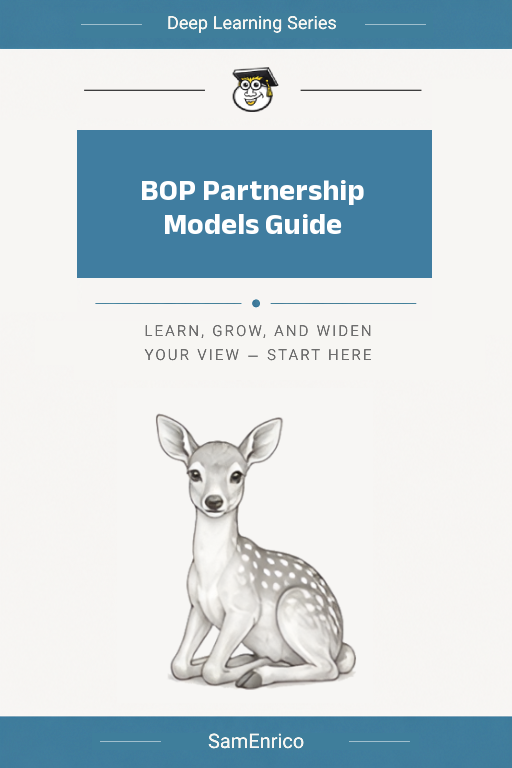
Non-FictionStartup GuideBOP Strategy
BOP Partnership Models Guide eBook
Partner with NGOs and government for low-income ma
Partner with NGOs and government for low-income market access. Co-creation and co-delivery.
Formats
Free sample
Chapter 1: The $5 Trillion Blind Spot--–- In 2002, a multinational consumer goods company launched what it called its “Bo P initiative” with great fanfare. The plan was simple: take their best-selling shampoo, reduce the bottle size by 60%, lower the price by 40%, and distribute it through rural women’s cooperatives in three Indian states. The company’s internal projections showed ten million units sold in the first year, a handsome profit margin, and a glowing CSR report about “serving the underserved.” Eighteen months later, the initiative had sold fewer than 200,000 units. The women’s cooperatives returned thousands of unsold bottles. Post-mortem focus groups revealed the problem: the smaller bottle was too expensive per milliliter than the larger sizes wealthier consumers bought, and rural buyers knew it.
They felt insulted. One woman told the researchers, “You think we are stupid because we are poor. We are not stupid. We are poor.” The company quietly discontinued the product and never spoke of the initiative again.This story is not an outlier. It is the rule.Between 2002 and 2015, over 140 major corporations launched formal “Bottom of the Pyramid” (Bo P) strategies.
By 2018, academic researchers at Oxford and INSEAD had tracked down the outcomes of these initiatives. Fewer than 15% survived beyond three years. Less than 5% achieved anything close to their projected scale. And in more than half the cases, the company’s own evaluation admitted that the initiative had done little to improve the lives of the low-income consumers it claimed to serve. The Fortune at the Bottom of the Pyramid—the provocative and influential 2004 book by C.K.
Prahalad that promised a $5 trillion market and a path out of poverty through corporate engagement—had produced, in the sober assessment of its own inheritors, a graveyard of good intentions.This book is the manual for how to do it differently. But before we can build the new model, we must understand why the old one failed so spectacularly—and why that failure was not an accident but a predictable consequence of a flawed foundational assumption.The Original Promise and Its Flaw Prahalad’s original insight was electrifying in its simplicity. Four billion people live on less than 8perday.Collectively,theirpurchasingpowerparity(PPP)exceeds8 per day. Collectively, their purchasing power parity (PPP) exceeds 8perday.Collectively,theirpurchasingpowerparity(PPP)exceeds5 trillion. That is larger than the economy of Japan, Germany, and the United Kingdom combined.
For decades, multinational corporations had ignored this population, dismissing them as too poor to matter. Prahalad argued the opposite: the poor represent a vast, untapped market. Moreover, by serving them, corporations could simultaneously generate profit and alleviate poverty. It was a win-win proposition that seemed almost too good to be true.As it turned out, it was too good to be true—not because the market size was miscalculated, but because the underlying model of how to serve it was fundamentally wrong.The original Bo P playbook, what we will call throughout this book Bo P 1.0, rested on three assumptions that each proved faulty in practice.Assumption One: The poor are price-sensitive consumers who will buy scaled-down versions of existing products. This led companies to take their existing product lines, strip away features, reduce packaging, and offer a “value version” at a lower price point.
The shampoo story above illustrates the flaw: price sensitivity does not mean indifference to value. Bo P consumers are not looking for cheap versions of rich people’s products. They are looking for products designed from the ground up for their specific constraints and aspirations. A smaller shampoo bottle is not a solution to a problem they have. It is an insult dressed up as generosity.Assumption Two: Existing distribution channels can be extended or lightly modified to reach rural poor consumers.
Companies assumed that if they partnered with local micro-retailers or women’s cooperatives, the product would flow downhill. But the last mile in Bo P markets is not a logistics problem—it is a trust problem. A woman running a village kiosk will not stock your product if she has never heard of your brand, if she cannot verify your quality, if she has no recourse for defective goods, and if the margin is too thin to justify the shelf space. Bo P 1.0 treated distribution as a pipe; it is actually a membrane that selectively permits only what local gatekeepers trust.Assumption Three: Poverty alleviation will follow automatically from market inclusion. This was the most seductive and most dangerous assumption.
If a poor family buys a more efficient cookstove, they save money on fuel. If they buy fortified rice, their children’s health improves. These are real benefits. But Bo P 1.0 assumed that any market transaction was inherently developmental. It overlooked the possibility that a transaction could be extractive—that a corporation could profit without meaningfully improving lives, or worse, could impoverish communities further by displacing local producers, creating debt cycles, or introducing products that solve one problem while creating two others.The Three Eras of Bo P Thinking To understand where we are going, we need a clear map of where we have been.
The evolution of Bo P thinking can be divided into three distinct eras. Each era represents not just a change in tactics but a different philosophy about the relationship between corporations, poor communities, and the purpose of business itself. We will introduce these eras once here, and throughout the book we will refer back to them without re-explaining the full framework.Bo P 1.0 – The Extraction Era (approximately 2000–2010) is what we have just described. It treats low-income communities as passive consumers. The corporation defines the problem, designs the solution, sets the price, and controls the distribution.
The community’s role is to buy. This era was characterized by high-profile failures, modest successes in a few sectors (microfinance, mobile phones), and a growing realization that something fundamental was missing.Bo P 2.0 – The Co-Venture Era (approximately 2010–2018) emerged as a corrective. In this model, corporations form joint ventures with local entrepreneurs, NGOs, or community-based organizations. The corporation brings technical expertise, branding, and capital. The local partner brings market knowledge, relationships, and trust.
Together, they co-create products and co-design distribution. This era produced genuine successes—notably in off-grid solar energy, where companies like d.light and M-KOPA worked with local sales agents and pay-as-you-go financing to reach millions of households. But Bo P 2.0 had a ceiling. Joint ventures are expensive to manage. They require constant negotiation between partners with different incentives.
And they rarely achieve the scale that pure commercial models promise, because they still place the corporation at the center of the ecosystem.Bo P 3.0 – The Ecosystem Enablement Era (emerging from 2018 forward) is the framework of this book. In Bo P 3.0, the corporation does not try to control the value chain. Instead, it acts as an enabler of local ecosystems. The corporation provides one or two critical inputs—a technology platform, a quality standard, a financing mechanism, a reliable off-take agreement—and then gets out of the way. Local entrepreneurs, community organizations, and government systems take the lead.
The corporation’s goal is not to own the customer relationship but to become a valuable, perhaps indispensable, node in a network it does not dominate. This is the model that…
This is the end of the free sample. Get the eBook to keep going. Buy now
About this book
Details
- Author
- Havens Armanda
- Publisher
- SamEnrico
- Language
- English
- Genre
- Non-Fiction, Startup Guide, BOP Strategy
- Released
- 2026-06-01
- Pages (approx.)
- 160
- Available as
- eBook, Audiobook

Read better in the ZLOADR app
Your eBooks on your phone or tablet. Sign in with your SamEnrico account and start reading.
More by Havens Armanda
 Third Person Self TalkHavens Armanda$11.99
 Affirmation Handwriting RepetitionHavens Armanda$11.99
 Spin Heart Rate Training ManualHavens Armanda$11.99
 Daily Decompression for ScholarsHavens Armanda$11.99
 The HGH and Bone Health GuideHavens Armanda$11.99
 The Buenos Aires Stock Scandal: Argentina's First Financial Fraud (1880s)Havens Armanda$11.99The Buenos Aires Stock Scandal: Argentina's First Financial Fraud (1880s)Havens Armanda$11.99
 Understanding Uveitis, PosteriorHavens Armanda$17.99
 Achievement Log for PromotionHavens Armanda$12.99
 IFTTT Personal AutomationHavens Armanda$11.99
 A Beginners Guide to Hapkido (Volume 1)Havens Armanda$11.99
You may also like
 Hong Kong Handover 1997Dunn Johnnie$11.99
 Zumba For Postnatal Recovery CourseNeal Christian$11.99
 Zumba for BeginnersLadner Nikia$11.99
 YouTube Comment Mining GuideHumes Pandora$12.99
 Worry Box MeditationCarlin Rudy$11.99
 Workplace Stress MeditationNguyen Lynn$11.99
 Workplace Stress and Sleep RepairHawley Ivory$11.99
 Workplace Perfectionism CureDelaney Jeffry$11.99
 Workplace Injustice Anger GuideWallen Isabelle$11.99
 Work Addiction and Burnout LinkGreenwood Ester$11.99
 Women in Yoga and WellnessBeattie Galina$11.99
 Women in Stand Up ComedyChun Evangeline$11.99