

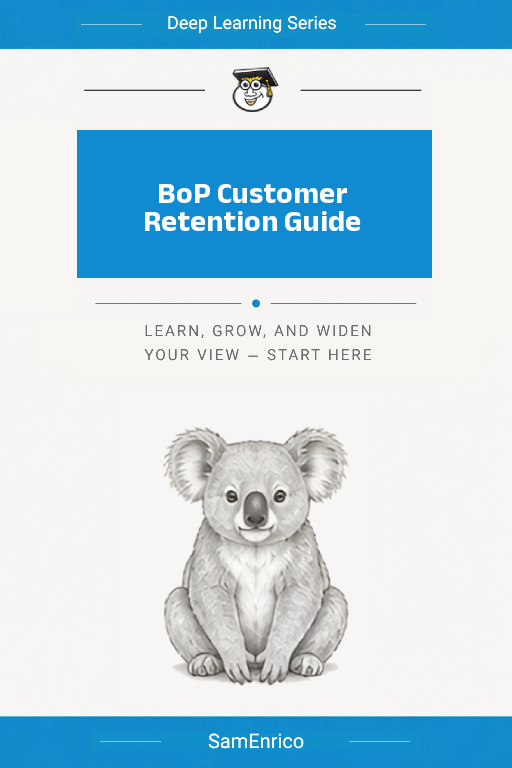
Non-FictionStartup GuideBOP StrategyRetention
BoP Customer Retention Guide eBook
Retain low income customers through loyalty progra
Retain low income customers through loyalty programs consistent quality and personal relationships.
Formats
Free sample
Chapter 1: The $14 Trillion Blind Spot--–- In 1957, a Venetian immigrant named Vittorio Casimiro opened a small store in São Paulo, Brazil. He had no inventory system. No formal pricing strategy. No marketing budget. He had a cart, some blankets and bed linens, and a belief that factory workers and domestic servants deserved the same dignity as the wealthy.
His competitors laughed. They called his customers "invisible" – people with no formal income, no credit history, no savings, no future as consumers.Fifty years later, Casas Bahia was the largest retail chain in Brazil, grossing over US$1 billion annually. Seventy percent of its customers had no formal or consistent income. And Vittorio Casimiro had become one of the richest men in the country – not despite serving the poor, but because of it.The story of Casas Bahia is not an anomaly. It is a warning.
While most businesses chase the same saturated middle-class customers, a 14trillionmarketsitslargelyignored.The4−5billionpeopleatthebaseoftheeconomicpyramid–thoselivingonlessthan14 trillion market sits largely ignored. The 4-5 billion people at the base of the economic pyramid – those living on less than 14trillionmarketsitslargelyignored.The4−5billionpeopleatthebaseoftheeconomicpyramid–thoselivingonlessthan2-5 per day – represent more collective purchasing power than the United States, Germany, the United Kingdom, Italy, France, and Japan combined.This book is about that market. But more specifically, it is about the question that keeps every Bo P-focused business founder awake at night: How do I keep my customers when everyone is chasing them?The Email That Started Everything The email arrived on a Tuesday afternoon from a social enterprise founder in Nairobi. Her business had grown from serving 500 customers to over 50,000 in just three years. But now, something was wrong.
Retention rates were dropping. Customers who had been loyal for years were drifting away. New competitors were offering lower prices, flashier promotions, and what seemed like easier credit. Her question was simple but urgent: "How do I keep my customers when everyone is chasing them?"I have received variations of that email dozens of times over the past decade. From a microfinance institution in Bangladesh watching its best borrowers leave for a new lender.
From a solar lamp company in India whose customers were switching to a cheaper, lower-quality competitor. From a mobile money platform in Kenya that had grown fast but could not stop customer churn.Each email came from a different country, a different industry, a different business model. But they all asked the same question. And they all struggled with the same reality: the strategies that work for retaining middle-class customers do not work at the base of the pyramid.Who Are the Bo P Customers?Before we can talk about retaining Bo P customers, we must understand who they are. The "bottom of the pyramid" – a term popularized by the late C.K.
Prahalad in his landmark book The Fortune at the Bottom of the Pyramid – refers to the 4-5 billion people living on less than $2-5 per day in purchasing power parity terms.But purchasing power is only part of the story. Bo P customers share five characteristics that distinguish them from middle- and high-income consumers.First, irregular and unpredictable incomes. Unlike salaried workers who receive a fixed amount on a predictable schedule, most Bo P customers earn their living through informal work – day labor, street vending, seasonal agriculture, piecework manufacturing. Their income fluctuates daily, weekly, and seasonally. One week they may earn $50; the next week, nothing.
This irregularity shapes every financial decision they make.Second, limited access to formal financial services. Bo P customers are often "unbanked" or "underbanked." They lack checking accounts, savings accounts, credit cards, and formal credit histories. When they need to borrow, they turn to informal lenders – friends, family, local moneylenders – who charge high interest rates. When they need to save, they hide cash under mattresses or join rotating savings groups.Third, high price sensitivity with brand consciousness. Bo P customers are extraordinarily price-sensitive because their margins are thin.
Every penny matters for survival. But they are not willing to buy any cheap product. They are brand-conscious and quality-aware because they cannot afford to waste money on products that fail. A poor customer who buys a cheap shoe that falls apart in a month has wasted more money than one who buys a more expensive but durable shoe.Fourth, strong reliance on social networks. In environments where formal institutions are weak, trust is built through personal relationships and community networks.
Bo P customers rely heavily on referrals from friends, family, and neighbors when making purchasing decisions. A recommendation from a trusted community member carries more weight than any advertisement.Fifth, dignity as a primary value. Bo P customers have often been treated as second-class citizens by businesses, governments, and financial institutions. They have been denied credit, dismissed as unprofitable, and made to feel invisible. The business that treats them with respect – that acknowledges their humanity, listens to their concerns, and serves them with dignity – earns loyalty that transcends price.The Economic Opportunity Everyone Is Missing Let me say this clearly: the Bo P market is not a charitable cause.
It is a massive economic opportunity.Prahalad estimated the collective purchasing power of Bo P consumers at over $14 trillion. To put that number in perspective, it is larger than the GDP of the United States, Germany, the United Kingdom, Italy, France, and Japan combined. That is not a niche market. That is the largest market in the world.This market is also growing. Bo P populations are younger than middle- and high-income populations, with higher birth rates and lower median ages.
As economies develop and infrastructure improves, Bo P consumers move up the income ladder, becoming middle-class consumers with even greater purchasing power. The business that captures Bo P loyalty today gains customers for a lifetime.The evidence is overwhelming. Companies that have cracked the Bo P code have built billion-dollar businesses:Casas Bahia (Brazil) built a credit system based on payment history rather than formal income documentation. Customers who proved reliable over time gained access to larger purchases and better terms. The result was a 70 percent customer base with no formal income and fierce loyalty that survived economic crises, competitive threats, and even the founder's death.CEMEX (Mexico) realized that poor Mexicans needed more than just cement – they needed housing solutions.
The company offered low fixed prices, credit for materials, pre-costed housing designs, and even supervised construction services for Mexicans working abroad. CEMEX moved from selling materials to selling solutions.Hindustan Lever Limited (India) recognized that poor Indian villagers could not afford a full-sized bottle of shampoo costing 1.Soitcreatedsingle−serveshampoosachetscosting1. So it created single-serve shampoo sachets costing 1.Soitcreatedsingle−serveshampoosachetscosting0.01. The innovation unlocked a massive market and made quality hygiene products accessible to millions.Aravind Eye Hospital (India) developed a cross-subsidization model where paying patients funded free care for the poor, while operational innovations drove down costs. The result was the largest eye care facility in the world, treating more patients at lower cost than any comparable institution.These companies did not succeed despite serving the poor.
They succeeded because they served the poor. They understood something that most businesses still do not: Bo P customers are not charity cases. They are value-conscious, brand-aware, fiercely…
This is the end of the free sample. Get the eBook to keep going. Buy now
About this book
Details
- Author
- Damon Florencia
- Publisher
- SamEnrico
- Language
- English
- Genre
- Non-Fiction, Startup Guide, BOP Strategy, Retention
- Released
- 2026-06-01
- Pages (approx.)
- 115
- Available as
- eBook, Audiobook

Read better in the ZLOADR app
Your eBooks on your phone or tablet. Sign in with your SamEnrico account and start reading.
More by Damon Florencia
 After Holiday Spending Hangover GuideDamon Florencia$11.99
 Values And Mission Alignment Complete GuideDamon Florencia$11.99
 Dream Creative Problem SolvingDamon Florencia$11.99
 Mindfulness for Impatient PeopleDamon Florencia$11.99
 Binge Eating Mindfulness Retreat GuideDamon Florencia$11.99
 Echoes of the Deep: The Lost Submarine That Changed the Cold WarDamon Florencia$11.99
 Understanding Congenital Adrenal Hyperplasia Due to 21-hydroxylase DeficiencyDamon Florencia$17.99
 Professor Interaction StylesDamon Florencia$12.99
 IT Support AssociateDamon Florencia$11.99
 How to Start a Shop Fronts Made of Wood Business (Beginners Guide)Damon Florencia$11.99
You may also like
 Hong Kong Handover 1997Dunn Johnnie$11.99
 Zumba For Postnatal Recovery CourseNeal Christian$11.99
 Zumba for BeginnersLadner Nikia$11.99
 YouTube Comment Mining GuideHumes Pandora$12.99
 Worry Box MeditationCarlin Rudy$11.99
 Workplace Stress MeditationNguyen Lynn$11.99
 Workplace Stress and Sleep RepairHawley Ivory$11.99
 Workplace Perfectionism CureDelaney Jeffry$11.99
 Workplace Injustice Anger GuideWallen Isabelle$11.99
 Work Addiction and Burnout LinkGreenwood Ester$11.99
 Women in Yoga and WellnessBeattie Galina$11.99
 Women in Stand Up ComedyChun Evangeline$11.99