
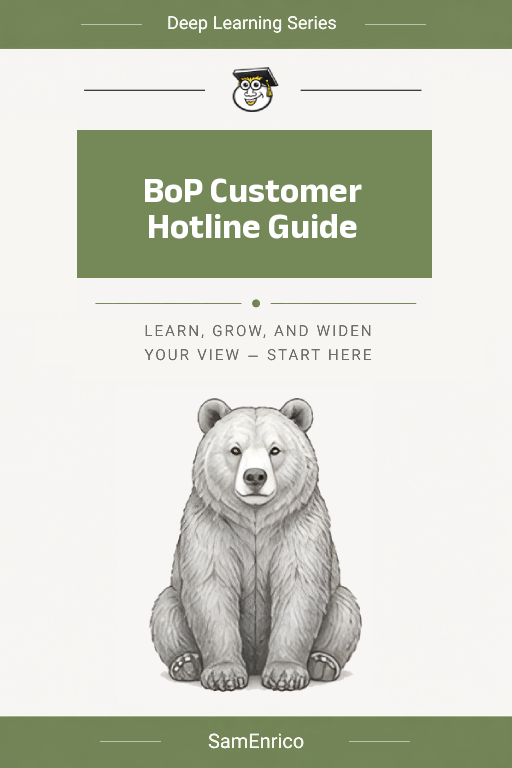
Non-FictionStartup GuideBOP StrategySupport
BoP Customer Hotline Guide eBook
Set up customer support hotline for low income cus
by Wang Sharice
Set up customer support hotline for low income customers using local languages and simple menus.
Formats
Free sample
Chapter 1: The 2 AM Funeral--–- The phone rang at 2:17 AM. Fatima answered it on the second ring, her heart already racing. It was her brother, calling from the village. Their mother had collapsed. No ambulance.
No hospital within thirty miles. Just a dirt road, a sputtering generator, and a smartphone with 12% battery and no credit left for a second call. Fatima tried to call the health insurance hotline. She had paid her premium. She had the card.
But the IVR asked her to "Press 1 for English, 2 for Urdu." Then "Enter your 12-digit policy number." Then "Press 3 for claims." Then "Your call is important to us. Please hold." The battery died at 2:23 AM. Her mother died at 4:11 AM. The insurance company processed the claim denial at 9:00 AM. Reason: "No prior authorization."This is not an exaggeration.
This is not a hypothetical. This is the reality of customer support for the Bottom of the Pyramid—the 4.5 billion people living on less than $10 per day. And if you are building a hotline for these customers without understanding the 2 AM Funeral, you are not building support. You are building a graveyard.This chapter dismantles the most expensive myth in customer experience: that serving low-income customers is simply about offering "cheaper" versions of existing products. It is not.
The Bo P customer does not need a cheaper version of your app. They need a completely different interface, built on completely different assumptions, operating under completely different constraints. Those constraints are not minor inconveniences. They are the difference between life and death. Between a loan repaid and a family bankrupt.
Between a customer retained and a brand destroyed forever.The Anatomy of Asymmetric Constraints Let us begin with a term that will recur throughout this book: asymmetric constraints. In standard customer support design, the organization and the customer operate under roughly symmetric conditions. The customer has a stable internet connection. The organization has a stable internet connection. The customer has a device that can run a modern app.
The organization has servers that can support that app. The customer has time. The organization has time. These symmetries allow for standard solutions: chatbots, ticketing systems, knowledge bases, IVRs with deep menus.In the Bo P context, every single one of these symmetries breaks. The customer has a phone, yes.
But they lack the stable electricity to charge it. They have airtime, yes. But every second on the line costs money that could buy food. They have literacy, maybe. But not necessarily in the language your menu uses.
They have time, yes. But not the kind of time that can be spent navigating a 7-level IVR while standing in the sun with a dying battery.These are not edge cases. They are the median case. According to GSMA, 3.4 billion people still use feature phones as their primary device. According to the World Bank, 750 million adults are non-literate.
According to the IEA, 770 million people lack access to electricity. These numbers overlap. The person with a feature phone is likely to be the same person with intermittent power, limited airtime, and low literacy. This is not a niche demographic. This is the majority of the human race.The Three Killers Every Bo P hotline must be designed around three immutable constraints.
Call them the Three Killers, because they kill customer trust, they kill resolution rates, and they kill your business case if ignored.Killer One: Intermittent Power The average Bo P household experiences power outages multiple times per week. In rural India, the average is 15 hours per week without electricity. In Nigeria, it is 12 hours. In Haiti, it is unpredictable to the point of uselessness. This means that the phone your customer is holding may have been charged yesterday.
It may have been charged this morning. It may have been charged never. The customer does not know. They only know that the battery icon is orange, and they have perhaps thirty minutes of talk time before the screen goes black.Standard hotline design assumes that the customer will have a stable power source throughout the call. This is absurd.
Your customer may be calling from a bus. From a market stall. From a field. From a shared family phone that is passed from hand to hand like a precious resource. When the battery dies, the call dies.
And when the call dies, the customer must decide whether to spend more airtime to call back, navigate the entire menu again, and hope the battery lasts through the second attempt. Most do not. They simply give up.This is not a technology problem. It is a design problem. As we will see in Chapter 6, solutions like persistent session states (saving the user's place when a call drops) directly address intermittent power.
But the first step is acknowledging that intermittent power is not a rare exception. It is the rule. Design for the rule, not the exception.Killer Two: Shared Devices In wealthy economies, the phone is personal. It is yours. It has your fingerprint, your passcode, your apps, your photos.
In Bo P economies, the phone is often shared. A single feature phone may serve an entire household of six or eight people. It may be passed from the father (who uses it for business calls) to the mother (who uses it for family coordination) to the teenage daughter (who uses it for school) to the grandmother (who uses it only for emergencies).Shared devices create three specific problems for hotline design. First, privacy is impossible. Any call your customer makes can be overheard by anyone in the household.
Sensitive topics—debt, health, domestic issues—cannot be discussed openly. This means your IVR must offer a way to signal "I need privacy" without saying it aloud. Second, authentication is compromised. If the phone is shared, then "something you have" (the device) is not unique to the user. Voice biometrics, which we cover in Chapter 7, becomes essential.
Third, the customer may not have the phone available when they need it. The father took it to the market. The teenager is charging it in her room. The customer must wait.Standard hotline design assumes a direct, private, always-available channel to the user. This assumption is lethal to Bo P adoption.
Build for a world where the phone is a household utility, not a personal device.Killer Three: Airtime Anxiety This is the most powerful of the three killers. Airtime anxiety is not rational in the way that economists think of rationality. It is not about the actual cost per minute. It is about the perceived risk. A Bo P customer may have 0.50ofairtimecreditontheirphone.Afive−minutecallmightcost0.50 of airtime credit on their phone.
A five-minute call might cost 0.50ofairtimecreditontheirphone.Afive−minutecallmightcost0.10. That leaves 0.40.Butthecustomerdoesnotknowhowlongthecallwilllast.Theydonotknowifthe IVRwillsendthemincircles.Theydonotknowiftheywillbeplacedonhold.Theydonotknowiftheywillneedtocallback.Sotheanticipatedcostisnot0.40. But the customer does not know how long the call will last. They do not know if the IVR will send them in circles. They do not know if they will be placed on hold.
They do not know if they will need to call back. So the anticipated cost is not 0.40.Butthecustomerdoesnotknowhowlongthecallwilllast.Theydonotknowifthe IVRwillsendthemincircles.Theydonotknowiftheywillbeplacedonhold.Theydonotknowiftheywillneedtocallback.Sotheanticipatedcostisnot0.10. It is $0.50—the entire balance, potentially lost to a failed resolution.This is not irrational. It is perfectly rational given uncertainty. When the outcome…
This is the end of the free sample. Get the eBook to keep going. Buy now
About this book
Details
- Author
- Wang Sharice
- Publisher
- SamEnrico
- Language
- English
- Genre
- Non-Fiction, Startup Guide, BOP Strategy, Support
- Released
- 2026-06-01
- Pages (approx.)
- 152
- Available as
- eBook, Audiobook

Read better in the ZLOADR app
Your eBooks on your phone or tablet. Sign in with your SamEnrico account and start reading.
More by Wang Sharice
 The Beginner Habit TrackerWang Sharice$11.99
 Russian Insurance Fraud GuideWang Sharice$11.99
 Dream Journal Goal SettingWang Sharice$11.99
 Shopping Addiction And Depression CourseWang Sharice$11.99
 Binge Eating Sleep Hygiene ProtocolWang Sharice$11.99
 Echoes of the Phantom Limb: The Unseen War Inside the BrainWang Sharice$11.99
 China Mobile Phone GuideWang Sharice$12.99
 How to Start a Motorised Caravans Business (Beginners Guide)Wang Sharice$11.99
 Understanding Congenital ContracturesWang Sharice$17.99
You may also like
 Hong Kong Handover 1997Dunn Johnnie$11.99
 Zumba For Postnatal Recovery CourseNeal Christian$11.99
 Zumba for BeginnersLadner Nikia$11.99
 YouTube Comment Mining GuideHumes Pandora$12.99
 Worry Box MeditationCarlin Rudy$11.99
 Workplace Stress MeditationNguyen Lynn$11.99
 Workplace Stress and Sleep RepairHawley Ivory$11.99
 Workplace Perfectionism CureDelaney Jeffry$11.99
 Workplace Injustice Anger GuideWallen Isabelle$11.99
 Work Addiction and Burnout LinkGreenwood Ester$11.99
 Women in Yoga and WellnessBeattie Galina$11.99
 Women in Stand Up ComedyChun Evangeline$11.99