
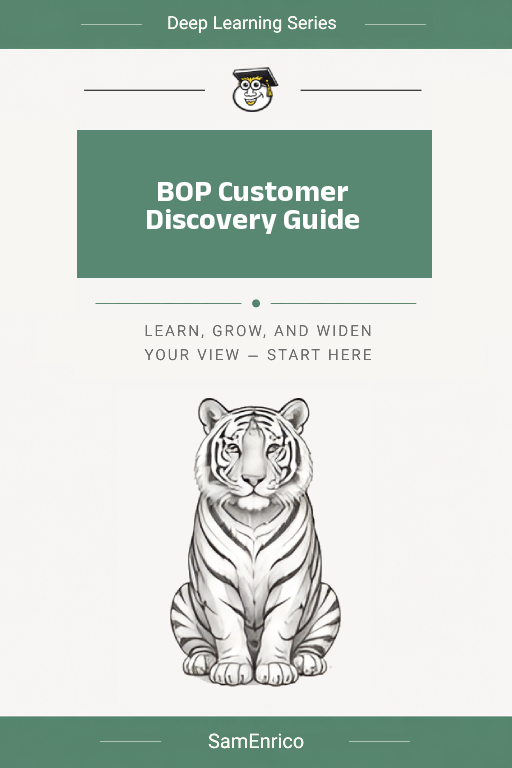
Non-FictionStartup GuideBOP Strategy
BOP Customer Discovery Guide eBook
Conduct customer interviews in low-income markets.
by Coles Marcel
Conduct customer interviews in low-income markets. Ask the right questions to uncover real needs.
Formats
Free sample
Chapter 1: The Politeness Trap--–- The first time I watched a customer discovery interview go wrong, I was sitting on a weathered plastic stool in a peri-urban settlement outside Nairobi. A well-intentioned entrepreneur named Mark had flown in from London to validate his solar-powered lantern. He had raised $50,000 in seed funding based on a simple hypothesis: millions of low-income families wanted a cleaner, cheaper alternative to kerosene.Mark sat across from a woman named Grace, a mother of four who sold vegetables at the local market. She earned about 3perday.Marksmiledwarmlyandaskedhisfirstquestion:"Grace,wouldyoubuythissolarlanternfor3 per day. Mark smiled warmly and asked his first question: "Grace, would you buy this solar lantern for 3perday.Marksmiledwarmlyandaskedhisfirstquestion:"Grace,wouldyoubuythissolarlanternfor10?"Grace looked at the lantern, glanced at Mark's expensive watch, and said, "Yes, that would be very helpful."Mark's face lit up.
He turned to his notebook and wrote: "Demand confirmed. Price point acceptable."What Mark didn't see was what happened next. After the interview, Grace walked to her neighbor's stall, borrowed $0.50 for kerosene, and went home to the same smoky, dimly lit room she had lived in for twelve years. She never bought the lantern. She never intended to.
She was being polite.This book exists because of that moment. The single most dangerous force in bottom-of-the-pyramid customer discovery is not poverty, illiteracy, or lack of infrastructure. It is politeness. And politeness, when mistaken for validation, has destroyed more social enterprises, development programs, and inclusive businesses than any other factor.Welcome to the Politeness Trap.The High-Agreement, Low-Commitment Problem Let me define the core problem with clinical precision. Low-income respondents are what researchers call "high-agreement, low-commitment" informants.
They will enthusiastically agree with your product idea, your price point, your distribution model, and your value proposition. Then they will walk away and never buy a single unit.Why does this happen? The answer lies in the survival calculus of scarcity.When you live at the economic margin, saying "no" to an outsider carries real risks. That stranger might be a government agent who could deny you services. They might be a lender who could approve or reject a future loan.
They might be a charity worker who could bring free goods next month. They might simply be someone who could cause social embarrassment by accusing you of being ungrateful. In a context where every relationship matters for survival, politeness is not a character flaw. It is a rational strategy.Conversely, saying "yes" costs nothing in the moment. A verbal commitment requires no cash, no effort, no ongoing obligation.
It takes two seconds and preserves all future optionality. If the product actually arrives, you can still say no later. If it doesn't, you lost nothing. From the customer's perspective, "yes" is the optimal short-term response every single time.This creates a catastrophic information asymmetry. You, the entrepreneur or researcher, believe you have received a signal of genuine demand.
The customer knows they have simply avoided social friction. You walk away optimistic. They walk away relieved that the awkward stranger has left. And your product fails six months later because exactly zero of those "enthusiastic" customers actually pay.I have seen this pattern repeat across dozens of countries and hundreds of products. A microfinance organization in India asked farmers if they wanted crop insurance.
Ninety-three percent said yes. Less than four percent purchased when the product launched. A clean cookstove company in Ghana asked women if they would replace their three-stone fire. Eighty-seven percent said yes. Six percent bought.
A mobile money startup in the Philippines asked jeepney drivers if they wanted digital savings accounts. Ninety-six percent said yes. Two percent signed up.These are not isolated failures. They are the predictable outcome of asking the wrong question to the wrong person in the wrong way.The Solutioneering Trap If politeness is the disease, solutioneering is the primary symptom. Solutioneering is the act of pitching your solution before you understand the problem.
It feels productive. It feels like progress. It is the fastest way to destroy your data.Here is what solutioneering sounds like in the field:"Would you buy this water filter for $5?""How often would you use this solar charger?""Would you recommend our loan product to a friend?""Which feature of this app do you like most?"Every single one of these questions contains a fatal flaw. They all assume that the customer shares your framing of the problem. They assume that a water filter is the right solution.
They assume that solar charging is a priority. They assume that a loan product is needed. They assume that an app is the appropriate channel.But what if the customer doesn't need a water filter? What if they need cheaper fuel to boil the water they already have? What if they need a larger container to store boiled water?
What if they need a way to know when water is safe without buying plastic test strips? Your question will never surface these alternatives because your question already contains the answer.Worse, once you mention your solution, the customer stops being a neutral informant and becomes a helpful collaborator. They want you to succeed. They want the conversation to end pleasantly. They will tell you whatever they think you want to hear.
I have watched customers invent entire usage scenarios for products they had zero interest in, simply because they sensed the interviewer was emotionally invested.The solutioneering trap is seductive because it produces immediate, clear, numeric validation. "Seventy-five percent said they would buy!" That feels like progress. You can put it in a pitch deck. You can show it to investors. You can celebrate with your team.
But it is fiction. It is the sound of politeness masquerading as data.The "Commiserate, Don't Sell" Rule If you cannot pitch your solution and you cannot ask about buying intent, what can you do? The answer is the single most important behavioral shift in this entire book: commiserate, don't sell.Commiserating means aligning yourself with the customer's struggle before you even hint at a solution. It means demonstrating that you understand their pain, not because you read about it in a report, but because you have seen it, touched it, smelled it. It means making the customer feel heard, not interrogated.Let me give you a concrete example.
Instead of walking into a home and asking, "Would you buy our water filter?" you sit down, look at the water storage container, and say, "Getting clean water every morning looks exhausting. Tell me about that."The difference is subtle but profound. The first question is about your product. The customer has no obligation to care about your product. The second question is about their life.
Every customer is an expert on their own life. You are inviting them to be the authority, not the subject of a sales pitch.Another example. Instead of asking, "Would you use our mobile savings app?" you say, "I notice you have cash hidden in different places around the house. Keeping money safe seems really stressful. What do you do when you're worried about theft?"Notice what happens here.
You are not asking for a commitment. You are not pitching a solution. You are naming an observation (hidden cash)…
This is the end of the free sample. Get the eBook to keep going. Buy now
About this book
Details
- Author
- Coles Marcel
- Publisher
- SamEnrico
- Language
- English
- Genre
- Non-Fiction, Startup Guide, BOP Strategy
- Released
- 2026-06-01
- Pages (approx.)
- 150
- Available as
- eBook, Audiobook

Read better in the ZLOADR app
Your eBooks on your phone or tablet. Sign in with your SamEnrico account and start reading.
More by Coles Marcel
 Self Talk for Anger Management CourseColes Marcel$11.99
 Growth Mindset For GrandparentsColes Marcel$11.99
 Rural Addiction TreatmentColes Marcel$11.99
 The Empathy for Shame GuideColes Marcel$11.99
 Spin Instructor Starter ManualColes Marcel$11.99
 Rustler’s Lament: The Ballad of the Ghost HerdColes Marcel$11.99
 How to Become a Plastic Tool MakerColes Marcel$11.99
 Certification Fraud DetectionColes Marcel$12.99
 Understanding Urea Cycle EnzymopathiesColes Marcel$17.99
 Freebie MarketingColes Marcel$11.99
You may also like
 Hong Kong Handover 1997Dunn Johnnie$11.99
 Zumba For Postnatal Recovery CourseNeal Christian$11.99
 Zumba for BeginnersLadner Nikia$11.99
 YouTube Comment Mining GuideHumes Pandora$12.99
 Worry Box MeditationCarlin Rudy$11.99
 Workplace Stress MeditationNguyen Lynn$11.99
 Workplace Stress and Sleep RepairHawley Ivory$11.99
 Workplace Perfectionism CureDelaney Jeffry$11.99
 Workplace Injustice Anger GuideWallen Isabelle$11.99
 Work Addiction and Burnout LinkGreenwood Ester$11.99
 Women in Yoga and WellnessBeattie Galina$11.99
 Women in Stand Up ComedyChun Evangeline$11.99