
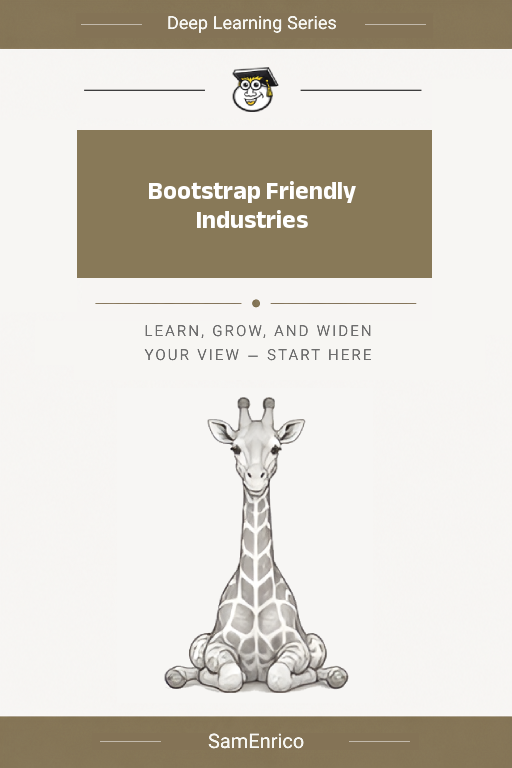
Bootstrap Friendly Industries eBook
Choose service based or digital product businesses
Choose service based or digital product businesses that don't require heavy upfront capital.
Formats
Free sample
Chapter 1: The Million-Dollar Lie--–- Every aspiring entrepreneur has heard it. Your parents said it. Your teachers implied it. The business books on the airport shelves scream it from their glossy covers: You need money to make money. The conventional wisdom goes like this – to start a business, you need a loan from a bank, a check from an investor, or a small fortune saved from a decade of corporate drudgery.
Without that capital, the story goes, you are locked out. You are destined to remain an employee, trading your time for someone else's paycheck, forever watching from the sidelines while the "real" entrepreneurs play the game.That story is a lie. It is the most expensive lie ever sold to the ambitious, and in this chapter, we are going to dismantle it brick by brick.The "capital barrier" – the idea that you need significant money to start – was a function of the industrial economy. In 1950, if you wanted to start a business, you needed a factory to manufacture goods. You needed a warehouse to store inventory.
You needed a retail storefront to sell to customers. Each of those required physical assets: machines, steel, wood, fabric, and a lease. In 1980, if you wanted to start a business, you needed a printing press for brochures, a fax machine for communication, and a Yellow Pages ad for marketing. Again, physical assets required upfront cash.But today, we live in the digital economy. The means of production have been democratized.
Your factory is a laptop. Your warehouse is a cloud server. Your storefront is a website. Your marketing is a social media account. The tools that once required millions of dollars in venture capital are now available for free or for a small monthly subscription.
The digital economy runs on leverage – but not financial leverage. It runs on leverage through code, through application programming interfaces, through automation, and through artificial intelligence.This book is built on a single, provocative premise: You do not need a factory, a warehouse, a loan, or an investor to build a profitable company in 2026 and beyond. The only assets you need are your existing skills, a willingness to learn a handful of modern tools, and a clear framework for choosing between two fundamentally different types of businesses. That framework is what we will build in this chapter and throughout this book.The goal of this chapter is threefold. First, we will expose the structural reasons why the "capital barrier" has collapsed – not through hype, but through observable shifts in technology and market behavior.
Second, we will introduce the core distinction that governs this entire book: the difference between Custom Services and Scalable Digital Products. This distinction will save you months of confusion and prevent the single most common mistake that bootstrappers make (trying to sell a product like a service, or vice versa). Third, we will perform a mindset reset, moving you from the scarcity question of "How much money do I need?" to the abundance question of "How much value can I create with the skills I already have?"By the end of this chapter, you will never look at entrepreneurship the same way again. You will see opportunity where others see barriers. And you will have the foundational framework that makes every subsequent chapter in this book actionable.The Industrial Hangover: Why We Still Believe the Lie The belief that you need money to make money is not a universal truth; it is a historical artifact.
It is the residue of an economic era that ended roughly twenty-five years ago. Call it an industrial hangover – a lingering belief system that no longer matches the reality of how value is created and captured in the digital age.In the industrial economy, the relationship between capital and production was linear and unforgiving. To produce one hundred chairs, you needed one hundred units of wood, one hundred units of fabric, one hundred units of labor, and a workshop large enough to house the operation. Each additional chair required additional physical inputs, and those inputs cost money upfront. The entrepreneur who wanted to compete had to raise that money before they could sell a single chair.
This created a world where wealth begat wealth and poverty remained locked out.The digital economy operates under completely different physics. A piece of software, a template, an online course, or an application programming interface can be created once and sold to one customer or to one million customers with almost no difference in cost. The marginal cost – the cost of producing one additional unit – is effectively zero. This changes everything. It means that the primary input is no longer capital; it is creativity, problem-solving ability, and the skill to use modern tools.Consider the following comparison.
In 1995, starting a software company required purchasing physical servers (thousands of dollars), setting up a data center (tens of thousands of dollars), and hiring a team of developers (hundreds of thousands of dollars in salaries). In 2025, you can build the same software using no-code platforms like Bubble or We Web for zero dollars during the development phase and less than one hundred dollars per month to host the live application. The barrier has fallen by a factor of roughly one thousand percent.The same pattern holds across every industry that this book covers. A freelance consultant in 1995 needed a physical office, a landline, a fax machine, a professional wardrobe, and money to print marketing materials. A consultant today needs a laptop, an internet connection, and a Calendly link.
A course creator in 1995 needed a recording studio, a physical warehouse for VHS tapes or CDs, and distribution deals with bookstores. A course creator today needs a smartphone camera and a platform like Teachable or Gumroad.The lie persists because the institutions that taught us about business – schools, banks, and traditional media – are still operating under the industrial mindset. Business school curricula are dominated by case studies of companies that raised millions of dollars in venture capital. Banks still require collateral and credit scores because their underwriting models were designed for physical inventory. And mainstream business media love stories of billion-dollar unicorns because those stories sell advertising, not because they represent the most common path to entrepreneurial success.The truth is that the vast majority of successful businesses in the United States – roughly ninety-nine point nine percent – are not venture-backed unicorns.
They are small, profitable, bootstrapped companies. Many of them started with less than one thousand dollars. Some started with zero. The only thing that has changed is that the tools have gotten better, cheaper, and more accessible.The Core Distinction That Will Save You Months of Confusion Every aspiring entrepreneur eventually faces a moment of paralysis. They have an idea, but they cannot decide how to execute it.
Should they offer it as a service? Should they build it as a product? Should they charge hourly or sell a subscription? This confusion leads to endless procrastination, wasted time, and ultimately, abandonment of the idea altogether.This book cuts through that confusion with a single, powerful distinction. There are only two types of businesses that are bootstrap-friendly: Custom Services and Scalable Digital Products.
Every viable business model in this book falls into one of these two categories. Once you understand the distinction, every…
This is the end of the free sample. Get the eBook to keep going. Buy now
About this book
Details
- Author
- Beall Edgardo
- Publisher
- SamEnrico
- Language
- English
- Genre
- Non-Fiction, Business Brief, Industries
- Released
- 2026-05-30
- Pages (approx.)
- 152
- Available as
- eBook, Audiobook

Read better in the ZLOADR app
Your eBooks on your phone or tablet. Sign in with your SamEnrico account and start reading.
More by Beall Edgardo
 Adam Scott Graceful ChampionBeall Edgardo$11.99
 Chore delegation For KidsBeall Edgardo$11.99
 Cognitive Symptoms of MDDBeall Edgardo$11.99
 Cognitive Reframing For RageBeall Edgardo$11.99
 Anki Keyboard ShortcutsBeall Edgardo$11.99
 Stress InoculationBeall Edgardo$11.99
 Senior Pet Loss GuideBeall Edgardo$11.99
 Persistent Depression SignsBeall Edgardo$11.99
 The Architect of the Glass City: A Djinn's Forgotten MasterpieceBeall Edgardo$11.99
 The Ransom of Verdun: Blood for the ArgonneBeall Edgardo$11.99
 Service Providers Guide to Sunroom & Patio Enclosure RemodelingBeall Edgardo$11.99
 How to Produce Human Resources and Management ConsultationBeall Edgardo$11.99