
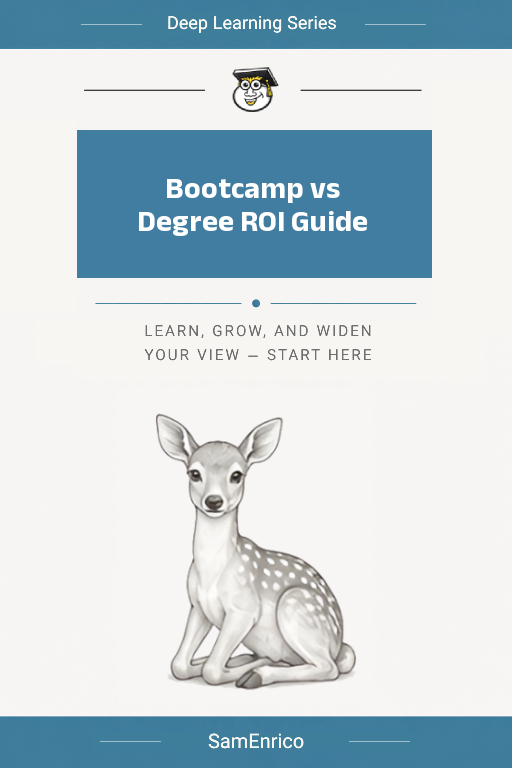
Non-FictionStudent's ShortcutCareer ROI
Bootcamp vs Degree ROI Guide eBook
Compare lifetime earnings, tuition costs, and oppo
by Koch Lucie
Compare lifetime earnings, tuition costs, and opportunity cost of coding bootcamps versus computer science degrees globally.
Formats
Free sample
Chapter 1: The Two Titans--The moment you decide to become a software developer, you step onto a battlefield. On one side stand the ancient cathedrals of learning—the universities, with their thousand-year history, their tenured professors, and their parchment that has opened doors since before the printing press. On the other side charge the bootcamps—the upstart gladiator schools, promising to forge you into a job-ready warrior in months, not years, and to do it without bankrupting your future.Between them lies a no-man's-land of marketing hype, survivor bias, and well-intentioned but useless advice from people who made their choice in a different economic era. Your cousin who graduated with a CS degree in 2010 and walked into a six-figure job at Google? He entered a bull market that may never return.
Your friend who did a bootcamp in 2021 and landed a remote role paying $120,000? She rode a pandemic-fueled hiring wave that has since crashed ashore.This chapter strips away the noise. It provides a neutral, surgical dissection of both educational paths—what you actually learn, how long it takes, what employers actually see, and who each path truly serves. By the end of this chapter, you will understand not just the differences between a degree and a bootcamp, but which kind of student belongs in which kind of program.The Computer Science Degree: A Cathedral of Knowledge The traditional computer science degree is not primarily designed to make you employable. This statement shocks many readers, but it is true.
The CS degree is designed to make you a computer scientist—someone who understands the fundamental principles of computation, who can reason about algorithms abstractly, who knows why computers work the way they do from the transistor up through the operating system and into the application layer.What You Actually Learn A four-year CS degree at an accredited university typically includes the following core curriculum, regardless of whether you attend Stanford or your local state school:First Year (Foundation)Introduction to Programming (typically Python or Java)Discrete Mathematics (logic, set theory, graph theory, proofs)Calculus I and II (for most programs, though some have reduced math requirements)Introduction to Computer Systems (bits, bytes, memory representation)Second Year (Core)Data Structures and Algorithms (the heart of the degree—arrays, linked lists, trees, hash tables, sorting, searching, complexity analysis)Computer Architecture (how processors execute instructions, pipelining, caches, assembly language)Object-Oriented Design (principles of software architecture, design patterns)Linear Algebra (increasingly important for AI/ML)Third Year (Advanced Core)Operating Systems (process scheduling, memory management, file systems, concurrency)Programming Languages (paradigms: functional, logic, object-oriented; language design principles)Theory of Computation (automata, computability, P vs NP)Probability and Statistics (for data science and machine learning)Fourth Year (Electives and Capstone)Electives: Artificial Intelligence, Machine Learning, Computer Graphics, Databases, Networks, Security, Compilers, Distributed Systems, Human-Computer Interaction Senior Capstone Project (often a year-long team software project)The Signaling Effect The most valuable thing a degree provides is not the knowledge—much of which you could learn on your own through MIT Open Course Ware or similar resources. The most valuable thing is the signal.When an employer sees "B.S. Computer Science, University of [Name]" on a resume, several automatic assumptions fire in the recruiter's mind: this person finished something difficult (a four-year commitment, not an eight-week sprint). This person has been vetted by an accredited institution (the university's brand stands behind them). This person has demonstrated an ability to learn abstract, mathematical material (a proxy for future learning).
This person has likely been exposed to the fundamentals that will allow them to debug problems they have never seen before.This signaling effect is so powerful that it persists even when the graduate remembers almost nothing from their algorithms class. The credential itself becomes a key that unlocks doors—especially the automated doors of Applicant Tracking Systems (ATS), which we will explore in Chapter 5.Global Variations Not all degrees are created equal, and not all countries structure them the same way:United States and Canada: Typically four years. Includes general education requirements (writing, humanities, social sciences) in addition to CS coursework. This is expensive—40,000to40,000 to 40,000to130,000 total tuition.United Kingdom and Commonwealth: Typically three years. No general education requirements; students focus exclusively on CS from day one.
Less expensive than US degrees, especially for domestic students (£9,000–£20,000 per year for international students).Continental Europe: Three years for a bachelor's degree, often tuition-free or very low cost even for international students (Germany, Norway, Finland, France). However, many programs teach in the local language, and the degree may not carry the same international brand recognition as US or UK degrees.India: Three or four years depending on the program (B.Sc. Computer Science is three years; B.Tech/B.E. is four). The top tier (IITs, NITs, BITS Pilani) commands a massive premium in the job market—graduates can expect 2–3 times the starting salary of bootcamp graduates.
The lower tier produces hundreds of thousands of graduates annually, many of whom struggle to find employment.Who the Degree Serves Best The traditional four-year CS degree is optimal for:Students under 22 with the time and financial support to complete a four-year program before entering the workforce. The long career horizon (30+ years) allows ample time to amortize the upfront investment.Students who need visa sponsorship to work in the United States, Canada, the United Kingdom, or other countries where immigration systems are built around accredited degrees. This is not a preference—it is often a requirement. Chapter 7 covers this in depth.Students targeting AI/ML, systems programming, compilers, databases, or security research. These fields require the theoretical depth that bootcamps do not provide.Students who thrive on external structure—classrooms, syllabi, deadlines, professors, teaching assistants.
If you struggled to complete Khan Academy courses on your own, you may need the scaffolding of a degree program.Students pursuing careers in government, defense, banking, or older enterprises where a degree may be a hard requirement due to regulation or corporate policy.The Coding Bootcamp: The Gladiator School The coding bootcamp is the counterrevolution. Born in 2011 (Dev Bootcamp in San Francisco, Hack Reactor in San Francisco, and Flatiron School in New York all launched within months of each other), bootcamps promised to do what universities would not: turn motivated learners into employable developers in less than six months, for a fraction of the cost.The proposition was simple. Universities taught theory. Employers needed practitioners. Bootcamps would bridge that gap.What You Actually Learn A typical 12-to-24-week bootcamp curriculum looks nothing like a university CS curriculum.
It is relentlessly practical, focused entirely on the tools and frameworks that employers are hiring for right now.Week 1–3: Programming Fundamentals Variables, data types, conditionals, loops, functions Arrays and objects (or dictionaries/lists depending on language)Basic problem-solving patterns Git and Git Hub fundamentals Week 4–6: Front-End Development HTML5 and CSS3 (flexbox, grid, responsive design)Java Script (ES6+: arrow functions, destructuring, promises, async/await)DOM manipulation and event handling React or Vue.js (component architecture, state management, hooks, routing)Basic UI/UX principles Week 7–10: Back-End Development Server-side programming (Node.js/Express, Python/Django, Ruby on Rails, or Java/Spring Boot)RESTful API design and implementation Authentication and authorization (JWT, OAuth)Databases (SQL with Postgre SQL or My SQL; No SQL with Mongo DB)Deployment…
This is the end of the free sample. Get the eBook to keep going. Buy now
About this book
Details
- Author
- Koch Lucie
- Publisher
- SamEnrico
- Language
- English
- Genre
- Non-Fiction, Student's Shortcut, Career ROI
- Released
- 2026-05-30
- Pages (approx.)
- 147
- Available as
- eBook, Audiobook

Read better in the ZLOADR app
Your eBooks on your phone or tablet. Sign in with your SamEnrico account and start reading.
More by Koch Lucie
 Duke Ellington OrchestraKoch Lucie$11.99
 Sleep Memory For MenopauseKoch Lucie$11.99
 The Phone Distraction Detox PlanKoch Lucie$11.99
 Medical Decisions Second GenKoch Lucie$11.99
 Imposter Syndrome Group GuideKoch Lucie$11.99
 Senior Subscription Technology GapsKoch Lucie$11.99
 Keto For Women Over 50Koch Lucie$11.99
 Systematic Withdrawal PlanKoch Lucie$11.99
 The Phantom of Whitechapel: A Victorian Copycat Killer’s Deadly ObsessionKoch Lucie$11.99
 The Phantom Ledger: How Cybercrime Fueled Gang Wars in AsiaKoch Lucie$11.99
 Understanding Foville's SyndromeKoch Lucie$11.99
 How to Produce Skateboard DecksKoch Lucie$11.99
You may also like
 Hong Kong Handover 1997Dunn Johnnie$11.99
 Zumba For Postnatal Recovery CourseNeal Christian$11.99
 Zumba for BeginnersLadner Nikia$11.99
 YouTube Comment Mining GuideHumes Pandora$12.99
 Worry Box MeditationCarlin Rudy$11.99
 Workplace Stress MeditationNguyen Lynn$11.99
 Workplace Stress and Sleep RepairHawley Ivory$11.99
 Workplace Perfectionism CureDelaney Jeffry$11.99
 Workplace Injustice Anger GuideWallen Isabelle$11.99
 Work Addiction and Burnout LinkGreenwood Ester$11.99
 Women in Yoga and WellnessBeattie Galina$11.99
 Women in Stand Up ComedyChun Evangeline$11.99