
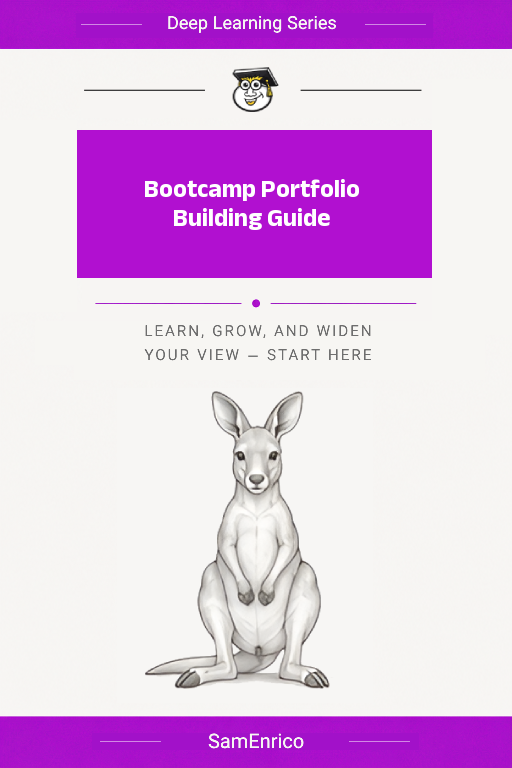
Non-FictionStudent's ShortcutPortfolio GuideGitHub Strategy
Bootcamp Portfolio Building Guide eBook
Create a standout GitHub portfolio during bootcamp
Create a standout GitHub portfolio during bootcamp that impresses recruiters more than your certificate or degree name.
Formats
Free sample
Chapter 1: The Trust Gap--–- Every bootcamp graduate remembers the moment. You’re three weeks into the job search, firing off applications with the same desperate rhythm. Your certificate is pinned to your Linked In. Your resume lists every technology you touched during the program. You’ve even added the bootcamp’s logo to your email signature.
And then the rejection arrives. Or worse: silence.You tell yourself they didn’t read your resume. You tell yourself the market is impossible for juniors. You tell yourself that if you just had a computer science degree from a four-year university, everything would be different.You are wrong about all of it.The problem is not your bootcamp. The problem is not your lack of a degree.
The problem is that recruiters have been burned too many times by candidates who look perfect on paper but cannot ship working code. They have interviewed graduates who aced algorithms exams but could not explain why their pull request broke the build. They have hired bootcamp alumni with flawless resumes who did not know how to use git beyond push and pull.This disconnect between credential and capability is what this book calls the Trust Gap.The Trust Gap is the quiet suspicion every technical recruiter develops after their first few years on the job: that a diploma or a certificate is a weak signal at best, and a misleading one at worst. A degree proves you survived a curriculum. A bootcamp certificate proves you attended and completed projects.
Neither proves you can think like an engineer, communicate with a team, or debug a production issue at 5 PM on a Friday.Your Git Hub profile, on the other hand, proves all of those things. It is the only verifiable, timestamped, peer-visible record of your actual engineering behavior. Every commit tells a story. Every issue you opened shows how you think. Every README you wrote demonstrates how you communicate.
Every pull request you merged—or tried to merge—reveals how you collaborate.This chapter is about understanding why your Git Hub portfolio matters more than any credential you will ever earn. It is about shedding the credential security blanket that bootcamp graduates cling to and embracing a harder but more honest truth: your code is your resume, your commit history is your work experience, and your documentation is your interview.By the end of this chapter, you will have completed a full digital footprint audit, committed to a sustainable contribution habit called the No Zero Weeks rule, and reframed your imposter syndrome from a weakness into evidence of growth.The Day the Credential Died Let us start with a story.In 2018, a hiring manager at a mid-sized Saa S company named Sarah received 247 applications for a single junior developer role. She filtered by degree first—computer science only. That left 89 candidates. She filtered by GPA above 3.5.
That left 42. She sent those 42 a take-home coding challenge. Seventeen came back. She interviewed seven. She extended an offer to one—a cheerful, well-spoken recent graduate from a respectable state university.He lasted six weeks.The problem was not that he could not code.
He could, after a fashion. The problem was that he could not work. He did not know how to read a stack trace. He ignored error messages. When his code failed tests, he did not investigate; he simply rewrote the same logic in a slightly different way and hoped.
He treated code review feedback as optional. And when Sarah sat him down to explain the problem, he said something she never forgot: "But I have a degree. I passed all my classes."That was the moment Sarah stopped caring about degrees.She is not alone. In a 2022 survey of technical recruiters at companies with more than 500 employees, 78 percent reported that they look at a candidate’s Git Hub profile before reading the Education section of their resume. The same survey found that 63 percent had hired a candidate without a traditional computer science degree specifically because their Git Hub portfolio demonstrated capability that their resume did not.The credential is not worthless.
It is just no longer sufficient. And for bootcamp graduates, who carry the additional burden of an industry that still questions the rigor of accelerated programs, the Git Hub portfolio is not just important—it is the only lever you have to override every bias working against you.The Anatomy of a Trust Gap Audit Before you can close the Trust Gap, you need to know what recruiters see when they look you up. Most bootcamp graduates have never performed a proper digital footprint audit. They assume their Git Hub is fine because they have not received complaints. This is a dangerous assumption.A Trust Gap audit answers three questions:What does a recruiter find when they Google your name right now?What story does your existing Git Hub commit history tell?What signals are you sending that you do not intend to send?Let us walk through each.Step One: The Vanity Search Open an incognito browser window.
Go to Google. Type your full name in quotes. Record everything that appears on the first three pages. Pay special attention to:Social media profiles (especially Twitter, Reddit, or Hacker News)Old Git Hub accounts you forgot about Comments you left on forums or blogs Any association with controversial topics or language If you find something embarrassing, unprofessional, or simply irrelevant, you have two options: delete it (if you control it) or bury it (by creating more professional content that pushes it down in search results). The single most effective way to bury old content is to build a strong Git Hub profile that ranks higher.
Git Hub profiles tend to rank well in search results because of Google’s preference for code-related domains.Step Two: The Commit History Autopsy Navigate to your Git Hub profile. Scroll down to the contribution graph—the grid of green squares that shows your commit activity over the past year. Ask yourself these questions:Is there long stretches of gray (no activity)? Recruiters interpret this as loss of interest or inability to maintain habits.Are all your commits clustered in a single week? This looks like last-minute cramming, not sustained learning.Do your commit messages make sense?
Messages like "fix", "update", and "asdf" signal sloppiness.Have you ever contributed to a repository that is not your own? If not, you have no evidence of collaboration.Now click through to your actual repositories. For each repository, ask:Does it have a README? If not, delete the repository or archive it. A repo without a README is a repo you do not care about.Is the README more than one sentence?
If it says "A todo app" or "Practice project", delete or archive.Is there any documentation beyond the README? A /docs folder? A CONTRIBUTING.md? If not, you are signaling that you do not value communication.Is the code linted and formatted consistently? Inconsistent indentation and mixed quote styles signal carelessness.Does the project actually run?
Clone it yourself and try. If it fails, either fix it or archive it.Step Three: The Unintended Signal Audit Here is where most bootcamp graduates…
This is the end of the free sample. Get the eBook to keep going. Buy now
About this book
Details
- Author
- Dillard Denis
- Publisher
- SamEnrico
- Language
- English
- Genre
- Non-Fiction, Student's Shortcut, Portfolio Guide, GitHub Strategy
- Released
- 2026-05-29
- Pages (approx.)
- 143
- Available as
- eBook, Audiobook

Read better in the ZLOADR app
Your eBooks on your phone or tablet. Sign in with your SamEnrico account and start reading.
More by Dillard Denis
 The Parent Physical Self CareDillard Denis$11.99
 Safety Training Presentation NervesDillard Denis$11.99
 Emotion Regulation for Narcissistic Injury GuideDillard Denis$11.99
 Exam Stress HypnosisDillard Denis$11.99
 Nicotine Anonymous Twelve StepsDillard Denis$11.99
 Hashtag Revolution: How #BlackLivesMatter Redefined Political CampaigningDillard Denis$11.99
 Fractured Steel: The Unraveling of the Tacoma NarrowsDillard Denis$11.99
 Understanding Brachymorphism Onychodysplasia Dysphalangism SyndromeDillard Denis$17.99
 10 Ways to Use Clementine (Recipe Book)Dillard Denis$11.99
 European Ecommerce Five Year ForecastDillard Denis$12.99European Ecommerce Five Year ForecastDillard Denis$12.99European Ecommerce Five Year ForecastDillard Denis$12.99
You may also like
 Hong Kong Handover 1997Dunn Johnnie$11.99
 Zumba For Postnatal Recovery CourseNeal Christian$11.99
 Zumba for BeginnersLadner Nikia$11.99
 YouTube Comment Mining GuideHumes Pandora$12.99
 Worry Box MeditationCarlin Rudy$11.99
 Workplace Stress MeditationNguyen Lynn$11.99
 Workplace Stress and Sleep RepairHawley Ivory$11.99
 Workplace Perfectionism CureDelaney Jeffry$11.99
 Workplace Injustice Anger GuideWallen Isabelle$11.99
 Work Addiction and Burnout LinkGreenwood Ester$11.99
 Women in Yoga and WellnessBeattie Galina$11.99
 Women in Stand Up ComedyChun Evangeline$11.99