
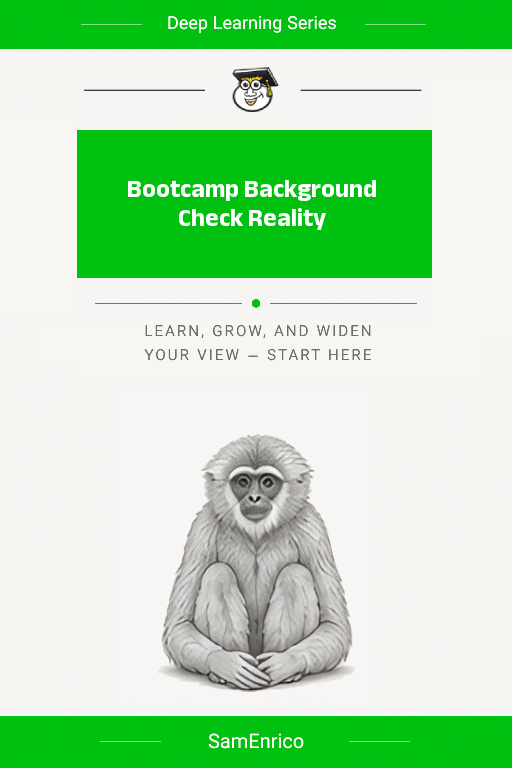
Non-FictionStudent's ShortcutVerification Truth
Bootcamp Background Check Reality eBook
Learn which countries and employers run education
Learn which countries and employers run education verification and whether bootcamp certificates appear on standard background checks.
Formats
Free sample
Chapter 1: The Geography of Trust–- Maria had done everything right. Twelve hundred hours of code. Fourteen live projects deployed. A technical interview that three senior engineers from Stripe later described as "impressive." The offer letter arrived on a Tuesday, signed and countersigned, promising $140,000 and a relocation package to San Francisco. She celebrated with her bootcamp cohort, posted a Linked In announcement, and started apartment hunting.Forty-eight hours later, the offer evaporated.The email came from HR, not the hiring manager.
Subject line: "Update regarding your background check." Maria opened it expecting a formality. Instead, she read: "We regret to inform you that based on the results of your background check, we are unable to proceed with your offer of employment." She called the recruiter immediately. The answer was cryptic: "The verification vendor reported that your education could not be confirmed."Maria had graduated from one of the most respected coding bootcamps in the United States. She had the certificate on her wall, the Git Hub profile to prove her skills, and a glowing reference from her instructor. None of it mattered.
The background check company had queried the National Student Clearinghouse, found no record of her bootcamp, and flagged her file. Stripe's HR system was configured to auto-reject any candidate with an "Unable to Verify" education flag. The hiring manager never saw the flag. The recruiter never saw her portfolio. A 50automateddatabasequeryhadoverriddena50 automated database query had overridden a 50automateddatabasequeryhadoverriddena140,000 job offer.This chapter is about why that happened and, more importantly, how to prevent it from happening to you.The Myth of the Universal Background Check Most people believe that a background check is a single, standardized process.
It is not. The global background screening industry generates approximately $14 billion annually, operating across dozens of countries, hundreds of vendors, and thousands of distinct verification protocols. What passes for a background check in Austin, Texas, would be rejected outright in Abu Dhabi. What satisfies a fintech startup in London would trigger a compliance violation at a bank in New York.The first and most important lesson of this book is this: background checks are not uniform. They are shaped by three forces that have nothing to do with your actual skills or integrity.The first force is geography.
Different countries have different legal frameworks, different verification infrastructures, and different cultural assumptions about what constitutes "proof" of education. The second force is industry regulation. Banking, healthcare, and defense operate under federal mandates that require documented verification of claimed credentials. The third force is employer configuration. Even within the same industry, two companies can use the same background check vendor but configure their systems differently—one set to auto-reject any flag, another set to forward flags to human reviewers.Understanding these three forces is the difference between a job offer that sticks and a job offer that disappears.This chapter focuses on the first force: geography.
We will map the world into three verification regimes, each with its own rules, risks, and strategies for bootcamp graduates. By the end of this chapter, you will know which countries require degree equivalency, which countries accept simple attendance confirmation, and which countries fall into a gray zone where bootcamp certificates can sometimes—but not always—work.Regime One: The Attestation Belt (GCC Countries)The Gulf Cooperation Council countries—the United Arab Emirates, Saudi Arabia, Kuwait, and Qatar—represent the most challenging verification environment for bootcamp graduates anywhere in the world. These nations operate under a system known as "attestation," a multi-stage diplomatic process designed to authenticate educational documents for work visas. The system was built for traditional universities and degree-granting institutions. Bootcamp certificates, no matter how reputable, are foreign to its logic.How Attestation Works The attestation process is not a background check in the American sense.
It is a diplomatic chain of custody. Each document must be verified by a series of authorities, each confirming the authenticity of the previous verification. The typical attestation chain has five steps:First, the certificate must be notarized by a local notary public in the country where the bootcamp is located. Second, the notarized document must be authenticated by the home country's Ministry of Foreign Affairs. Third, the document must be authenticated by the destination country's embassy in the home country.
Fourth, after the candidate arrives in the GCC country, the document must be authenticated by that country's local Ministry of Foreign Affairs. Fifth and finally, the fully attested document is submitted for the work visa application.Each step costs money, takes time, and introduces a point of failure. For a traditional university degree from an accredited institution, the process is tedious but predictable. For a bootcamp certificate, the process typically fails at step three.Why Bootcamps Fail at the Embassy Stage The destination country's embassy is not evaluating the quality of your education. It is checking a single binary question: Is the issuing institution recognized by the home country's Ministry of Education as a degree-granting institution?
Most coding bootcamps are not on that list. They are not accredited. They do not grant degrees. They grant certificates of completion. To the embassy officer, that distinction is dispositive.This is not about educational quality or your professional skills.
It is about diplomatic trust. The attestation system was designed to prevent fraud by ensuring that every educational credential presented for a work visa has been verified by a chain of government authorities. That chain works well for universities. It was never designed for the alternative education market.The Crucial Distinction: Absolute Rejection vs. Workaround Here is where many guides get it wrong.
They will tell you that bootcamp certificates are "rejected" in the GCC countries. That statement is both true and misleading. It is true if you submit the bootcamp certificate as a standard educational credential through the normal attestation process. It is misleading because there are workarounds—alternative pathways that can sometimes satisfy immigration officers.The most promising workaround is the Skill Verification Certificate, issued by government bodies such as Dubai's Knowledge and Human Development Authority (KHDA) or Saudi Arabia's Qiyas. These certificates do not claim that your bootcamp is a degree.
Instead, they provide a government-issued statement of competencies, verifying that you have demonstrated certain skills through a recognized assessment process. Some immigration officers accept these certificates in lieu of a traditional attested degree. Others do not. The outcome varies by officer, by country, and by the specific visa category.Because this workaround is complex and high-stakes, the full details—including step-by-step instructions, timelines, and success rates—are covered in Chapter 9. For the purposes of this chapter, the key takeaway is this: if you are targeting the GCC countries, do not assume that your bootcamp certificate will be accepted.
Do not assume it will be rejected either. Instead, research the specific visa category, contact the relevant government bodies, and consider the Skill Verification Certificate pathway.Regime Two: The European Equivalency Network (ENIC-NARIC)Europe operates under a fundamentally different philosophy. The ENIC-NARIC network, spanning 56 countries, provides a harmonized framework for evaluating foreign credentials. Unlike the GCC attestation system, which cares primarily about diplomatic authentication, the European system cares about educational equivalence.The Principle of Substantial Equivalence When you submit a foreign educational…
This is the end of the free sample. Get the eBook to keep going. Buy now
About this book
Details
- Author
- Fogle Nakisha
- Publisher
- SamEnrico
- Language
- English
- Genre
- Non-Fiction, Student's Shortcut, Verification Truth
- Released
- 2026-05-26
- Pages (approx.)
- 146
- Available as
- eBook, Audiobook

Read better in the ZLOADR app
Your eBooks on your phone or tablet. Sign in with your SamEnrico account and start reading.
More by Fogle Nakisha
 Personal Ing For Success Negotiation LeverageFogle Nakisha$11.99
 ABCDE Method for Daily TasksFogle Nakisha$11.99
 Intuitive Eating Perfectionism Recovery HandbookFogle Nakisha$11.99
 Pregabalin Withdrawal TaperFogle Nakisha$11.99
 The Homeless CoderFogle Nakisha$11.99
 The Vanishing of the Princess of WalesFogle Nakisha$11.99
 The Unbreakable Bowl: The Legend of the 1975 Little League World SeriesFogle Nakisha$11.99
 Understanding Birdshot ChorioretinopathyFogle Nakisha$17.99
 US LLC for Software EntrepreneursFogle Nakisha$12.99
 Short MoviesFogle Nakisha$11.99
 How to Start a Poultry Keeping Machinery Business (Beginners Guide)Fogle Nakisha$11.99
You may also like
 Hong Kong Handover 1997Dunn Johnnie$11.99
 Zumba For Postnatal Recovery CourseNeal Christian$11.99
 Zumba for BeginnersLadner Nikia$11.99
 YouTube Comment Mining GuideHumes Pandora$12.99
 Worry Box MeditationCarlin Rudy$11.99
 Workplace Stress MeditationNguyen Lynn$11.99
 Workplace Stress and Sleep RepairHawley Ivory$11.99
 Workplace Perfectionism CureDelaney Jeffry$11.99
 Workplace Injustice Anger GuideWallen Isabelle$11.99
 Work Addiction and Burnout LinkGreenwood Ester$11.99
 Women in Yoga and WellnessBeattie Galina$11.99
 Women in Stand Up ComedyChun Evangeline$11.99