
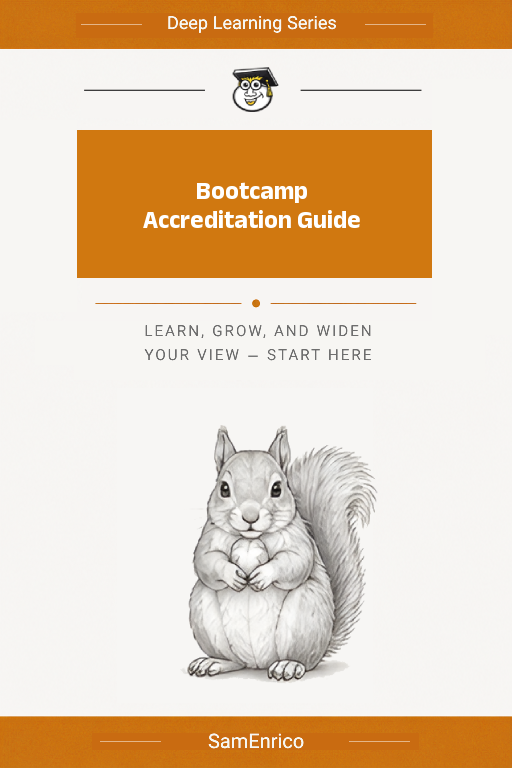
Non-FictionStudent's ShortcutAccreditation
Bootcamp Accreditation Guide eBook
Understanding bootcamp accreditation and why it ma
by Ramey Elvie
Understanding bootcamp accreditation and why it matters for employer recognition.
Formats
Free sample
Chapter 1: The PDF Lie...--–- The email arrived at 8:47 AM on a Tuesday. Sarah, a senior engineering manager at a midsize fintech company, had posted a junior developer role three days earlier. By the time she poured her first coffee, 487 applications sat in her queue. She clicked through the first twenty resumes mechanically—CS degrees from state schools, a few from prestigious universities, and then the bootcamp graduates. Each bootcamp grad attached a certificate.
Beautifully designed, usually with a gold seal, a signature in cursive, and an embossed-looking border. One said “Full Stack Web Development Certificate – 500 hours completed.” Another claimed “Advanced Data Analytics – Honors.” A third boasted “Graduate with Distinction.”Sarah had no way of knowing if any of these documents were real.She could, in theory, call each bootcamp. But that would take hours. She could email their registrar’s office. But that would take days.
So she did what most hiring managers do: she ignored them entirely. The certificates became visual noise. She scanned for Git Hub links, for live project URLs, for anything she could click and see immediately. The PDFs themselves were worthless.This is the PDF problem. And it costs bootcamp graduates billions of dollars in lost wages every year.The Great Unverifiable Middle The modern credentialing landscape has a gaping hole in its center.
At one end, you have university degrees. They are slow to earn, expensive, and increasingly misaligned with tech industry needs—but they are verifiable. Any employer can call the registrar at an accredited university and confirm a degree’s authenticity within minutes. The systems are old, bureaucratic, and reliable. At the other end, you have professional certifications like AWS Certified Solutions Architect or Comp TIA Security+.
These are vendor-backed, exam-based, and equally verifiable through public databases maintained by the certifying bodies.In between sits the bootcamp certificate. It is not a degree. It is not a certification. It is a PDF that says “you finished.” And that PDF carries no built-in trust.The problem is not that bootcamps produce bad graduates. The problem is that employers cannot tell the difference between a genuine graduate and a forgery without spending time they do not have.
This is the core friction of the modern tech hiring market, and it has a name: verification latency.Verification Latency: The Hidden Tax on Non-Degree Credentials Verification latency is the time delta between when an employer receives a credential and when they can confirm it is authentic. For a university degree, latency is measured in minutes—a phone call, an email to the registrar, a quick check of the National Student Clearinghouse. For a professional certification, latency is measured in seconds—a lookup in a public database or an API call from the ATS. For a bootcamp certificate? Latency is measured in days, if it happens at all.This latency is not a minor inconvenience.
It is a structural barrier that systematically filters out bootcamp graduates from the hiring pipeline before their skills are ever evaluated.Consider the economics. A hiring manager at a growing tech company might receive 250 applications for a single entry-level role. Assuming they spend 60 seconds per application on initial screening, that is already four hours of work. If they attempted to verify even half of the bootcamp certificates manually—calling each school, waiting on hold, leaving voicemails, waiting for callbacks—the screening process would balloon to twenty or thirty hours. No manager has that time.
So the certificates go unverified. And the candidates go unscreened.The result is a market failure. Bootcamp graduates invest 10,000to10,000 to 10,000to20,000 and three to six months of their lives in intensive training, only to have their credential treated as invisible. Employers, desperate for technical talent, reject qualified candidates simply because they cannot efficiently distinguish them from frauds. Everyone loses.The Forgery Problem Is Worse Than You Think It is shockingly easy to forge a bootcamp certificate.
A motivated high school student with access to Adobe Illustrator and a $15 template from Etsy can produce a document indistinguishable from a real bootcamp’s graduation certificate in under an hour. Add a fake signature, a fake seal, and a fake graduation date, and the document is complete. There is no centralized registry. There is no public API. There is no standard format.This is not a theoretical risk.
In 2024, a federal investigation uncovered a ring operating out of New Jersey that had sold more than 2,000 fake bootcamp certificates to job seekers for $200 each. The certificates claimed graduation from legitimate, well-known bootcamps. The buyers used them to secure jobs at banks, insurance companies, and even a state government agency. The bootcamps themselves had no way to prevent this because their certificates were static images with no verification infrastructure.One bootcamp founder told investigators: “We spent $50,000 on a beautiful certificate design and printing. We never thought about whether anyone could actually check if it was real.”The Cost of Uncertainty for Hiring Managers Verification latency does not just hurt candidates.
It imposes real costs on employers. When a hiring manager cannot verify a credential, they face a choice: take a risk on an unverified candidate, or filter them out entirely. Both options have consequences.Taking a risk means potentially hiring someone with falsified credentials. The cost of a bad technical hire is enormous. Studies estimate that a failed software engineering hire costs between 2x and 3x the employee’s annual salary when you factor in recruiting, onboarding, training, lost productivity, and termination costs.
For a 100,000role,thatis100,000 role, that is 100,000role,thatis200,000 to $300,000 per bad hire.Filtering out unverified candidates means rejecting potentially excellent engineers. The opportunity cost is equally high. In a tight labor market, turning away qualified candidates means slower product development, missed deadlines, and burned-out existing teams.Most hiring managers choose the third path: they ignore the certificates entirely and focus on other signals. They look for Git Hub portfolios, personal projects, previous employment history, and technical assessments. These are all valuable signals.
But they are incomplete. A bootcamp that invests heavily in career services, curriculum quality, and student support has no way to differentiate itself from a two-week You Tube crash course if both issue the same unverifiable PDF.This is the tragedy of the unaccredited bootcamp. Quality is invisible. Effort is unprovable. And the PDF certificate—the supposed proof of completion—is functionally worthless.A Case Study: The Fintech That Hired a Ghost In 2023, a fast-growing European fintech called Veridian Payments learned this lesson the hard way.
The company had grown from 20 to 200 engineers in eighteen months and was desperate for junior talent. Their head of recruiting, Marcus, had started ignoring bootcamp certificates entirely because they were too hard to verify. Instead, he relied on take-home coding challenges and behavioral interviews.One candidate, “Alex,” submitted a bootcamp certificate from a reputable-looking program called “Code Stack Academy.” The certificate listed a graduation date of March 2023 and a specialization in React and Node.js. Alex performed well on the coding challenge—so well, in fact, that Marcus suspected foul play but could not prove it. Alex was hired.Three months later, Veridian discovered that Alex was not one person but two.
The real Alex, a competent but overworked bootcamp graduate, had completed the coding challenge himself. But once hired, he outsourced…
This is the end of the free sample. Get the eBook to keep going. Buy now
About this book
Details
- Author
- Ramey Elvie
- Publisher
- SamEnrico
- Language
- English
- Genre
- Non-Fiction, Student's Shortcut, Accreditation
- Released
- 2026-05-29
- Pages (approx.)
- 156
- Available as
- eBook, Audiobook

Read better in the ZLOADR app
Your eBooks on your phone or tablet. Sign in with your SamEnrico account and start reading.
More by Ramey Elvie
 Messner Gasherbrum SoloRamey Elvie$11.99
 Overcoming Workaholism in ExecutivesRamey Elvie$11.99
 The Interruption RetrospectiveRamey Elvie$11.99
 The EQ for Chefs GuideRamey Elvie$11.99
 Menachem Mendel SchneersonRamey Elvie$11.99
 Chiropractic for VertigoRamey Elvie$11.99
 Self Hypnosis For Writing FlowRamey Elvie$11.99
 Twelve Step Prison OutreachRamey Elvie$11.99
 Line of Credit ManagementRamey Elvie$11.99
 The Last Broadcast: How a Radio Show Saved Lives During 9/11Ramey Elvie$11.99
 The Sky Dancer of Takao: Japan's Forgotten Winged PioneerRamey Elvie$11.99
 Paddling the Frozen Frontier: The Antarctic Kayak OdysseyRamey Elvie$11.99
You may also like
 Hong Kong Handover 1997Dunn Johnnie$11.99
 Zumba For Postnatal Recovery CourseNeal Christian$11.99
 Zumba for BeginnersLadner Nikia$11.99
 YouTube Comment Mining GuideHumes Pandora$12.99
 Worry Box MeditationCarlin Rudy$11.99
 Workplace Stress MeditationNguyen Lynn$11.99
 Workplace Stress and Sleep RepairHawley Ivory$11.99
 Workplace Perfectionism CureDelaney Jeffry$11.99
 Workplace Injustice Anger GuideWallen Isabelle$11.99
 Work Addiction and Burnout LinkGreenwood Ester$11.99
 Women in Yoga and WellnessBeattie Galina$11.99
 Women in Stand Up ComedyChun Evangeline$11.99