
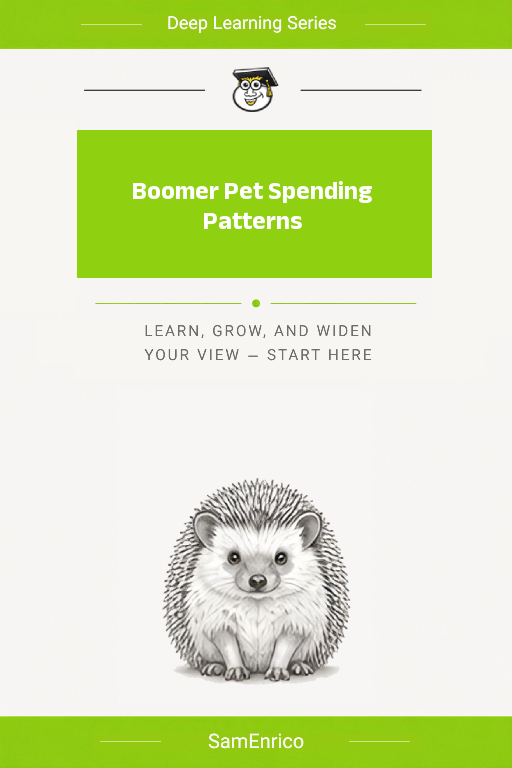
Non-FictionConsumer Mind ReportPet Economics
Boomer Pet Spending Patterns Audiobook
Analyze veterinary, food, and accessory expenditur
Analyze veterinary, food, and accessory expenditures for Baby Boomer pet owners treating animals as surrogate children in empty nest years.
Formats
Free sample
Chapter 1: The Surrogate Shift--Every year, Americans spend more on pet Halloween costumes than the GDP of several small nations. But behind the glittering facade of the $158 billion pet industry lies an uncomfortable truth that no marketing report dares to whisper: the dog wearing the pumpkin sweater is not loved more than the farm dog sleeping on a hay bale. She is simply positioned differently. And nowhere is this repositioning more profound, more financially consequential, and more psychologically intricate than in the empty nests of Baby Boomers.The modern pet industry has constructed an elaborate mythology around Millennial “fur parents” who throw birthday parties for their French bulldogs and feed them organic, human-grade meals delivered by bicycle. This mythology is useful for selling subscriptions and generating Instagram engagement, but it obscures a much more significant economic reality.
While Millennials drive volume and trends, Baby Boomers drive wealth. And the engine of that wealth is not a lifestyle choice or an aesthetic preference. It is a psychological mechanism that this book will call the Surrogate Shift.Understanding this mechanism requires setting aside nearly everything you think you know about the pet industry. The conferences, the trade publications, the keynote speeches—they all focus on the young, the digital-native, the image-conscious. Meanwhile, in quiet homes across America, Boomers are writing checks that the pet industry has barely noticed.
A 12,000chemotherapytreatmentforaneleven−year−old Labrador.A12,000 chemotherapy treatment for an eleven-year-old Labrador. A 12,000chemotherapytreatmentforaneleven−year−old Labrador.A20,000 pet trust funded alongside the will. A $15,000 home renovation to install pet-safe flooring and a built-in washing station. These transactions rarely appear in the data dashboards that pet executives love to present. They are too lumpy, too unpredictable, too...
Boomer.But they are the financial bedrock of the industry. And they will continue to be so for the next ten to fifteen years, until the last of the Boomers ages out of active pet ownership. Understanding why Boomers spend the way they do—what drives them, what scares them, what they value—is not an academic exercise. It is a strategic necessity for any business that wants to survive the coming demographic transition.The Empty Nest as Economic Event Most discussions of the empty nest focus on psychology or relationships. Few recognize it as an economic event of considerable magnitude.
When the last child leaves home, a typical upper-middle-class household experiences a significant increase in discretionary income. The monthly expenses…
This is the end of the free sample. Get the Audiobook to keep going. Buy now
About this book
Details
- Author
- Mcfarland Loria
- Publisher
- SamEnrico
- Language
- English
- Genre
- Non-Fiction, Consumer Mind Report, Pet Economics
- Released
- 2026-06-01
- Pages (approx.)
- 145
- Available as
- eBook, Audiobook

Listen in the VoxFlicks app
Audiobooks and audio dramas wherever you go. Sign in with your SamEnrico account and press play.
More by Mcfarland Loria
 Letting Go of TailgatersMcfarland Loria$11.99
 Gambling Addiction and Anxiety ManualMcfarland Loria$11.99
 Breath Work for Deeper StretchingMcfarland Loria$11.99
 Daily Review for Minimalists GuideMcfarland Loria$11.99
 The Last Telegram: The Secret Codebreakers of Room 40Mcfarland Loria$11.99
 The Bone Whisperers: How Prehistoric Hunters Mastered Probability in the Ice AgeMcfarland Loria$11.99
 Fulfillment SupervisorMcfarland Loria$11.99
 Understanding Barbiturate OverdoseMcfarland Loria$17.99
 One Page Podcast Marketing PlanMcfarland Loria$12.99
 10 Ways to Use Chilli Oil (Recipe Book)Mcfarland Loria$11.99
You may also like
 Hong Kong Handover 1997Dunn Johnnie$11.99
 Zumba For Postnatal Recovery CourseNeal Christian$11.99
 Zumba for BeginnersLadner Nikia$11.99
 YouTube Comment Mining GuideHumes Pandora$12.99
 Worry Box MeditationCarlin Rudy$11.99
 Workplace Stress MeditationNguyen Lynn$11.99
 Workplace Stress and Sleep RepairHawley Ivory$11.99
 Workplace Perfectionism CureDelaney Jeffry$11.99
 Workplace Injustice Anger GuideWallen Isabelle$11.99
 Work Addiction and Burnout LinkGreenwood Ester$11.99
 Women in Yoga and WellnessBeattie Galina$11.99
 Women in Stand Up ComedyChun Evangeline$11.99