
Non-FictionConsumer Mind ReportAutomotive
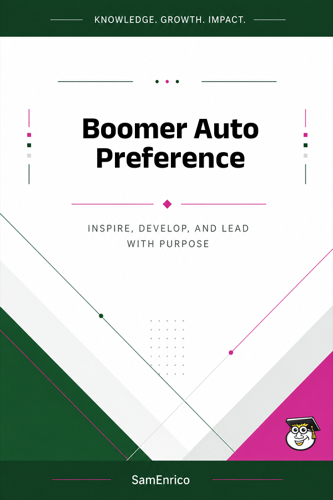
Boomer Auto Preference eBook
Analyze SUV and truck purchasing patterns.
by Adcock Misha
Analyze SUV and truck purchasing patterns.
Formats
Free sample
Chapter 1: The Last Garage...–- The first time Frank realized he could no longer drive a sedan, he was trying to extract himself from his daughter's Honda Civic. It was Thanksgiving 2021, raining in Portland, and his left knee—the one replaced in 2017—refused to bend the required forty-seven degrees. His right knee, still original equipment but bone-on-bone from thirty years of factory floors, wasn't much better. There he was, seventy-two years old, a retired electrician who had rebuilt carburetors blindfolded in his twenties, now stranded half-in and half-out of a Japanese compact car while his grandson watched from the porch. "You okay, Grandpa?" the boy called out.
Frank wanted to say something dignified. Instead, he grunted, pivoted on the door frame, and essentially fell backward onto the wet driveway. He wasn't hurt. He was humiliated. And he was done.That Civic, a perfectly good 2019 model with low miles and excellent fuel economy, represented everything the automotive industry had spent two decades telling Frank he should want.
It was sensible. It was economical. It was—and this was the word that appeared in every car magazine and every You Tube review—smart. But Frank didn't need smart. He needed a vehicle he could enter without a strategy session.
He needed a seat that met him halfway instead of forcing him to fold himself into origami. He needed, as he would later tell his wife over cold leftovers, "something I don't have to put on."Frank is not a statistic. But he is also exactly the statistic. He is one of the 76 million Baby Boomers—Americans born between 1946 and 1964—who collectively control more than half of the nation's disposable income and purchase nearly 40 percent of all new vehicles sold in the United States. He is the reason sedans are dying.
He is the reason SUVs and trucks now dominate every auto showroom from Miami to Seattle. And he has no idea that his aching knees have reshaped a trillion-dollar industry.This book is about Frank and the seventy-five million nine hundred ninety-nine thousand others like him. It is about the quiet, unexamined revolution in American car buying that has unfolded over the past twenty-five years—a revolution driven not by gas prices or environmental regulations or any of the other forces journalists like to write about, but by the simple, brutal reality of human aging. Baby Boomers are getting older. Their bodies no longer do what they once did.
And they are voting with their wallets for vehicles that accommodate the people they have become, not the teenagers they remember being.The Myth of the Rational Buyer For decades, economists and automotive analysts have operated under a comforting assumption: people buy cars based on rational calculations of price, fuel economy, reliability, and resale value. Car companies spend millions on research to optimize these variables. They conduct conjoint analyses and build regression models and segment buyers by income and education and zip code. And then someone like Frank walks into a dealership, completely ignoring the spreadsheet, and buys a Toyota 4Runner that gets seventeen miles per gallon because "it feels right."Here is the truth that the data alone cannot capture: car buying is not a rational act. It is an emotional, psychological, and deeply physical act.
A vehicle is the second-largest purchase most people make, after a home. They live in it for hours each day. They trust it with their lives and the lives of their children. And for Baby Boomers—a generation that came of age when cars were symbols of freedom, rebellion, and identity—the decision is even more freighted with meaning.The 1960s and 1970s were the golden age of American car culture. Frank got his license in 1968, the year of the Mustang fastback and the Charger R/T and the GTO Judge.
He didn't own any of those, of course. He drove a beat-up Ford Falcon that burned oil and smelled like his father's cigarettes. But the point was not the car he had. The point was the possibility. The highway stretched out ahead of him, and any destination was within reach.
That feeling—the open road, the radio playing, nothing but asphalt and sky—became the emotional template for a generation. Even now, fifty-five years later, when Frank closes his eyes and thinks about driving, he doesn't picture a sensible crossover with lane-keeping assist and adaptive cruise control. He pictures freedom.That is the first and most important thing to understand about Boomer auto preference: it is not about transportation. It is about identity. When a Boomer buys an SUV or a truck, they are not merely buying a larger vehicle.
They are buying a continuation of the story they started telling themselves when they first slid behind a steering wheel as a teenager. The low-slung coupe of their youth is gone—their knees couldn't handle it anyway—but the feeling of autonomy, of command, of being able to go anywhere and do anything, that feeling has been transferred to a new form. The sports car has become the sport utility vehicle. The muscle car has become the lifted truck. The engine note has changed, and the seat height has risen, but the dream remains remarkably intact.The Body Remembers What the Mind Forgets At the same time that Boomers were holding onto their youthful dreams of freedom, their bodies were quietly betraying them.
The statistics are stark. By age sixty-five, approximately one in two adults has been diagnosed with some form of arthritis. By age seventy, that number rises to nearly seventy percent. Knee replacements have become so common that they are almost routine—over seven hundred thousand performed annually in the United States alone. Hip replacements add another half million.
Back pain, spinal stenosis, degenerative disc disease, the list of age-related mobility limitations goes on and on.None of this is news. People age. Bodies wear out. But what has gone almost entirely unremarked is how these physical changes interact with the design of automobiles. The average sedan has a seat height of approximately fifteen inches from the ground.
To enter a sedan, a person must stand facing the seat, bend their knees to lower their hips, rotate their torso while supporting their weight on one leg, and then swing the other leg inside. This is not difficult for a twenty-five-year-old with healthy joints. For a sixty-five-year-old with arthritis in both knees, it is a biomechanical nightmare. The motion requires a squat—the very movement that orthopedic surgeons explicitly tell their patients to avoid.Now consider the counter-height seat of a typical crossover SUV, measured at twenty-two to twenty-four inches from the ground. The entry motion is entirely different.
The person stands facing the seat, rotates their hips, and sits down laterally. The knees bend only slightly, to about one hundred ten degrees instead of sixty. The weight transfer is simpler. The risk of falling is dramatically reduced. For a Boomer with mobility limitations, the difference between fifteen inches and twenty-three inches is not a matter of comfort.
It is the difference between driving and not driving.Frank's daughter did not know any of this when she bought her Civic. She chose it because it…
This is the end of the free sample. Get the eBook to keep going. Buy now
About this book
Details
- Author
- Adcock Misha
- Publisher
- SamEnrico
- Language
- English
- Genre
- Non-Fiction, Consumer Mind Report, Automotive
- Released
- 2026-06-10
- Pages (approx.)
- 147
- Available as
- eBook, Audiobook

Read better in the ZLOADR app
Your eBooks on your phone or tablet. Sign in with your SamEnrico account and start reading.
More by Adcock Misha
 Creative Habits for Project ManagersAdcock Misha$11.99
 Niacin Cholesterol Reduction GuideAdcock Misha$11.99
 Fertility Awareness Method GuideAdcock Misha$11.99
 Disney Villain Voice StoriesAdcock Misha$11.99
 Assertive Tone of VoiceAdcock Misha$11.99
 Senior Hearing Loss EsteemAdcock Misha$11.99
 Pelvic Nerve PainAdcock Misha$11.99
 The Opium Wars of the Golden Triangle: The Warlord's GambitAdcock Misha$11.99
 Hypatia of Alexandria: The Last Oracle of the Classical WorldAdcock Misha$11.99
 How to Produce Cove BASEAdcock Misha$11.99
 Harriers: Scent Hound BreedAdcock Misha$11.99
 Ramadan B2B Selling EtiquetteAdcock Misha$12.99
You may also like
 Hong Kong Handover 1997Dunn Johnnie$11.99
 Zumba For Postnatal Recovery CourseNeal Christian$11.99
 Zumba for BeginnersLadner Nikia$11.99
 YouTube Comment Mining GuideHumes Pandora$12.99
 Worry Box MeditationCarlin Rudy$11.99
 Workplace Stress MeditationNguyen Lynn$11.99
 Workplace Stress and Sleep RepairHawley Ivory$11.99
 Workplace Perfectionism CureDelaney Jeffry$11.99
 Workplace Injustice Anger GuideWallen Isabelle$11.99
 Work Addiction and Burnout LinkGreenwood Ester$11.99
 Women in Yoga and WellnessBeattie Galina$11.99
 Women in Stand Up ComedyChun Evangeline$11.99