
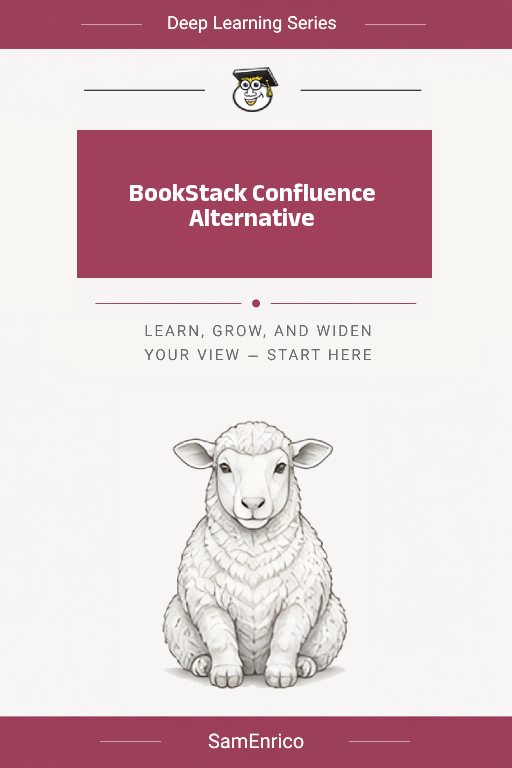
BookStack Confluence Alternative eBook
Create internal documentation with free BookStack
by Kellogg Luci
Create internal documentation with free BookStack instead of paying for Confluence or Notion.
Formats
Free sample
Chapter 1: The Ownership Illusion--–- The email arrived on a Tuesday, but the damage had been brewing for years. Sarah, the head of operations at a 65-person Saa S company, stared at the subject line: "Your Confluence instance will be migrated to cloud-only effective April 1st. New pricing applies." She clicked open. The annual renewal had increased from 7,200to7,200 to 7,200to14,400—a 100 percent jump with zero new features, zero additional users, and zero warning during the budget cycle that had closed two months earlier.Her stomach tightened. Not because the money would break the company, but because of what the number represented.
Every department had already trimmed fat. Marketing had canceled their social media scheduler. Engineering had postponed their monitoring tool upgrade. And now, the tool that held every runbook, every onboarding checklist, every post-mortem, and every client contract detail was about to double in price with no negotiation possible. "We're a customer, not a partner," she muttered, staring at the boilerplate language that offered no human contact for appeals.She pulled up the analytics dashboard for their Confluence instance.
The numbers were damning. Of 65 licensed users, only 22 had logged in during the past 30 days. Of those, 14 had made any edits. The rest were "read-only ghosts"—people who paid full price just to occasionally look something up. Meanwhile, she knew for a fact that three separate departments maintained their own Google Docs folders because Confluence was "too slow" and "too hard to find anything in." The shadow IT had grown so quietly that nobody had noticed until now, when the bill arrived like an eviction notice.This chapter is for everyone who has received that email, discovered that invoice, or realized that their company's collective knowledge is being held hostage by a vendor who sees them as a wallet, not a partner.
It is the story of how we got here, why the pricing models of Saa S knowledge management tools are designed to exploit rather than serve, and how a tiny, open-source project called Book Stack offers a way out that has nothing to do with begging for a discount or accepting inferior software.The Lie of Per-Seat Pricing Software-as-a-Service pricing models follow a seemingly logical pattern: pay for what you use. The more users, the more value, the more you pay. This sounds fair on the surface. It resembles utility billing—more water, higher bill; more electricity, higher bill. But knowledge management tools break this analogy in a fundamental way.When you add a user to Confluence or Notion, you are not consuming a scarce resource like water or electricity.
A server costs the same whether 22 people or 65 people access it. The marginal cost of adding one more reader is effectively zero—a few kilobytes of bandwidth and a handful of database queries. Yet vendors charge as if each new user requires building a new data center. This is not pricing based on cost. It is pricing based on extracted value, and the extraction mechanism works because leaving is painful.The chapter presents a worked example that Sarah wishes she had calculated years earlier.
Her 65-person team paid Confluence 10peruserpermonthonanannualcontract,totaling10 per user per month on an annual contract, totaling 10peruserpermonthonanannualcontract,totaling7,800 per year. But only 22 people actively used the tool. The effective cost per active user was 29.54permonth.Meanwhile,thethreeshadow ITGoogle Docfolderscostnothinginsoftwarebutcreatedmassivehiddencostsinduplicatedwork,versioncontrolchaos,andlosttribalknowledge.Whenshecalculatedthefullyloadedcostofherteam′sdocumentationecosystem—includingthehoursspentsearching,recreating,andreconcilingcontradictoryinformation—thetotalexceeded29.54 per month. Meanwhile, the three shadow IT Google Doc folders cost nothing in software but created massive hidden costs in duplicated work, version control chaos, and lost tribal knowledge. When she calculated the fully loaded cost of her team's documentation ecosystem—including the hours spent searching, recreating, and reconciling contradictory information—the total exceeded 29.54permonth.Meanwhile,thethreeshadow ITGoogle Docfolderscostnothinginsoftwarebutcreatedmassivehiddencostsinduplicatedwork,versioncontrolchaos,andlosttribalknowledge.Whenshecalculatedthefullyloadedcostofherteam′sdocumentationecosystem—includingthehoursspentsearching,recreating,andreconcilingcontradictoryinformation—thetotalexceeded90,000 annually.Per-seat pricing creates a perverse incentive for vendors.
They want you to buy more seats, but they have no financial incentive to make those seats valuable. In fact, the opposite is true. If every seat delivered massive value, you would use the tool more efficiently, perhaps even reducing headcount or finding ways to share access. The vendor's ideal customer is one that pays for 100 seats but only uses 20, because that is pure profit. The vendor's nightmare customer is one that pays for 20 seats and extracts maximum value from each, because that leaves no room for upsell.This structural misalignment explains why Confluence and Notion continually push features like AI databases, advanced analytics, and complex automations.
Those features justify price increases and encourage license expansion, but they do nothing to solve the fundamental problem that most teams face: they just need a place to put their documentation where it can be found, trusted, and updated without friction.The Knowledge Tax: What You Actually Pay The subscription fee is the decoy. The real cost is the knowledge tax—the hours your team spends every week searching for information, recreating lost documents, verifying contradictory sources, or simply giving up because it is easier to ask a colleague than to navigate the wiki.Research consistently shows that knowledge workers spend between 1.5 and 3 hours per week searching for internal information. In a 50-person company with an average fully loaded cost of 75perhour(salary,benefits,overhead),thattranslatesto75 per hour (salary, benefits, overhead), that translates to 75perhour(salary,benefits,overhead),thattranslatesto7,500 to 15,000perweekinlostproductivity.Overayear:15,000 per week in lost productivity. Over a year: 15,000perweekinlostproductivity.Overayear:390,000 to 780,000.The780,000. The 780,000.The6,000 Confluence subscription is not the problem.
It is a symptom of a much larger failure.The knowledge tax manifests in five specific ways that most organizations never measure:First, the search tax. Every time an employee types a query into the wiki search bar and finds nothing relevant (or finds ten irrelevant results), they have wasted time. But the real damage is that they learn to distrust the wiki. After enough failed searches, they stop trying altogether and default to asking colleagues, interrupting deep work and spreading institutional knowledge through fragile, unwritten channels.Second, the recreation tax. When documentation cannot be found, employees recreate it.
A support agent writes a troubleshooting guide that already exists but is buried under five levels of nested pages. An engineer documents a deployment process that three other engineers have already documented separately, each in a different location and format. The company ends up paying five times for the same document, and worse, now has five contradictory versions.Third, the verification tax. When an employee finds documentation, they cannot trust that it is current. They spend additional time verifying the date, checking with the author, cross-referencing against other sources, or testing the steps themselves.
This tax is invisible because it looks like "due diligence," but it represents pure waste—work that would be unnecessary if the documentation carried an implicit guarantee of freshness.Fourth, the onboarding tax. New hires are the primary victims of poor documentation. A well-documented company can bring a new engineer to productivity in two weeks. A poorly documented company takes six weeks or more. For a senior hire costing 200,000annually,thoseextrafourweeksrepresent200,000 annually, those extra four weeks represent 200,000annually,thoseextrafourweeksrepresent15,000 in lost productivity before they contribute anything.
Multiply that by ten new hires per year, and the tax exceeds the cost of any software subscription.Fifth, the incident…
This is the end of the free sample. Get the eBook to keep going. Buy now
About this book
Details
- Author
- Kellogg Luci
- Publisher
- SamEnrico
- Language
- English
- Genre
- Non-Fiction, Startup Guide, Documentation, Wiki
- Released
- 2026-06-01
- Pages (approx.)
- 132
- Available as
- eBook, Audiobook

Read better in the ZLOADR app
Your eBooks on your phone or tablet. Sign in with your SamEnrico account and start reading.
More by Kellogg Luci
 Collaborative Prototyping Sessions CourseKellogg Luci$11.99
 The Messenger Bot Lead FunnelKellogg Luci$11.99
 Burnout Reduced Hours GuideKellogg Luci$11.99
 IBS Gut Directed HypnotherapyKellogg Luci$11.99
 Feeling Trapped in Obligation AngerKellogg Luci$11.99
 The Algorithm That Stole the Election: How Social Media Reshaped DemocracyKellogg Luci$11.99
 The Last Human Job: How AI Is Reshaping WorkKellogg Luci$11.99
 Understanding Chronic Inflammatory Demyelinating PolyneuropathyKellogg Luci$17.99
 Client Service OperationsKellogg Luci$11.99
 Checklist Product BlueprintKellogg Luci$12.99
 How to Become a Development MechanicKellogg Luci$11.99