
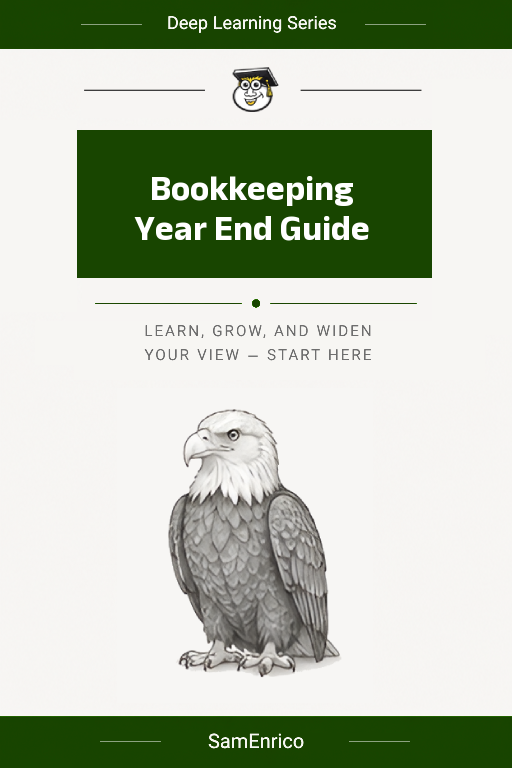
Non-FictionSide Hustle ArchitectYear EndTax Prep
Bookkeeping Year End Guide eBook
Help small business clients with year end bookkeep
by Hearn Virgil
Help small business clients with year end bookkeeping including financial review and tax prep.
Formats
Free sample
Chapter 1: The Master Source File--The phone call that changed how I think about year-end bookkeeping came on a freezing Tuesday in February. A bakery owner named Sarah was on the other end of the line, her voice somewhere between panic and exhaustion. She had just gotten off the phone with her CPA, who informed her that the $40,000 loss she thought she was claiming on her taxes didn't exist because she couldn't find receipts for seventeen thousand dollars of deductible expenses. She had the money. She spent the money.
But she had no proof. And in the world of taxes, no proof means no deduction."I threw everything in a box," she told me. "I thought that was enough."Sarah is not lazy. She is not stupid. She works seventy hours a week, has three children, and built her bakery from a single mixer in her apartment to a storefront that serves four hundred customers a day.
She simply did what most small business owners do: she survived until January, then tried to reconstruct an entire year's financial history from memory and crumpled receipts.That call taught me something I have never forgotten. The problem with year-end bookkeeping is rarely laziness or incompetence. The problem is that no one ever gives business owners a system designed for actual human beings who are already exhausted.This chapter is that system.The Core Problem: You Don't Know What You Don't Have Here is the single most damaging truth about small business bookkeeping: most owners do not discover that they are missing documents until the moment they need those documents most. You do not realize you lost a bank statement until your CPA asks for it on February 10th. You do not realize you never saved a receipt until the IRS audit letter arrives in June.
You do not realize a loan balance is wrong until you apply for a new loan and the bank asks why your books show different numbers than theirs.This is not a motivation problem. It is an organization problem disguised as a motivation problem.The solution begins with a simple shift in thinking. Instead of treating document gathering as something you will do "at year-end," you treat it as something you prepare for continuously throughout the year. Instead of hoping you have everything, you create a single location where everything lives. Instead of searching through fifteen different folders, email attachments, paper piles, and phone photos, you open one binder and find exactly what you need.This chapter introduces that system.
It is called the Master Source File.What Is the Master Source File?The Master Source File is a centralized, organized collection of every source document you will need to close your books, prepare your tax return, and answer questions from your CPA, your banker, or the IRS. It is not fancy. It is not expensive. It does not require special software or an accounting degree.It requires a binder. Or a folder.
And a commitment to using it.I define the Master Source File this way: a single physical or digital location that contains all supporting documents for your business's financial transactions, organized by month and by account type, maintained consistently throughout the year.Let me break down each part of that definition.A single location means you never ask "where is that document?" because there is only one place it could be. If you use a physical binder, every piece of paper goes into that binder. If you use a digital folder (Google Drive, Dropbox, One Drive), every digital file goes into that folder. Not your email. Not your downloads folder.
Not your phone's camera roll. The Master Source File.Supporting documents means the raw evidence of your transactions: bank statements, credit card statements, loan statements, receipts, invoices, depreciation schedules, prior-year tax returns, and any other document that proves a number on your books.Organized by month and by account type means you can find any document in less than sixty seconds. A physical binder might have monthly dividers (January through December) and behind each month, subdividers for Bank Statements, Credit Cards, Receipts, and Invoices. A digital folder might have subfolders named "01-January," "02-February," and so on, with consistent file naming like "2025-01_Bank Statement.pdf."Maintained consistently throughout the year means you do not wait until December to start. The Master Source File is a living system.
Every time you receive a document, it goes into the file. Every time you pay a bill, the receipt goes into the file. Every time you download a bank statement, it goes into the file. Not next week. Not "when you have time." Immediately.Why Most Business Owners Fail at This (And Why You Won't)Before we build your Master Source File, let me tell you why most attempts at organization fail.
Because if you understand the failure modes, you can design around them.Failure Mode Number One: The Shoebox Strategy. This is Sarah the baker's approach. Throw everything into a box (literal or metaphorical) and hope that someone else will sort it out later. The problem is that no one sorts it out later. The CPA charges you by the hour to sort it, and they bill $300 or more per hour.
The shoebox strategy is not free. It is simply deferred cost with interest.Failure Mode Number Two: The Multiple Locations Strategy. You keep bank statements in your email, receipts in a drawer, loan documents in a file cabinet, and credit card statements in a different email folder. At year-end, you cannot find anything because everything is somewhere else. You spend hours searching.
You give up on some documents entirely. You miss deductions.Failure Mode Number Three: The Perfect System Strategy. You buy expensive software, watch twelve hours of tutorials, design a color-coded folder structure with cross-referenced indexing, and then never use it because it is too much work to maintain. The perfect system is the enemy of the done system.Failure Mode Number Four: The Memory Strategy. You do not save documents because you assume you will remember.
You do not remember. No one remembers seventeen thousand dollars of receipts from eleven months ago. The human brain is not designed for that. Your memory is not the problem. Your refusal to write things down is.The Master Source File defeats all four failure modes because it is simple, centralized, low-friction, and does not rely on memory.
You do not need to remember anything. You just need to put the document in the file when you get it.Building Your Physical Master Source File Let us start with the physical version, because it works for the vast majority of small business owners. Digital is fine too, and we will cover that, but physical has advantages: you cannot accidentally delete it, you do not need an internet connection to access it, and the act of putting paper into a binder creates a physical habit that digital notifications cannot replicate.You will need the following supplies, which you can buy at any office supply store for less than thirty dollars:One three-inch three-ring binder. Do not buy a smaller binder. Do not convince yourself that you do not have enough documents to…
This is the end of the free sample. Get the eBook to keep going. Buy now
About this book
Details
- Author
- Hearn Virgil
- Publisher
- SamEnrico
- Language
- English
- Genre
- Non-Fiction, Side Hustle Architect, Year End, Tax Prep
- Released
- 2026-05-29
- Pages (approx.)
- 137
- Available as
- eBook, Audiobook

Read better in the ZLOADR app
Your eBooks on your phone or tablet. Sign in with your SamEnrico account and start reading.
More by Hearn Virgil
 Password Chunking SystemHearn Virgil$11.99
 Binge Eating and Social Media Comparison CourseHearn Virgil$11.99
 Digital Anger in RelationshipsHearn Virgil$11.99
 Researcher Deep Focus GuideHearn Virgil$11.99
 Beginner's Workout ScheduleHearn Virgil$11.99
 The Silk Road's Shadow Traveler: Ibn Battuta's Pacific DeceptionHearn Virgil$11.99
 Gold Rush Ghosts: The Unseen Fortunes of the KlondikeHearn Virgil$11.99
 Air Cargo Carrier DBHearn Virgil$12.99
 Understanding Encephalopathy Progressive Optic AtrophyHearn Virgil$17.99
 How to Start a Contingency Insurance Business (Beginners Guide)Hearn Virgil$11.99
 Food Store SupervisorHearn Virgil$11.99
You may also like
 Hong Kong Handover 1997Dunn Johnnie$11.99
 Zumba For Postnatal Recovery CourseNeal Christian$11.99
 Zumba for BeginnersLadner Nikia$11.99
 YouTube Comment Mining GuideHumes Pandora$12.99
 Worry Box MeditationCarlin Rudy$11.99
 Workplace Stress MeditationNguyen Lynn$11.99
 Workplace Stress and Sleep RepairHawley Ivory$11.99
 Workplace Perfectionism CureDelaney Jeffry$11.99
 Workplace Injustice Anger GuideWallen Isabelle$11.99
 Work Addiction and Burnout LinkGreenwood Ester$11.99
 Women in Yoga and WellnessBeattie Galina$11.99
 Women in Stand Up ComedyChun Evangeline$11.99