
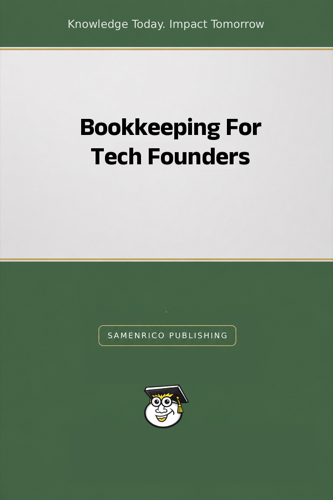
Non-FictionStartup GuideBookkeeping
Bookkeeping For Tech Founders eBook
Simplifies expense tracking and receipt organizati
Simplifies expense tracking and receipt organization.
Formats
Free sample
Chapter 1: The Excel Trap--Most founders don’t realize they’re already dead. They just haven’t stopped moving yet.You raised a seed round. You have eight employees. Your product is gaining traction. And every month, you open a spreadsheet—maybe called 2026_Finances_FINAL_v3.xlsx—and you copy over numbers from your bank account, your Stripe dashboard, and a Pay Pal account you forgot existed until just now.
You check the bottom cell. The number is green. You close the laptop and feel vaguely responsible.That feeling is a lie.The truth is that Excel is not a tool for you anymore. It is a trap. And by the time you realize it, you will have already lost something valuable: a term sheet, a tax credit, or simply the eight weeks of your life you will never get back untangling a hidden formula error.This chapter is not about why spreadsheets are bad.
This chapter is about the exact moment they become deadly, the specific ways they fail startups differently than they fail established businesses, and the warning signs that every tech founder ignores until it is too late.Let me tell you about Maya.The $5 Million Formula Error Maya was a technical founder. She had built a B2B Saa S platform from zero to $800k in annual recurring revenue. She had raised $2 million from a respectable venture firm. She had eight employees, a growing customer base, and a spreadsheet.Her spreadsheet was beautiful. She had color-coded tabs.
She had formulas that pulled from her bank’s CSV export and her Stripe API export and a manual entry for a corporate card that didn’t integrate with anything. She spent two hours every Sunday night reconciling. She felt in control.Then she started her Series A raise.The lead VC sent a due diligence request: “Please provide twelve months of clean financials, a P&L by month, and a breakdown of gross margin by customer cohort.”Maya’s spreadsheet could not do that. Not because she was bad at Excel—she was excellent at Excel—but because Excel is not a relational database. Every time she tried to slice the data a new way, she had to rebuild the entire structure.
She hired a part-time bookkeeper. The bookkeeper found three errors in the first hour.Error one: A formula in the AWS cost column had been summing the wrong range for six months, understating hosting expenses by $47,000.Error two: A row had been accidentally deleted during a late-night edit, removing $23,000 in contractor payments from the ledger entirely.Error three: The R&D tax credit documentation—what little existed—was scattered across four different email threads and a Notes app entry from a conversation with a CPA who had since stopped returning calls.The VC’s due diligence team found all of this in ninety minutes. The term sheet was withdrawn. The reason given was “incomplete financial infrastructure.” Maya spent the next three months fixing her books instead of building her product. She survived, but she lost the momentum.
She lost the valuation. And she lost the clean shot at Series A that she had worked two years to earn.Maya is not a cautionary tale about incompetence. Maya is a cautionary tale about timing. She was using the right tool for a six-person company. She kept using it for an eight-person company.
And that two-person difference cost her millions.The Inflection Point You Will Miss Every startup has an inflection point where spreadsheets stop working. The problem is that the inflection point arrives silently. There is no alert. No error message. No pop-up that says “Congratulations, you have outgrown Excel.”The inflection point is not based on revenue.
It is not based on headcount, although headcount is a proxy. The inflection point is based on transaction volume and transaction complexity.Here is the rule:If you have more than fifty monthly transactions across more than three financial accounts (checking, credit card, payment processor), you have crossed the inflection point.Fifty transactions sounds like a lot. It is not. Let me break it down.One AWS invoice: one transaction. One payroll run: one transaction.
One Stripe payout: one transaction. One Zoom subscription: one transaction. One coffee meeting with an investor where you paid with a corporate card: one transaction. One refund to a customer: one transaction. One monthly bill from your lawyer: one transaction.If you have eight employees and one hundred customers, you are easily at sixty to eighty transactions per month.
And that is before you count the things you do not remember: the Adobe Creative Cloud license for your designer, the Figma subscription for your product team, the data enrichment tool that your head of sales signed up for on a trial and never canceled.At fifty transactions, a spreadsheet is annoying. At one hundred transactions, a spreadsheet is dangerous. At two hundred transactions, a spreadsheet is a liability that will eventually cost you money, time, or both.I have worked with dozens of founders who crossed the inflection point without noticing. Every single one described the same symptoms:“I spend my Sunday nights doing books instead of being with my family.”“I always feel like something is wrong, but I can’t prove it.”“My CPA asks for reports that I cannot generate without rebuilding my spreadsheet from scratch.”“I missed a tax deadline because I didn’t know I had to file in a new state.”“I think I might be missing R&D credits, but I don’t have the documentation.”If any of those sentences feel familiar, you are already past the inflection point. The only question is how much it will cost you before you leave Excel behind.The Three Hidden Costs of Messy Books Founders think messy books cost time.
They do. But time is not the most expensive cost. The most expensive costs are invisible until they hit you.Hidden Cost One: Runway Erosion You Cannot See Runway is the most important number in a startup. It is also the easiest number to miscalculate when your books are messy.Here is how most founders calculate runway: they look at their bank account balance, divide by their average monthly spend, and call it a day. That calculation is wrong in three ways.First, average monthly spend hides seasonality.
If you spent $50k last month on a one-time legal fee, your average looks higher than reality, and you think you have less runway than you do. Second, average monthly spend hides growth. If you hired three people this month, your spend is going up, and you think you have more runway than you do. Third, and most dangerously, average monthly spend hides net burn—the difference between what you spend and what you earn.A founder with $500k in the bank and $100k in monthly expenses thinks they have five months of runway. But if they also have $60k in monthly revenue, their net burn is only $40k.
They actually have twelve and a half months of runway. That is a massive difference. It means they can take more risk, hire more aggressively, and negotiate from a position of strength.Conversely, a…
This is the end of the free sample. Get the eBook to keep going. Buy now
About this book
Details
- Author
- Mcfarlane Margot
- Publisher
- SamEnrico
- Language
- English
- Genre
- Non-Fiction, Startup Guide, Bookkeeping
- Released
- 2026-06-06
- Pages (approx.)
- 146
- Available as
- eBook, Audiobook

Read better in the ZLOADR app
Your eBooks on your phone or tablet. Sign in with your SamEnrico account and start reading.
More by Mcfarlane Margot
 Franchising Your Local Brand Across Borders Carbon FootprintMcfarlane Margot$11.99
 Alcoholism and Parenting Recovery WorkbookMcfarlane Margot$11.99
 HIIT for Over 60 GuideMcfarlane Margot$11.99
 Assertiveness in Love GuideMcfarlane Margot$11.99
 Infidelity Recovery StressMcfarlane Margot$11.99
 Senior Housing REIT AnalysisMcfarlane Margot$11.99
 Joint Pain and Food AddictionMcfarlane Margot$11.99
 The Crown’s Digital Dilemma: How the Royal Family Navigated Social Media ScandalsMcfarlane Margot$11.99
 The Bay Street Betrayal: How a Stockbroker’s Threats Shook Canada’s Financial EliteMcfarlane Margot$11.99
 A Collector's Handbook to the Delage D8-120Mcfarlane Margot$11.99
 Student Work Culture DifferencesMcfarlane Margot$12.99
 EU VAT Export and Import GuideMcfarlane Margot$12.99
You may also like
 Hong Kong Handover 1997Dunn Johnnie$11.99
 Zumba For Postnatal Recovery CourseNeal Christian$11.99
 Zumba for BeginnersLadner Nikia$11.99
 YouTube Comment Mining GuideHumes Pandora$12.99
 Worry Box MeditationCarlin Rudy$11.99
 Workplace Stress MeditationNguyen Lynn$11.99
 Workplace Stress and Sleep RepairHawley Ivory$11.99
 Workplace Perfectionism CureDelaney Jeffry$11.99
 Workplace Injustice Anger GuideWallen Isabelle$11.99
 Work Addiction and Burnout LinkGreenwood Ester$11.99
 Women in Yoga and WellnessBeattie Galina$11.99
 Women in Stand Up ComedyChun Evangeline$11.99