
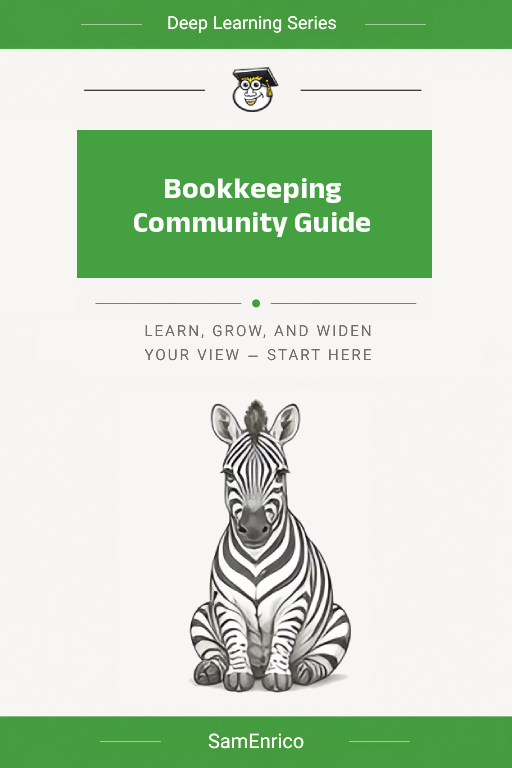
Non-FictionSide Hustle ArchitectCommunityNetworking
Bookkeeping Community Guide eBook
Join freelance bookkeeping communities for support
Join freelance bookkeeping communities for support and business growth tips.
Formats
Free sample
Chapter 1: The Lonely Ledger Myth--–- The email arrived at 11:47 PM on a Tuesday. Sarah, a certified bookkeeper with eight years of experience, had just finished reconciling her seventh client of the day. Her back ached from the kitchen chair she had been sitting in for fourteen hours. Her third cup of coffee had gone cold two hours ago. She stared at the screen, at the neat columns of debits and credits she had balanced perfectly, and felt absolutely nothing.
No satisfaction. No pride. Just a hollow exhaustion that had become her constant companion.She opened the email. It was from a potential client, a small marketing agency with messy books and a desperate tone. They needed help immediately.
A year of backlog. Receipts in shoeboxes. A former bookkeeper who had ghosted them six months ago. The pay was good—$75 an hour, well above the market rate in her Midwest city. Sarah should have been thrilled.
Instead, she closed her laptop, walked to her bedroom, and cried for twenty minutes. Not because she was sad. Because she was alone, and she had no one to tell that she could not take on another client, and she had no one to ask whether she should raise her rates, and she had no one to remind her that she had started this business to have freedom, not to become a prisoner in her own home.Two months later, Sarah quietly closed her bookkeeping practice. She returned to a full-time corporate job, trading her flexible schedule for a cubicle and a manager who called her by the wrong name. She was competent.
She was certified. She was, by every objective measure, a good bookkeeper. And she failed anyway.This book is for every Sarah—and for the thousands of freelance bookkeepers who will quit this year not because they lack skill, but because they lack a community.The Statistic That Should Terrify You Let us begin with a number that the bookkeeping industry does not like to discuss: 67 percent. According to the 2024 Quick Books Solopreneur Report, which surveyed more than 3,000 independent bookkeepers and accountants across the United States, nearly two out of every three freelance bookkeepers abandon their practices within twenty-four months of starting. That is not a failure rate.
That is a massacre.Let that sink in for a moment. If you are reading this book as a new freelancer, the odds are statistically against you. Not because you are bad at bookkeeping. Not because you lack the technical skills. Not because you chose the wrong software or the wrong pricing model or the wrong niche.
You fail—if you fail—for a reason that most business books refuse to name.You fail because you are alone.The same report asked departing bookkeepers to identify their primary reason for quitting. Only 12 percent cited lack of technical knowledge or certification gaps. Only 18 percent cited insufficient client demand. The remaining 70 percent cited variations of the same answer: isolation, burnout, lack of peer support, and the crushing weight of making every decision alone. They did not need more Quick Books training.
They needed someone to tell them that their pricing was not too high, that their difficult client was not their fault, and that working sixteen hours on a Saturday was not a badge of honor but a symptom of a broken system.Consider a parallel universe. In traditional accounting firms, new hires receive training, supervision, and a desk next to someone who has done the job before. When they make a mistake, a manager catches it. When they face a difficult client, a partner handles the escalation. When they feel uncertain about a technical question, they turn to the person in the next cubicle.
This is not charity. This is infrastructure. The firm has built a support system that insulates individual employees from the full weight of every decision.Now consider the freelance bookkeeper. You wake up alone. You open your email alone.
You decide which clients to pursue alone. You set your rates alone. You argue with late-paying clients alone. You learn new software alone. You reconcile impossible messes alone.
You celebrate wins—if you celebrate at all—alone. Every decision, every risk, every mistake lands entirely on you. This is not freedom. This is the most high-stakes solo sport in the modern economy.The thesis of this book is simple and, I hope, liberating: Your isolation is not a personality flaw. It is a business liability.
And like any liability, you can insure against it, mitigate it, and eventually eliminate it—not by becoming more extroverted, but by building a community of peers who share your profession, your struggles, and your goals.The Hour-for-Dollar Trap Let us examine the most common financial mistake that isolated freelancers make, a mistake so pervasive that it has its own name in this book: the Hour-for-Dollar Trap.Here is how it works. You start your freelance practice with a simple equation: you need to earn a certain amount of money each month to pay your bills, save for retirement, and maybe treat yourself to a nice dinner. You look at what other bookkeepers charge—maybe you saw a forum post or asked a friend—and you set your hourly rate at 50,or50, or 50,or75, or 100.Thenyoumultiplythatratebythenumberofhoursyouarewillingtowork.Fortyhoursat100. Then you multiply that rate by the number of hours you are willing to work. Forty hours at 100.Thenyoumultiplythatratebythenumberofhoursyouarewillingtowork.Fortyhoursat75 equals 3,000perweek,3,000 per week, 3,000perweek,12,000 per month, $144,000 per year.
Not bad. Not bad at all.The trap is not the math. The trap is the assumption that hours are scalable.A full-time employee works forty hours per week because their employer covers overhead, benefits, training, sick days, vacation time, and the slow periods between projects. A freelancer works forty billable hours per week only if they spend an additional fifteen to twenty hours on non-billable work: marketing, proposals, invoicing, collections, software updates, continuing education, and the endless administrative friction of running a business. This means that a 75hourlyrate,inrealterms,oftenyields75 hourly rate, in real terms, often yields 75hourlyrate,inrealterms,oftenyields45 to $55 per hour once you account for unpaid labor.But the real trap is deeper.
When you sell hours, you place a hard ceiling on your income. There are only so many hours in a week. There are only so many weeks in a year. Even if you work every hour you are awake, even if you never take a vacation, even if you are a productivity machine, you will hit a wall. And when you hit that wall, you have two choices: raise your rates (which requires confidence and negotiation skills that isolated freelancers often lack) or burn out (which is statistically more likely).Consider two bookkeepers.
Both are skilled. Both serve similar clients. Both want to earn $120,000 per year.Bookkeeper A charges 75perhour.Toreach75 per hour. To reach 75perhour.Toreach120,000, she needs to bill 1,600 hours per year—approximately thirty-two billable hours per week, every week, with no vacation, no sick days, and no gaps between clients. In reality, she will work fifty to sixty hours per week to achieve thirty-two billable hours, because the non-billable work never stops.
She is exhausted. She resents her clients. She dreams of quitting.Bookkeeper B charges a flat monthly fee of 1,500perclient,andsheserveseightclients.Eachclientrequiresapproximatelyfourhoursofworkpermonth—twohoursforcorebookkeeping,onehourforreportingandanalysis,andonehourforclientcommunication.Thatisthirty−twohoursofworkpermonth,oreighthoursperweek.Sheearns1,500 per…
This is the end of the free sample. Get the eBook to keep going. Buy now
About this book
Details
- Author
- Branham Elfriede
- Publisher
- SamEnrico
- Language
- English
- Genre
- Non-Fiction, Side Hustle Architect, Community, Networking
- Released
- 2026-06-01
- Pages (approx.)
- 142
- Available as
- eBook, Audiobook

Read better in the ZLOADR app
Your eBooks on your phone or tablet. Sign in with your SamEnrico account and start reading.
More by Branham Elfriede
 Mindfulness for Relationship RageBranham Elfriede$11.99
 Food Addiction Recovery Sleep Hygiene WorkbookBranham Elfriede$11.99
 Meal Prep Chunking GuideBranham Elfriede$11.99
 Business Student Pressure GuideBranham Elfriede$11.99
 Beginner Gym Equipment GuideBranham Elfriede$11.99
 The Last Dragon of AvalonBranham Elfriede$11.99
 The Frozen Saviors: The Prehistoric Rescue That Defied the Ice AgeBranham Elfriede$11.99
 Four-poster Bed CraftBranham Elfriede$11.99
 Rail Freight DirectoryBranham Elfriede$12.99
 Understanding Encephalopathy-basal Ganglia-calcificationBranham Elfriede$17.99
 How to Start a Prefabricated Constructions (commercial) Assembly and Erection Business (Beginners GuBranham Elfriede$11.99
You may also like
 Hong Kong Handover 1997Dunn Johnnie$11.99
 Zumba For Postnatal Recovery CourseNeal Christian$11.99
 Zumba for BeginnersLadner Nikia$11.99
 YouTube Comment Mining GuideHumes Pandora$12.99
 Worry Box MeditationCarlin Rudy$11.99
 Workplace Stress MeditationNguyen Lynn$11.99
 Workplace Stress and Sleep RepairHawley Ivory$11.99
 Workplace Perfectionism CureDelaney Jeffry$11.99
 Workplace Injustice Anger GuideWallen Isabelle$11.99
 Work Addiction and Burnout LinkGreenwood Ester$11.99
 Women in Yoga and WellnessBeattie Galina$11.99
 Women in Stand Up ComedyChun Evangeline$11.99