
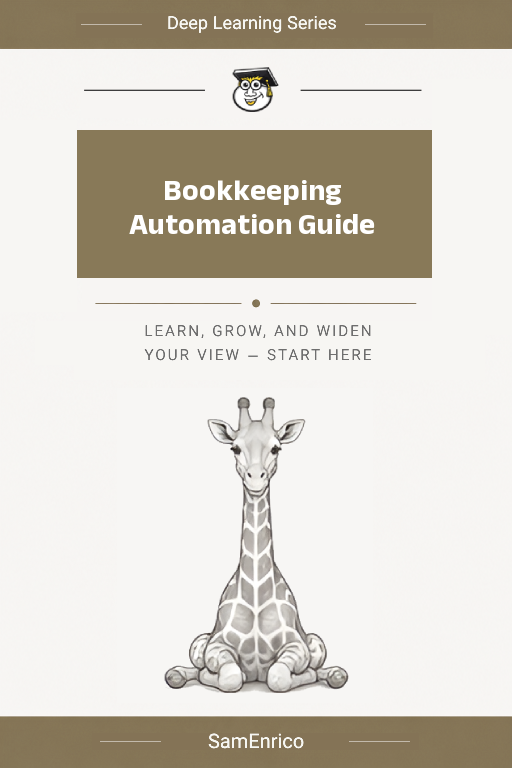
Non-FictionSide Hustle ArchitectAutomationEfficiency
Bookkeeping Automation Guide eBook
Automate bookkeeping workflows using receipt scann
Automate bookkeeping workflows using receipt scanners and bank feeds to save time.
Formats
Free sample
Chapter 1: The 10-Hour Lie--Maria’s Sunday ritual began with good intentions. She would brew a pot of coffee, pull out her laptop, and open the shoebox. Not a real shoebox—it was actually an old Amazon delivery box, overflowing with crumpled receipts, sticky notes with handwritten totals, and at least three napkins that had somehow become financial records. By 2:00 PM, she would still be staring at the same spreadsheet, cross-eyed and frustrated, wondering why the bank feed didn’t match the pile of paper. By 5:00 PM, the tears would come.
Not dramatic sobs, but quiet, exhausted crying in her parked car before picking up her kids from soccer practice.Maria owned a small bakery called Rise & Shine. Her croissants were legendary in her Chicago neighborhood. Her books were a disaster. And she hated bookkeeping with a passion that surprised even her.She is not alone.The Manual Bookkeeping Trap Let me tell you what you already know: bookkeeping is the least loved part of owning a business. It is not why you started your company.
You started because you had a skill—baking, coding, designing, coaching, plumbing, healing—and you wanted to share it with the world. You did not wake up one morning thinking, I cannot wait to categorize 147 transactions from Staples.But here is the lie that keeps business owners trapped: You have to do it yourself, and it has to be perfect.That lie costs you hours every week. It costs you clarity about your own money. And worst of all, it costs you the energy you should be spending on your actual business. A 2024 study of over 2,500 small business owners found that the average owner spends 9.7 hours per week on manual bookkeeping tasks.
Nearly ten hours. That is more than a full workday. Every seven days, you lose an entire day to typing numbers into boxes.I want you to imagine something different. Imagine waking up on Monday morning, opening your laptop, and seeing that your books are already done. Every receipt matched.
Every transaction categorized. Every bank feed synchronized. You spend fifteen minutes—just fifteen—reviewing the few items the robot wasn’t sure about. Then you close your laptop and go back to running your business.That is not a fantasy. That is what this book will give you.But first, we need to understand why manual bookkeeping feels so terrible.
It is not because you are bad at math. It is not because you lack discipline. It is because you are using tools and methods designed for a different era—an era before cloud computing, before AI, before receipt scanners that fit in your pocket.The Four-Letter Promise Throughout this book, I will teach you a simple framework. I call it the Four-Letter Promise, because it replaces your current multi-step manual process with just four actions, each with a single word. Here it is:Scan.
Sync. Code. Review.Let me break down what these mean in plain English.Scan means capture the receipt at the moment of purchase. You take a photo with your phone, or you forward a digital receipt to a special email address. That is it.
No filing. No folders. No typing.Sync means that photo or email is automatically sent to the cloud—specifically, to a receipt scanner application that lives between your phone and your accounting software. You will not see this step happening. It happens in the background, like magic, except it is just software.Code means artificial intelligence reads the receipt.
It looks at the date, the vendor name, the total amount, and often even the individual line items. Then it assigns the transaction to the correct account in your Chart of Accounts. Did you buy flour for the bakery? The AI learns to put that in "Cost of Goods Sold." Did you buy a new laptop? That goes to "Office Equipment." Did you buy dinner for a client?
That goes to "Meals and Entertainment." The AI gets better over time, and you will teach it when it makes mistakes.Review is the only step where you, the human, need to pay attention. Once a week—I recommend Monday mornings—you open your accounting software and look at the "exception dashboard." This is a list of transactions the AI was not confident about. Maybe the receipt was blurry. Maybe the vendor name was misspelled. Maybe it was a split transaction that needed manual approval.
You review these few items, correct them, and close the software.That is it. Scan, Sync, Code, Review.No manual data entry. No spreadsheets. No shoeboxes.The Four-Letter Promise is the spine of this book. Every chapter will teach you how to implement one piece of this framework until it becomes automatic—until you stop thinking about bookkeeping altogether.But before we go any further, I need to know where you are starting from.
Are you a complete beginner, buried in paper? Are you somewhere in the middle, using Quick Books but still typing everything manually? Or are you advanced, looking to fine-tune an existing system?Take the quiz below. It takes three minutes. Be honest—there is no shame in any score.
The only shame is staying stuck.The Automation Score Quiz Answer each question as honestly as you can. Give yourself 1 point for each "Yes" answer.Do you currently use cloud accounting software (Quick Books Online, Xero, Fresh Books, or similar)?Yes = 1 point. No = 0 points.Are your business bank accounts and credit cards connected to that software via live feeds (not manual uploads)?Yes = 1 point. No = 0 points.Do you use a receipt scanner app (Hubdoc, Dext, Auto Entry, or similar) that automatically sends receipts to your accounting software?Yes = 1 point. No = 0 points.Have you set up any automation rules (e.g., "If vendor = Starbucks, then account = Meals") in the past six months?Yes = 1 point.
No = 0 points.Do you spend less than one hour per week on bookkeeping?Yes = 1 point. No = 0 points.When tax season comes, can you send your accountant a complete set of organized financial reports in under two hours?Yes = 1 point. No = 0 points.Do you look at your financial reports at least once a month and actually understand what they mean?Yes = 1 point. No = 0 points.Have you gone more than 30 days without manually typing a single transaction into your ledger?Yes = 1 point. No = 0 points.Now total your score.0–2 points: Data Entry Clerk.
You are doing everything manually. You probably have a shoebox (or three). You dread bookkeeping. You are exactly who this book was written for. Do not feel bad—most business owners start here.
By Chapter 4, you will have eliminated 80% of your manual work.3–5 points: Cautious Automator. You have some pieces in place, but you are not fully leveraging automation. You might have cloud software but still type in receipts. Or you might have a scanner but no bank feeds. You are close.
This book will close the gaps and save you five to seven hours per week.6–8 points: Financial Intelligence Officer. Congratulations. You are already running lean. But I promise there is still room to improve. You may be missing advanced exception handling, real-time dashboards, or predictive analytics.
The final chapters of this book are written for you.What is your score? Write it down. Put it somewhere you…
This is the end of the free sample. Get the eBook to keep going. Buy now
About this book
Details
- Author
- Mccullough Leann
- Publisher
- SamEnrico
- Language
- English
- Genre
- Non-Fiction, Side Hustle Architect, Automation, Efficiency
- Released
- 2026-05-28
- Pages (approx.)
- 150
- Available as
- eBook, Audiobook

Read better in the ZLOADR app
Your eBooks on your phone or tablet. Sign in with your SamEnrico account and start reading.
More by Mccullough Leann
 The Anger Time-Out ProtocolMccullough Leann$11.99
 Accountant Interruption ManualMccullough Leann$11.99
 Self Hypnosis Induction Techniques CourseMccullough Leann$11.99
 Language Acquisition ChunkingMccullough Leann$11.99
 Beginner Bodyweight WorkoutMccullough Leann$11.99
 The Phoenix Protocol: How a 19th-Century Fire Code Saved a CityMccullough Leann$11.99
 The Billion-Dollar Bubble: How a Math Genius and a Wall Street Whiz Kid Blew Up the WorldMccullough Leann$11.99
 Understanding Emphysema-penoscrotal Web-deafness-mental RetardationMccullough Leann$17.99
 Financial Reporting AnalystMccullough Leann$11.99
 Dangerous Goods LogisticsMccullough Leann$12.99
 How to Start a Process Pressure Sphere Business (Beginners Guide)Mccullough Leann$11.99
You may also like
 Hong Kong Handover 1997Dunn Johnnie$11.99
 Zumba For Postnatal Recovery CourseNeal Christian$11.99
 Zumba for BeginnersLadner Nikia$11.99
 YouTube Comment Mining GuideHumes Pandora$12.99
 Worry Box MeditationCarlin Rudy$11.99
 Workplace Stress MeditationNguyen Lynn$11.99
 Workplace Stress and Sleep RepairHawley Ivory$11.99
 Workplace Perfectionism CureDelaney Jeffry$11.99
 Workplace Injustice Anger GuideWallen Isabelle$11.99
 Work Addiction and Burnout LinkGreenwood Ester$11.99
 Women in Yoga and WellnessBeattie Galina$11.99
 Women in Stand Up ComedyChun Evangeline$11.99