
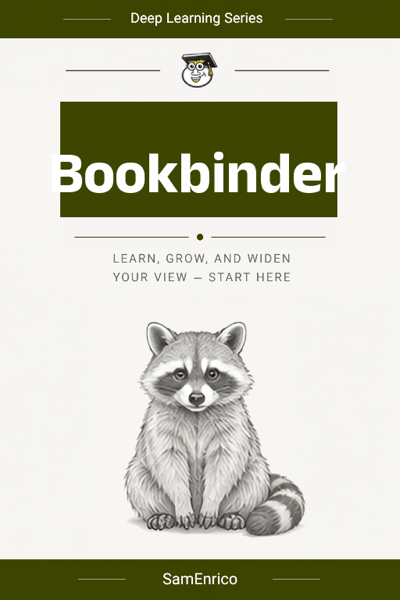
Non-FictionInformativeEducational
Bookbinder eBook
A Coursebook on Bookbinder
by Kearns Gaye
A Coursebook on Bookbinder
Formats
Free sample
Chapter 1: The Buried Spark–- Every book on your shelf is a corpse. Not dead in the way of dust and neglect, but dead in the sense of suspended animation. It waits. It waits for hands to open it, for a spine to be cracked, for the threads of its binding to be tested. And when a book finally breaks—when the hinge tears, when the cover detaches, when the pages begin to fall like autumn leaves—most people throw it away.
You will not. You are about to learn what only a handful of craftspeople still know: that a broken book is not garbage. It is a patient, waiting to be healed.This is not a book about making pretty journals from craft store supplies, though you will learn to make beautiful things. It is not a book about the arcane chemistry of medieval vellum, though you will learn to respect archival standards. This is a book about the space between those two worlds—the place where mindful creativity meets technical precision, where the stress-relieving rhythm of folding and sewing meets the unyielding rules of grain direction and reversible adhesives.You are holding a coursebook.
That means every chapter builds on the one before it. You cannot skip the anatomy lesson and expect to sew a headband correctly. You cannot ignore the glue-up chapter and wonder why your case cracks after six months. But you also do not need a studio full of antique presses or a wallet full of cash. The first book ever bound was made with nothing more than folded parchment, linen thread, and two wooden boards.
You will start there, too.Before you pick up a single tool, however, you must answer a more fundamental question. It is the question that separates the person who buys supplies and abandons them in a drawer from the person who is still binding books twenty years from now. That question is simple: Why do you want to bind books?The answer matters more than you think.The Three Paths In the first decade of the twenty-first century, bookbinding split into three distinct streams. Before that, binding was largely a trade—a dying one at that, pushed to the margins by mass production and digital screens. But something unexpected happened.
As screens proliferated, the desire for physical, tactile objects grew. People began seeking out handmade books not despite the digital age, but because of it. And those people fell into three categories.The Restorer is the first path. This reader is drawn to old things—family Bibles with cracked spines, antique ledgers from a closed general store, a childhood copy of The Hobbit that has been read to pieces. The restorer values precision, history, and ethics.
She wants to know not just how to fix a book, but whether she should. She asks questions like: Does this repair preserve the original material or replace it? Will my work be reversible in fifty years? Am I healing this book or altering it beyond recognition? The restorer sleeps well knowing that a book rescued today will outlive her grandchildren.The Artist is the second path.
This reader is drawn to expression—junk journals stuffed with found paper, zines stapled and sewn in tiny editions, altered books that become sculptures, sketchbooks with exposed spines and uneven edges. The artist values uniqueness, texture, and emotional resonance. He asks questions like: How can I make this cover feel like a secret? What happens if I sew with red thread instead of white? Can I bind a book that has no right angles at all?
The artist sleeps well knowing that no one else has ever made anything exactly like what he made today.The Publisher is the third path. This reader is drawn to utility—short-run hardcovers for self-published novels, wedding guest books that will be signed once and treasured forever, thesis bindings for graduate students who want their dissertation to look like a real book. The publisher values efficiency, repeatability, and commercial viability. She asks questions like: How can I bind ten identical copies in the same time it takes to bind one? What is the cheapest archival material that still looks professional?
Can I charge enough to make this a business? The publisher sleeps well knowing that her books are being used, signed, shipped, and loved.Here is the secret that no other bookbinding guide will tell you: You do not have to choose one path forever. Most binders move between all three over the course of their lives. You might start as an artist, making chaotic junk journals for the joy of it. Five years later, you might find yourself restoring a family Bible for an elderly neighbor.
Ten years after that, you might be publishing short runs of poetry chapbooks for local writers. The paths are not competitive. They are complementary.But knowing which path speaks to you right now will shape how you read this book. The restorer will linger over Chapter 10, memorizing the ethics of conservation. The artist will skip ahead to Chapter 8 to see the marbled edge techniques.
The publisher will devour Chapter 11 for the print-on-demand workflow. That is fine. This book is designed to be read in order, but it is also designed to be revisited. You will come back to different chapters as you grow.Take thirty seconds right now. Close your eyes.
Imagine yourself binding a book. What does it look like? Is it old or new? Plain or decorated? For yourself or for someone else?
Open your eyes. That image—that instinctive preference—is your starting path. Write it down somewhere. You will check back in Chapter 12 to see if it has changed.The Psychology of Craft Before you fold your first sheet of paper, you need to understand why your hands are about to do what they are about to do. There is a reason bookbinding has exploded in popularity over the last decade, and it is not because people need more notebooks.
It is because your brain is starving for something that screens cannot provide.Neuroscience research from the past fifteen years has confirmed what craft traditions have known for millennia: repetitive, tactile actions change your brain chemistry. When you fold a signature, your hands send signals to your brain that reduce cortisol—the stress hormone—and increase dopamine and serotonin. This is not vague wellness language. This is measurable. In one 2019 study from Drexel University, participants who engaged in creative activities for just forty-five minutes showed significant cortisol reduction regardless of their prior artistic experience.
The act of making something, even badly, was enough.Bookbinding is particularly effective because it engages both hemispheres of your brain simultaneously. The left hemisphere—your logical, sequential side—handles measurement, grain direction, and the order of operations. The right hemisphere—your intuitive, spatial side—handles design, material choices, and the feel of a properly creased fold. Few crafts demand this kind of bilateral engagement. Knitting is repetitive but not highly sequential.
Woodworking is sequential but not highly tactile. Bookbinding sits at the intersection.There is another psychological benefit that no one talks about enough: closure. In a world of infinite scrolling and unfinished digital projects…
This is the end of the free sample. Get the eBook to keep going. Buy now
About this book
Details
- Author
- Kearns Gaye
- Publisher
- SamEnrico
- Language
- English
- Genre
- Non-Fiction, Informative, Educational
- Released
- 2026-06-02
- Pages (approx.)
- 114
- Available as
- eBook, Audiobook

Read better in the ZLOADR app
Your eBooks on your phone or tablet. Sign in with your SamEnrico account and start reading.
More by Kearns Gaye
 The Low T in Younger Men GuideKearns Gaye$11.99
 Jamaican Social Media SupportKearns Gaye$11.99
 Interruption Request Form System CourseKearns Gaye$11.99
 Biblical Studies Essay GuideKearns Gaye$11.99
 Workplace Anger Breathwork GuideKearns Gaye$11.99
 The Battle of Megiddo: Thutmose III's First Strike for EmpireKearns Gaye$11.99
 A Beginners Guide to Farkle (Volume 1)Kearns Gaye$11.99
 YouTube Audience Retention GuideKearns Gaye$12.99
 Leisure Spending Post Pandemic GuideKearns Gaye$12.99
 Understanding Polyarthritis, SystemicKearns Gaye$17.99
You may also like
 Hong Kong Handover 1997Dunn Johnnie$11.99
 Zumba For Postnatal Recovery CourseNeal Christian$11.99
 Zumba for BeginnersLadner Nikia$11.99
 YouTube Comment Mining GuideHumes Pandora$12.99
 Worry Box MeditationCarlin Rudy$11.99
 Workplace Stress MeditationNguyen Lynn$11.99
 Workplace Stress and Sleep RepairHawley Ivory$11.99
 Workplace Perfectionism CureDelaney Jeffry$11.99
 Workplace Injustice Anger GuideWallen Isabelle$11.99
 Work Addiction and Burnout LinkGreenwood Ester$11.99
 Women in Yoga and WellnessBeattie Galina$11.99
 Women in Stand Up ComedyChun Evangeline$11.99