
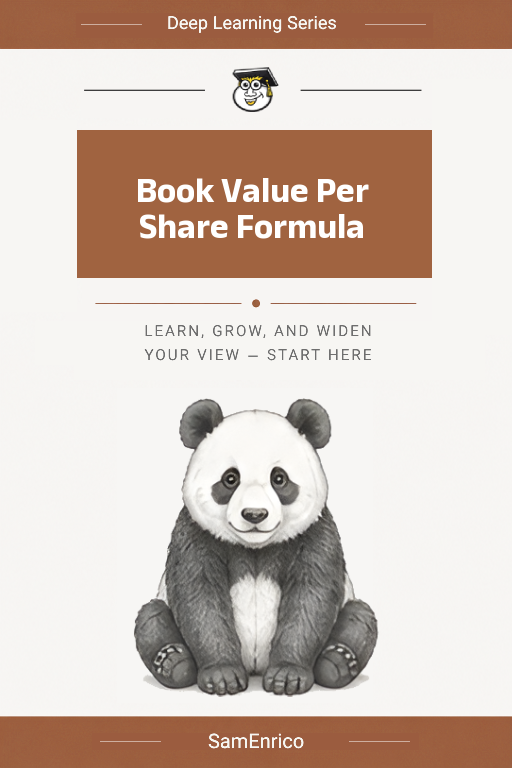
Book Value Per Share Formula eBook
Divide shareholders equity by outstanding shares t
Divide shareholders equity by outstanding shares to find net asset value per share, comparing to market price.
Formats
Free sample
Chapter 1: The Price Is a Liar--Every single day, millions of investors open their brokerage apps, glance at a stock price, and make a decision. Buy. Sell. Hold. They watch the green and red numbers dance across their screens, and they convince themselves that the price they see represents something real.
It does not. The price is a liar.Not because markets are rigged, though they sometimes are. Not because algorithms manipulate tickers, though they do. The price is a liar for a far more fundamental reason: price tells you what someone else just paid for a dream. It does not tell you what the company is actually worth if you strip away the hype, the fear, and the noise.This book exists to teach you a different number.
A quieter number. A number that does not scream from the front page of Yahoo Finance or flash across CNBC in bold red letters. That number is called Book Value per Share, and it represents the single most important reality check in all of investing. It answers one question that ninety-nine percent of investors never bother to ask: “If this company shut down tomorrow, paid off everyone it owes, and sold everything it owns, how much cash would land in my pocket?”That number is the truth. Everything else is speculation.The Great Illusion Let us start with a story.
In the spring of 2021, a company called Game Stop captured the world’s attention. Its stock price had been hovering around twenty dollars. Then, driven by a frenzied crowd of retail investors coordinating on a subreddit called Wall Street Bets, the price exploded to nearly five hundred dollars per share in a matter of weeks. People who had bought at twenty sold at four hundred and called themselves geniuses. People who bought at four hundred watched helplessly as the price crashed back to forty and called themselves victims.Throughout that entire mania, almost no one asked what Game Stop was actually worth on a liquidation basis.
Had they done so, they would have discovered a number far closer to ten dollars per share than five hundred. The company was losing money. Its retail stores were closing. Its physical inventory—DVDs, consoles, collectibles—was depreciating rapidly. The book value per share sat in the single digits.
The market price had detached from reality so completely that the divergence was not a gap but a chasm.Yet thousands of investors ignored the chasm because they believed the price. They trusted the ticker. They assumed that if thousands of other people were buying at four hundred dollars, there must be something of value there. This is what behavioral economists call social proof, and it is the enemy of rational investing.The price is a liar not because it is fraudulent but because it is emotional. A stock price represents the last transaction between a fearful seller and a greedy buyer.
It captures a moment of sentiment, not a lifetime of substance. When you look at a price of one hundred dollars, you are seeing the result of someone’s fear that the stock will go lower and someone else’s greed that it will go higher. You are not seeing what the company owns, what it owes, or what would remain if the music stopped.This chapter will teach you to see through that lie. You will learn the difference between price and value, the distinction between a trader and an investor, and the single most important question you can ever ask about a stock. By the time you finish these pages, you will never look at a ticker the same way again.The Accountant Versus The Trader To understand why book value matters, you must first understand two fundamentally different ways of looking at a business.The trader views stocks as pieces of paper that go up and down.
The trader cares about momentum, sentiment, technical patterns, and news flow. The trader’s horizon is measured in days, hours, or even minutes. When a trader buys a stock at fifty dollars, they are betting that someone else will pay fifty-one dollars tomorrow. The trader does not care what the company makes, what it owns, or whether it will exist in five years. The trader cares only about the direction of the price.The accountant views stocks as fractional ownership of real businesses with real assets and real liabilities.
The accountant does not care what the stock traded for yesterday. The accountant cares what the company owns—cash, inventory, buildings, machines, patents—and what it owes—debts, leases, pensions, lawsuits. The accountant asks: if I bought this entire company today, what would I actually get?The reason most individual investors lose money is not that they are stupid. Most individual investors are perfectly intelligent. The reason they lose money is that they think like traders while lacking the tools, speed, and information that professional traders possess.
They watch CNBC, read Twitter, follow Reddit, and convince themselves that they can outguess the market on a minute-to-minute basis. They cannot. No one can.Benjamin Graham, the father of value investing and the mentor to Warren Buffett, understood this better than anyone. In his classic work The Intelligent Investor, Graham introduced a character he called Mr. Market.
Mr. Market is your business partner in a private company. Every single day, he shows up at your door and offers to buy your shares or sell you his. Some days, Mr. Market is euphoric.
He quotes an absurdly high price because he believes the future is infinite growth. Other days, Mr. Market is depressed. He quotes an absurdly low price because he believes the world is ending.Here is the secret: you do not have to listen to him. You can ignore Mr.
Market entirely. You can wait until he offers a price that makes sense relative to the actual value of the business. Or you can sell to him when he is manic and buy from him when he is depressed. The price Mr. Market offers is not reality.
It is only an opinion.The stock market is simply Mr. Market writ large. Every price you see is an opinion. Book value is the reality check against that opinion.The One Question That Separates Winners From Losers If you take nothing else from this chapter, take this question. Write it down.
Tape it to your computer monitor. Recite it before you buy any stock.“If this company closed tomorrow, paid off everyone it owes, and sold everything it owns, how much cash would land in my pocket?”That question is the entire foundation of book value investing. It forces you to think like an accountant and an owner rather than a trader and a gambler. It strips away the narrative, the hype, the CEO’s charisma, the product launch, the meme stock momentum, and all the other noise that distracts investors from what actually matters.Let us walk through the logic step by step.Imagine you are considering buying a small business—a local hardware store. The owner shows you his financial statements.
The store has one hundred thousand dollars in cash in the bank. It has two hundred thousand dollars worth of…
This is the end of the free sample. Get the eBook to keep going. Buy now
About this book
Details
- Author
- Humphreys Arianne
- Publisher
- SamEnrico
- Language
- English
- Genre
- Non-Fiction, Student's Shortcut
- Released
- 2026-06-01
- Pages (approx.)
- 150
- Available as
- eBook, Audiobook

Read better in the ZLOADR app
Your eBooks on your phone or tablet. Sign in with your SamEnrico account and start reading.
More by Humphreys Arianne
 Voice Acting Retirement LifeHumphreys Arianne$11.99
 Exit Strategy Multiples ApproachHumphreys Arianne$11.99
 Senior Volunteer ConfidenceHumphreys Arianne$11.99
 Iron Optimization For Women CourseHumphreys Arianne$11.99
 Slide Design Best PracticesHumphreys Arianne$11.99
 Pelvic Floor PilatesHumphreys Arianne$11.99
 Creative Habits for SalesHumphreys Arianne$11.99
 Boomer vs Gen Z SpendingHumphreys Arianne$11.99
 The Salim Group Scandal: Indonesia's Corporate Empire UnraveledHumphreys Arianne$11.99
 The Vanishing of the Skywatchers: The Lost Crew of Flight 19Humphreys Arianne$11.99
 Giraffes: Towering HerbivoresHumphreys Arianne$11.99
 How to Produce Cotton BallsHumphreys Arianne$11.99
You may also like
 Hong Kong Handover 1997Dunn Johnnie$11.99
 Zumba For Postnatal Recovery CourseNeal Christian$11.99
 Zumba for BeginnersLadner Nikia$11.99
 YouTube Comment Mining GuideHumes Pandora$12.99
 Worry Box MeditationCarlin Rudy$11.99
 Workplace Stress MeditationNguyen Lynn$11.99
 Workplace Stress and Sleep RepairHawley Ivory$11.99
 Workplace Perfectionism CureDelaney Jeffry$11.99
 Workplace Injustice Anger GuideWallen Isabelle$11.99
 Work Addiction and Burnout LinkGreenwood Ester$11.99
 Women in Yoga and WellnessBeattie Galina$11.99
 Women in Stand Up ComedyChun Evangeline$11.99