
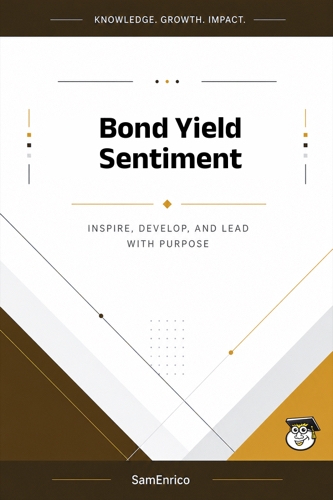
Non-FictionBusiness BriefBonds
Bond Yield Sentiment eBook
Read investor risk appetite through Treasury yield
Read investor risk appetite through Treasury yields.
Formats
Free sample
Chapter 1: The Great Deception--–- On March 9, 2020, at precisely 9:32 AM Eastern Time, something impossible happened.The yield on the 10-year Treasury note fell below 0.5 percent for the first time in human history. Not since the Great Depression, not during the Civil War, not even through the inflationary hellscape of the 1970s had the world’s most important number sunk so low. The previous record had been set just six days earlier. Before that, the record had been set four days before that. The bond market was collapsing into a singularity of fear, and almost no one outside a small circle of institutional traders understood what it meant.That same morning, the Dow Jones Industrial Average opened down more than 1,000 points.
The S&P 500 would trigger its first circuit breaker in twenty-three years before lunch. By the end of the week, every major stock index on earth had entered a bear market. The fastest decline in history had begun.The talking heads on CNBC blamed the coronavirus. The pundits on Bloomberg Television blamed Saudi oil price wars. The politicians in Washington blamed each other.They were all wrong.The virus was the spark, not the fire.
The oil shock was kindling, not the inferno. The real fire had been smoldering for months inside the US Treasury market, invisible to anyone who didn’t know where to look. The yield curve had inverted in August 2019. The term premium had gone negative. Credit spreads had begun to widen.
The bond market had been screaming “RECESSION” for seven months, but nobody was listening because stocks were still hitting all-time highs.That is the great deception that this chapter will destroy forever: the belief that the stock market tells you what is coming.It does not.The stock market tells you what investors hope is coming. The bond market tells you what they fear is coming. And between hope and fear, fear always wins.The $26 Trillion Truth Let us begin with a simple statement that will sound like heresy to anyone raised on a diet of financial television: the stock market is not the real market.The real market is bonds.Specifically, the US Treasury market—a $26 trillion ocean of debt that dwarfs the roughly $50 trillion global stock market when measured by daily trading volume. On an average day, $600 billion worth of Treasuries change hands. That is six times the daily volume of the New York Stock Exchange.
When the big players—pension funds, sovereign wealth funds, central banks, endowments, and the world’s largest asset managers—need to move money, they do not buy Apple stock. They buy Treasuries.And here is the critical insight that separates professional investors from everyone else: bond traders put real money behind their beliefs in a way that stock traders simply do not.Think about this for a moment. If you buy a stock and it drops 20 percent, what do you do? Most people hold. They tell themselves stories about mean reversion, about the company’s long-term prospects, about the brilliance of the CEO.
They can hold for years, sustained by nothing more than hope. The stock market is the world’s largest support group for people who refuse to admit they made a mistake.Bond traders cannot do that.A bond has a maturity date. If you buy a 10-year Treasury at 4 percent and yields rise to 5 percent the next week, the price of your bond drops by roughly 8 percent. You cannot wait for the “story” to improve. You cannot tell yourself the CEO will turn things around.
You have a contract that pays a fixed amount of interest for a fixed period of time, and the market has just told you that contract is worth less than you paid for it. Every single day, the bond market forces its participants to confront reality.This is why bond yields are the single most reliable sentiment gauge in all of finance. They are not opinions. They are not hopes. They are not narratives.
They are the collective, cold-blooded judgment of the world’s largest capital pools, expressed in the only language that matters: price.The Hope Versus Truth Framework To understand why bonds predict stocks and not the other way around, you need to internalize a framework that I call Hope Versus Truth.Stocks are Hope. When you buy a share of Tesla or Nvidia or Amazon, you are not buying the company’s current earnings. You are buying a story about earnings five or ten years from now. The price-to-earnings ratio of the S&P 500 has averaged roughly 16 over the last century. That means the market is paying $16 for every $1 of current earnings—a bet that those earnings will grow.
In the late 1990s, the P/E ratio hit 30. In 2021, it hit 35. That was not rational valuation. That was hope, distilled into a number.Bonds are Truth. When you buy a 10-year Treasury at 4.5 percent, you are buying a known stream of cash flows.
You will receive $45 per year for every $1,000 you invest. At the end of ten years, you will get your $1,000 back. There is no story. There is no hope. There is only the creditworthiness of the United States government.
The yield is the market’s assessment of certainty.Here is the insight that will change how you see every financial chart: hope is elastic, truth is inelastic.When hope collides with reality, hope loses.In March 2020, hope was still predicting a V-shaped recovery as late as February 19, when the S&P 500 hit an all-time high of 3,386. Truth had already collapsed. On February 21, the 10-year yield fell below 1.5 percent for the first time since 2016. By March 3, it was below 1 percent. The bond market was screaming “something is very wrong” while the stock market was still humming along, convinced that the coronavirus was “just the flu.”The stock market eventually caught up.
It always does. But by the time stocks crashed, bond traders had already moved their money to safety. They had already protected their clients. They had already won.The Flight to Quality: How Fear Moves When investors become terrified, they do not buy gold. They do not buy Bitcoin.
They do not buy real estate. All of those assets carry risk—counterparty risk, liquidity risk, custody risk, regulatory risk.When investors become truly terrified, they buy short-term US Treasuries.This is called the “flight to quality,” and it is the most powerful recurring pattern in global finance. The mechanism is simple but brutal. A pension fund managing $500 billion has a mandate to protect capital. When the fund’s risk models flash red—usually because of widening credit spreads or a spike in volatility—the managers have two choices: sell risky assets or hedge.
Most choose to sell. And what do they buy with the proceeds? They buy Treasury bills. Not because Treasury bills offer attractive returns. They do not.
They buy them because Treasury bills will still be there tomorrow, and the day after, and the day after, no matter what happens to the stock market.This buying demand pushes Treasury prices up. And because bond prices and yields move in opposite directions, rising prices mean falling yields.So here is the simple rule that you…
This is the end of the free sample. Get the eBook to keep going. Buy now
About this book
Details
- Author
- Cantwell Elroy
- Publisher
- SamEnrico
- Language
- English
- Genre
- Non-Fiction, Business Brief, Bonds
- Released
- 2026-06-07
- Pages (approx.)
- 154
- Available as
- eBook, Audiobook

Read better in the ZLOADR app
Your eBooks on your phone or tablet. Sign in with your SamEnrico account and start reading.
More by Cantwell Elroy
 Loneliness Recovery GuideCantwell Elroy$11.99
 The Sustainable Drive HandbookCantwell Elroy$11.99
 Academic Stress Relief WorkbookCantwell Elroy$11.99
 The Great Swiss Bank Heist: How a Rogue Employee Stole Millions and Changed Banking Forever (1983)Cantwell Elroy$11.99
 How to Start a Photographic Unexposed Film Business (Beginners Guide)Cantwell Elroy$11.99
 How to Produce Baby BottlesCantwell Elroy$11.99
 One Person Agile BootstrapCantwell Elroy$12.99
 Quality Program ManagerCantwell Elroy$11.99
You may also like
 Hong Kong Handover 1997Dunn Johnnie$11.99
 Zumba For Postnatal Recovery CourseNeal Christian$11.99
 Zumba for BeginnersLadner Nikia$11.99
 YouTube Comment Mining GuideHumes Pandora$12.99
 Worry Box MeditationCarlin Rudy$11.99
 Workplace Stress MeditationNguyen Lynn$11.99
 Workplace Stress and Sleep RepairHawley Ivory$11.99
 Workplace Perfectionism CureDelaney Jeffry$11.99
 Workplace Injustice Anger GuideWallen Isabelle$11.99
 Work Addiction and Burnout LinkGreenwood Ester$11.99
 Women in Yoga and WellnessBeattie Galina$11.99
 Women in Stand Up ComedyChun Evangeline$11.99