
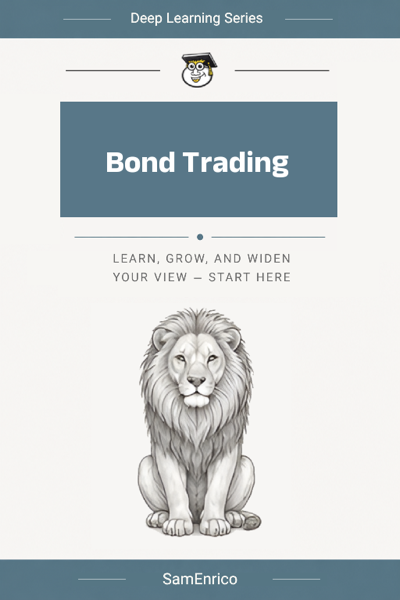
Bond Trading eBook
A Coursebook on Bond Trading
by Oshea Andria
A Coursebook on Bond Trading
Formats
Free sample
Chapter 1: The Silent War--– The bond market is the largest financial market in the world, yet most traders never see the battlefield. Every day, $1 trillion worth of bonds changes hands globally — more than equities and foreign exchange combined. And nearly all of it happens in the dark, invisible to the public, negotiated over phone lines, private chat rooms, and proprietary electronic screens that most people will never access. This is not the stock market. There is no flashing ticker for every trade.
There is no Robinhood app with confetti. There is only the quiet, relentless grind of institutional money moving silently from one balance sheet to another, and the traders who know how to navigate this opaque world can build fortunes while the rest of the world sleeps.Understanding the bond market ecosystem is not merely academic — it is survival. The graveyards of finance are filled with traders who entered the bond market thinking it worked like equities. They assumed liquidity was always available. They assumed prices were transparent.
They assumed that hitting "buy" on a screen meant they owned a bond. By the time they learned otherwise, their firms had already sustained seven-figure losses. This chapter strips away the mystery and builds a map of the territory: who the players are, how bonds are born, where they trade, and why the collapse of a single dealer can freeze the entire system.The Issuers: Where Bonds Come From Every bond begins with a borrower. Unlike stocks, which represent ownership in a company, bonds represent debt — legally binding promises to repay borrowed money with interest. The universe of bond issuers falls into five categories, each with its own trading characteristics, regulatory environment, and liquidity profile.Sovereign governments are the most powerful issuers.
The United States Treasury alone issues over $2 trillion in new debt annually, financing the federal government through a well-oiled auction mechanism. German Bunds, Japanese Government Bonds (JGBs), UK Gilts, and French OATs follow similar patterns. These bonds are considered the closest thing to "risk-free" in their respective currencies — not because default is impossible, but because governments can tax, print money, or both. For traders, sovereign bonds serve as the foundation of the pricing universe: every corporate bond, every mortgage-backed security, every emerging market debt instrument is priced as a spread over a sovereign benchmark.Corporate issuers range from Apple and Microsoft to speculative startups issuing high-yield debt. Investment-grade corporations (rated BBB- or higher by S&P, or Baa3 by Moody's) issue bonds with relatively low credit risk.
High-yield corporations (rated BB+ and below) pay higher coupons to compensate investors for meaningful default risk. A corporate bond's trading behavior depends heavily on its rating: investment-grade issues trade in size with reasonable liquidity; high-yield issues trade less frequently, with wider spreads and more price sensitivity to company-specific news.Municipal issuers — state and local governments, school districts, utilities — issue bonds to fund public infrastructure. In the United States, these "munis" offer tax-exempt interest, creating a dedicated investor base of high-net-worth individuals and specialized mutual funds. Municipal trading is famously illiquid: many muni bonds trade only a handful of times per year, and dealers maintain large inventories to facilitate customer trades.Supranational issuers include the World Bank, European Investment Bank, and Asian Development Bank. These bonds, often called "Sovereign, Supranational, and Agency" (SSA) debt, trade similarly to sovereign bonds but with slightly wider spreads.
Agency issuers — Fannie Mae, Freddie Mac, the Federal Home Loan Banks — occupy a gray area between sovereign and corporate credit, benefiting from implicit government backing that became explicit for Fannie and Freddie during the 2008 financial crisis.The key insight for traders is that every issuer type behaves differently under stress. In a flight-to-quality event, sovereign bonds rally while corporate and high-yield bonds sell off. Municipal bonds may become completely untradeable for days. Understanding these behavioral differences is the first step toward avoiding catastrophic positioning.The Investors: Who Actually Owns Bonds If issuers create bonds, investors absorb them. But not all investors trade the same way — and understanding their distinct motivations is essential to predicting price movements and liquidity conditions.Institutional asset managers — pension funds, insurance companies, mutual funds — are the largest holders of bonds globally.
A typical pension fund has long-dated liabilities (future retiree payments) and therefore seeks long-duration assets. These investors rarely trade on short-term views; instead, they rebalance quarterly, extend duration when yields rise, and reduce credit exposure when default fears increase. Their predictability creates trading opportunities for more active participants: a trader who knows that insurance companies must buy 30-year bonds every January to match policy liabilities can position ahead of that demand.Central banks are not ordinary investors. They are policy-driven liquidity providers. When the Federal Reserve engages in quantitative easing (QE), it buys bonds not because they are cheap, but because it wants to lower long-term interest rates.
When it performs quantitative tightening (QT), it allows bonds to roll off its balance sheet or sells them outright. These operations dwarf any other market participant: the Fed held over $8 trillion in Treasury and agency securities at its peak. Central bank buying can artificially depress yields for years; central bank selling can create liquidity vacuums. A trader who ignores central bank policy calendars does so at their peril.Hedge funds and proprietary trading desks are the most active participants. They trade bonds to express views on interest rates, credit spreads, curve shape, and volatility.
They use leverage extensively through repo and derivatives. They hold positions for minutes or months. Their collective activity creates liquidity but also amplifies volatility. When hedge funds all crowd into the same trade — as they did with the "basis trade" between Treasury cash and futures in 2020 — the eventual unwind can be violent.Retail investors access bonds primarily through mutual funds and ETFs. The rise of bond ETFs (discussed in detail later in this chapter) has democratized access: a retail investor can now buy TLT (i Shares 20+ Year Treasury Bond ETF) with a single click, achieving duration exposure that once required a million-dollar minimum.
However, retail flows tend to be pro-cyclical — buying after prices have risen, selling after prices have fallen — creating profitable contrarian opportunities for institutional traders.The Primary Market: Auctions and Syndications Before a bond trades in the secondary market, it must first be issued. The primary market mechanics differ dramatically between sovereign and corporate issuers, and understanding these mechanics gives traders an edge.U.S. Treasury auctions occur on a predictable schedule: 4-week and 8-week bills every Tuesday; 13-week and 26-week bills every Monday; 2-year, 5-year, and 7-year notes at monthly intervals; 10-year and 30-year bonds quarterly. The auction format is uniform: competitive bids from primary dealers (a designated group of 24 financial institutions) set the stop-out yield, while non-competitive bids from retail and small institutions fill at the average yield. For a trader, the auction cycle creates predictable patterns: in the days before an auction, the market often "cheapens" (yields rise) to attract bidders; after the auction, the market may rally as dealers hedge their underwriting exposure.Corporate bond syndication follows a different model.
When a corporation wants to issue debt, it hires a group of underwriters (typically one to five banks) to form a syndicate. The syndicate markets the…
This is the end of the free sample. Get the eBook to keep going. Buy now
About this book
Details
- Author
- Oshea Andria
- Publisher
- SamEnrico
- Language
- English
- Genre
- trading, Informative, Educational
- Released
- 2026-05-04
- Pages (approx.)
- 139
- Available as
- eBook, Audiobook

Read better in the ZLOADR app
Your eBooks on your phone or tablet. Sign in with your SamEnrico account and start reading.
More by Oshea Andria
 The Sobriety Workbook for Early RecoveryOshea Andria$11.99
 Greenland Ice Cap LeaderOshea Andria$11.99
 Remote Teaching GuideOshea Andria$11.99
 John Ramsey Polygraph TestsOshea Andria$11.99
 The Phantom of Rue Morgue: Montreal's Unsolved Mob ExecutionOshea Andria$11.99
 Learn to Play the Chemnitzer ConcertinaOshea Andria$11.99
 Equity for Technical CofounderOshea Andria$12.99
 How to Start a Caravan Sites Business (Beginners Guide)Oshea Andria$11.99
You may also like
 Shift Work Shift Trading GuideDuff Cathrine$11.99
 Insider Trading SentimentWurtz Shawnda$11.99
 Gambler's Fallacy TradingGaydos Shu$11.99
 Cryptocurrency Trading AddictionGeorge Kathleen$11.99
 Brokerage Account Margin TradingSegura Hermila$11.99
 Gambling Addiction and Day TradingClanton Hyacinth$11.99
 Beginner Mindfulness for Stock TradersFultz Mary$11.99
 Dividend Capture Strategy GuideWallace Antoinette$11.99
 Unauthorized Trading CasesQuintanilla Ima$11.99
 Insider Trading Heist TheoryTripp Luvenia$11.99
 Trader Distraction Control GuideSummers Gina$11.99
 Loss Aversion Trading GuideBoucher Ellamae$11.99