
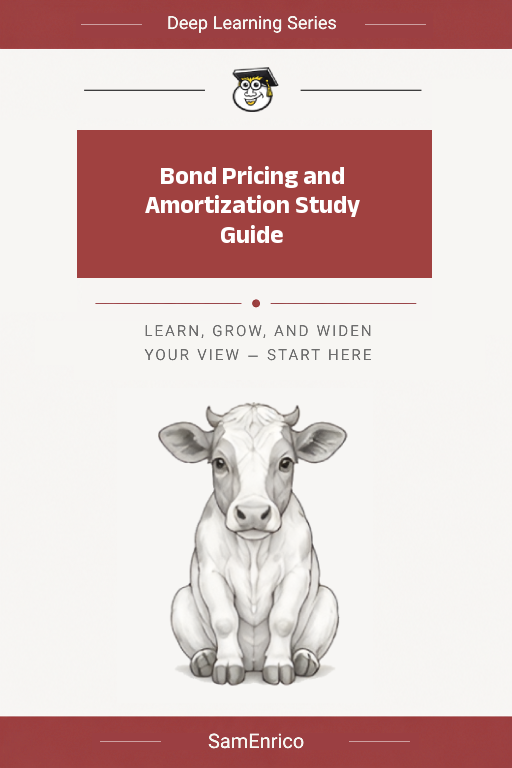
Non-FictionStudent's ShortcutLiabilities
Bond Pricing and Amortization Study Guide eBook
Calculate bond issue price, discount amortization,
by Weems Fae
Calculate bond issue price, discount amortization, and carrying value using effective interest method.
Formats
Free sample
Chapter 1: The Hidden Trap--– In the winter of 1994, a well-respected chief financial officer of a regional bank chain stood before his board of directors to explain a 17millionloss.Thebankhadnotmadeanybadloans.Ithadnotbeenembezzled.Itsbrancheswereprofitable.Yetthelosswasreal,anditstemmedfromsomethingthe CFOhadbelievedheunderstoodcompletely:bonds.Thebankheld17 million loss. The bank had not made any bad loans. It had not been embezzled. Its branches were profitable. Yet the loss was real, and it stemmed from something the CFO had believed he understood completely: bonds.
The bank held 17millionloss.Thebankhadnotmadeanybadloans.Ithadnotbeenembezzled.Itsbrancheswereprofitable.Yetthelosswasreal,anditstemmedfromsomethingthe CFOhadbelievedheunderstoodcompletely:bonds.Thebankheld200 million in long-term bonds issued by the U.S. government, considered the safest investment in the world. When the Federal Reserve unexpectedly raised interest rates six times that year, the market value of those "safe" bonds plummeted. The bank was not forced to sell, but under accounting rules at the time, it had to mark some of those bonds to market, and the resulting loss triggered a breach of its regulatory capital requirements. The CFO resigned three months later.What happened to that bank executive happens to accounting students, finance professionals, and even seasoned investors every single day: they understand the mechanical steps of bond accounting but miss the underlying force that drives everything.
That force is the inverse relationship between interest rates and bond prices. This chapter is not an introduction. It is a trap door. Most people who study bonds learn the definition of stated rate versus market rate, memorize the three pricing rules, and move on. They pass their exams.
They get their certifications. And then, like that CFO, they make expensive mistakes because their knowledge is shallow. This chapter will give you something deeper: an intuition so strong that you will never again look at a bond without instantly knowing whether it trades at a premium or discount, what that means for the issuing company's income statement, and how changes in the economy will affect its value. By the time you finish, you will not merely know the rules—you will feel them in your bones.The Two Rates That Control Everything Every bond ever issued carries two interest rates. One is printed in bold letters on the bond certificate.
The other exists only in the minds of investors and changes by the second. Confusing these two rates is the number one mistake on the CPA exam, the CFA exam, and in real-world financial analysis. Let us make sure you never make it.The stated rate, also called the coupon rate or nominal rate, is the interest rate that determines how much cash the bond issuer will pay the bondholder each period. If a 1,000bondhasastatedrateof81,000 bond has a stated rate of 8% paid annually, the bondholder receives 1,000bondhasastatedrateof880 every year until maturity. The stated rate is a contract.
It does not change. It does not care about the economy, the company's credit rating, or what the Federal Reserve does. It is carved in stone.The market rate, also called the effective rate or yield to maturity, is the rate of return that investors demand to lend money to this specific issuer at this specific moment. Unlike the stated rate, the market rate is alive. It moves constantly based on three forces: the general level of interest rates set by central banks, the creditworthiness of the issuer, and the time remaining until the bond matures.
You cannot see the market rate on the bond certificate. You have to calculate it from the bond's current price. But it is the market rate, not the stated rate, that determines what the bond is actually worth.Here is the most important sentence in this entire chapter: The stated rate determines cash flow. The market rate determines value. If you remember nothing else, remember that.
When a bond is first issued, the stated rate and the market rate are usually very close. The underwriters price the bond so that the stated rate roughly matches what investors demand. But the moment the bond begins trading in the secondary market, the two rates diverge. The stated rate stays fixed. The market rate begins its endless dance.The Inverse Relationship: Why Up Means Down Now we arrive at the principle that separates those who understand bonds from those who merely calculate them: when market interest rates rise, existing bond prices fall.
When market interest rates fall, existing bond prices rise. This is not a theory. It is a mathematical certainty. It emerges from the simple fact that bonds compete for investor dollars.Imagine you own a bond that pays 50peryearininterest.Thatisa550 per year in interest. That is a 5% stated rate on a 50peryearininterest.Thatisa51,000 face value.
You are happy with your investment. Then the Federal Reserve raises interest rates. New bonds are now being issued with a 7% stated rate, paying 70peryear.Askyourself:wouldanyrationalinvestorbuyyourbondfor70 per year. Ask yourself: would any rational investor buy your bond for 70peryear.Askyourself:wouldanyrationalinvestorbuyyourbondfor1,000 when they could buy a new bond for the same price and get 20moreperyear?Ofcoursenot.Tosellyourbond,youmustloweritspriceuntilthebuyer′seffectiveyieldmatchesthenewmarketrate.Ifyoulowerthepriceenough,thebuyermightpay20 more per year? Of course not.
To sell your bond, you must lower its price until the buyer's effective yield matches the new market rate. If you lower the price enough, the buyer might pay 20moreperyear?Ofcoursenot.Tosellyourbond,youmustloweritspriceuntilthebuyer′seffectiveyieldmatchesthenewmarketrate.Ifyoulowerthepriceenough,thebuyermightpay800 for your bond, and at that price, the $50 annual interest represents a 6.25% yield—still below 7%, so you lower it further. Eventually, the price settles where the yield to maturity equals the market rate. That price is always lower than face value when market rates have risen.The reverse is equally true. If market rates fall to 3%, your bond paying $50 per year becomes a treasure.
Investors will bid up its price until the yield to maturity falls to 3%. That price will be above face value. You have just experienced the inverse relationship firsthand.This relationship is not linear. A 1% change in market rates does not produce a 1% change in bond prices, especially for long-term bonds. A 30-year bond might fall 15% or more when rates rise by 1%.
A 2-year bond might fall only 2%. This sensitivity is called duration, and we will explore it in later chapters. For now, focus on the direction: rates up, prices down; rates down, prices up. Burn this into your neural pathways.The Three Pricing Scenarios: Premium, Discount, and Par Armed with the inverse relationship, we can now describe the three possible states of any bond. These states apply both at initial issuance and throughout the bond's life in the secondary market.Scenario One: Par Value (Face Value)A bond sells at par when the stated rate equals the market rate.
If investors demand exactly what the bond promises to pay, there is no reason to adjust the price. A 1,000bondsellsfor1,000 bond sells for 1,000bondsellsfor1,000. The journal entry is simple: debit Cash 1,000,credit Bonds Payable1,000, credit Bonds Payable 1,000,credit Bonds Payable1,000. There is no premium or discount to amortize. Interest expense each period will equal the cash paid.
This is the baseline case—common in stable economic times but rare during periods of rapid change.Scenario Two: Premium (Above Face Value)A bond sells at a premium when the stated rate exceeds the market rate. Investors are willing to pay extra—a premium—to receive above-market interest payments. A 1,000bondmightsellfor1,000 bond might sell…
This is the end of the free sample. Get the eBook to keep going. Buy now
About this book
Details
- Author
- Weems Fae
- Publisher
- SamEnrico
- Language
- English
- Genre
- Non-Fiction, Student's Shortcut, Liabilities
- Released
- 2026-06-01
- Pages (approx.)
- 134
- Available as
- eBook, Audiobook

Read better in the ZLOADR app
Your eBooks on your phone or tablet. Sign in with your SamEnrico account and start reading.
More by Weems Fae
 Keto For Type 2 Diabetes ReversalWeems Fae$11.99
 Service Level Agreements IndiaWeems Fae$11.99
 The Mountain Walking MeditationWeems Fae$11.99
 Legal Professional FlowWeems Fae$11.99
 The Timbuktu Taste: Where Math Meets Mastery in the KitchenWeems Fae$11.99
 How to Produce Camera Digital BacksWeems Fae$11.99
 Human Resources ExpertWeems Fae$11.99
 How to Start a Lubricating Products for Motor Vehicles Business (Beginners Guide)Weems Fae$11.99
You may also like
 Hong Kong Handover 1997Dunn Johnnie$11.99
 Zumba For Postnatal Recovery CourseNeal Christian$11.99
 Zumba for BeginnersLadner Nikia$11.99
 YouTube Comment Mining GuideHumes Pandora$12.99
 Worry Box MeditationCarlin Rudy$11.99
 Workplace Stress MeditationNguyen Lynn$11.99
 Workplace Stress and Sleep RepairHawley Ivory$11.99
 Workplace Perfectionism CureDelaney Jeffry$11.99
 Workplace Injustice Anger GuideWallen Isabelle$11.99
 Work Addiction and Burnout LinkGreenwood Ester$11.99
 Women in Yoga and WellnessBeattie Galina$11.99
 Women in Stand Up ComedyChun Evangeline$11.99