
Non-FictionBusiness BriefFixed Income
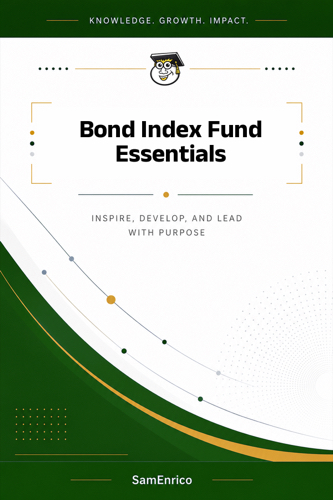
Bond Index Fund Essentials eBook
Covers total bond market index funds, treasury fun
by Lay Ehtel
Covers total bond market index funds, treasury funds, and corporate bond ETFs for income.
Formats
Free sample
Chapter 1: The Loser's Game--–- Most investors lose money in bonds without ever knowing why. They buy a bond fund, watch the price bounce up and down, collect a few coupon payments, and eventually sell – often at exactly the wrong time. Then they blame bonds, or the fund manager, or the Federal Reserve. But the real problem is not any of those things. The real problem is that most people are playing the wrong game entirely.In his classic book Winning the Loser's Game, Charles Ellis made a distinction that forever changed how we think about investing.
In a winner's game, the outcome is determined by the correct actions of the winner. In a loser's game, the outcome is determined by the mistakes made by the loser. Professional tennis is a winner's game – the player who hits more winners wins. Amateur tennis is a loser's game – the player who makes fewer unforced errors wins. Bond investing, Ellis argued, is a loser's game.
The path to success is not making brilliant predictions about interest rates or picking the next high-flying corporate bond. The path to success is simply making fewer mistakes than everyone else.This chapter will show you why bond indexing works, why active management consistently fails in fixed income, and how embracing the "average" can put you in the top 10% of all bond investors over time. By the end, you will understand why the most sophisticated investors in the world – from Warren Buffett to the Yale endowment – use bond index funds for their core fixed-income holdings. And you will never again feel the urge to chase yield, time the market, or pay high fees for underperformance.The Efficient Market Hypothesis Meets Bond Street The Efficient Market Hypothesis (EMH) is one of the most misunderstood and maligned ideas in finance. Critics love to point out that markets are not perfectly efficient – and they are right.
Markets are not perfect. But the relevant question for investors is not whether markets are perfectly efficient. The relevant question is whether markets are efficient enough that professional money managers cannot consistently exploit mispricings after accounting for their fees and trading costs.For bond markets, the evidence is overwhelming: yes, they are efficient enough.Consider what moves bond prices. A bond is a legal promise to pay a stream of future cash flows – coupons and principal. The price of that bond today is simply the present value of those future cash flows, discounted at a rate that reflects three things: the risk-free rate (set by the Federal Reserve and Treasury market), the credit risk of the issuer (the chance they might default), and the liquidity of the bond (how easily you can sell it).
All three of these factors are publicly known or rapidly become known.The risk-free rate is announced by the Federal Reserve and traded in the world's deepest, most liquid market – US Treasuries. Millions of transactions per day immediately incorporate any news about Fed policy into prices. Credit risk is analyzed by dozens of rating agencies (Moody's, S&P, Fitch) and hundreds of buy-side analysts at major asset managers. When a company releases earnings, announces a merger, or takes on new debt, bond traders react within seconds. Liquidity is observable through bid-ask spreads and trading volume.There are no secrets in the bond market.
No back room where undisclosed information sits waiting for a clever investor to exploit. By the time you read about a company's troubles in the Wall Street Journal, the bond price has already adjusted. By the time you hear the Federal Reserve Chair speak, traders have already placed their bets.This is not a theory. This is empirical fact. A landmark study by Yale professor Robert Shiller (who won the Nobel Prize for his work on market efficiency – or rather, the limits of it) found that bond prices move far more than can be explained by changes in future cash flows.
That sounds like evidence of inefficiency. But Shiller's interpretation was the opposite: bond prices move because expected returns change, not because investors have private information about defaults. The movements are rational responses to new information about the economic environment – information that is available to everyone simultaneously.The practical implication is brutal but liberating: nobody can consistently predict interest rates.Think about what that means. The entire active bond management industry – thousands of portfolio managers, analysts, and traders earning hundreds of millions of dollars in fees – is built on the premise that they can predict which way rates will move, which sectors will outperform, and which individual bonds will avoid default. If the market is efficient enough that these predictions have no value, then those fees are not a payment for skill.
They are a tax on ignorance.The Statistical Smackdown: Active Managers Versus the Index The evidence against active bond management is not subtle. It is not ambiguous. It is a statistical beatdown of epic proportions.Standard & Poor's publishes the SPIVA Scorecard twice per year, comparing the performance of active funds to their benchmark indices. The results for bond funds are remarkably consistent across time periods and geographies:Over 5-year periods, approximately 75-85% of active core bond funds underperform the Bloomberg Aggregate Bond Index after fees.Over 10-year periods, the failure rate rises to 85-90%.Over 20-year periods, more than 90% of active bond funds fail to beat their index.Let me state that differently: if you picked an active bond fund at random twenty years ago, you had less than a 10% chance of picking one that beat a simple, low-cost index fund. And that is before taxes – active funds trade more, generating capital gains distributions that hurt taxable investors even more.The small minority of funds that do beat the index in any given period are not consistent winners.
The SPIVA research also tracks "persistence" – whether funds that outperformed in one period continue to outperform. For bond funds, persistence is essentially zero. A fund in the top quartile over the past five years has no better than random odds of being in the top quartile over the next five years. Yesterday's winner is tomorrow's mean reversion candidate.Why does this happen? Three reasons.First, bond returns are compressed.
The expected return of a high-quality bond fund is only 3-5% per year. The standard deviation (volatility) is also low, around 3-5%. In such a low-return, low-volatility environment, fees consume an enormous percentage of the potential return. A 0.50% expense ratio eats 10-15% of a 4% expected return. The active manager has to generate that much alpha just to break even with the index fund.Second, bond markets are dominated by giants who have no informational advantage.
The largest players in the bond market – pension funds, insurance companies, sovereign wealth funds, and central banks – are not trying to beat the market. They are trying to match liabilities, manage duration, or implement monetary policy. They trade for reasons that have nothing to do with mispricing. This creates noise, but not opportunity for active managers because the noise is random.Third, bond indices are rules-based and transparent. Unlike stock indices, which are market-cap weighted and sometimes criticized for including overvalued companies, bond indices have embedded quality screens.
The Bloomberg Aggregate Bond Index, for example, includes only investment-grade bonds (rated BBB- or higher) with at least $300 million…
This is the end of the free sample. Get the eBook to keep going. Buy now
About this book
Details
- Author
- Lay Ehtel
- Publisher
- SamEnrico
- Language
- English
- Genre
- Non-Fiction, Business Brief, Fixed Income
- Released
- 2026-06-08
- Pages (approx.)
- 151
- Available as
- eBook, Audiobook

Read better in the ZLOADR app
Your eBooks on your phone or tablet. Sign in with your SamEnrico account and start reading.
More by Lay Ehtel
 Mining Rescue Team StressLay Ehtel$11.99
 Orchestra Conductor StressLay Ehtel$11.99
 Victory Garden VeteransLay Ehtel$11.99
 The Phantom of the Stock Exchange: Europe's First Serial Financial KillerLay Ehtel$11.99
 Freemium End to End TestingLay Ehtel$12.99
 How to Produce BirdsLay Ehtel$11.99
 Architectural Project ManagerLay Ehtel$11.99
 How to Become a PagerLay Ehtel$11.99
You may also like
 Hong Kong Handover 1997Dunn Johnnie$11.99
 Zumba For Postnatal Recovery CourseNeal Christian$11.99
 Zumba for BeginnersLadner Nikia$11.99
 YouTube Comment Mining GuideHumes Pandora$12.99
 Worry Box MeditationCarlin Rudy$11.99
 Workplace Stress MeditationNguyen Lynn$11.99
 Workplace Stress and Sleep RepairHawley Ivory$11.99
 Workplace Perfectionism CureDelaney Jeffry$11.99
 Workplace Injustice Anger GuideWallen Isabelle$11.99
 Work Addiction and Burnout LinkGreenwood Ester$11.99
 Women in Yoga and WellnessBeattie Galina$11.99
 Women in Stand Up ComedyChun Evangeline$11.99