
Non-FictionAnnual CheckupCorporate Compliance
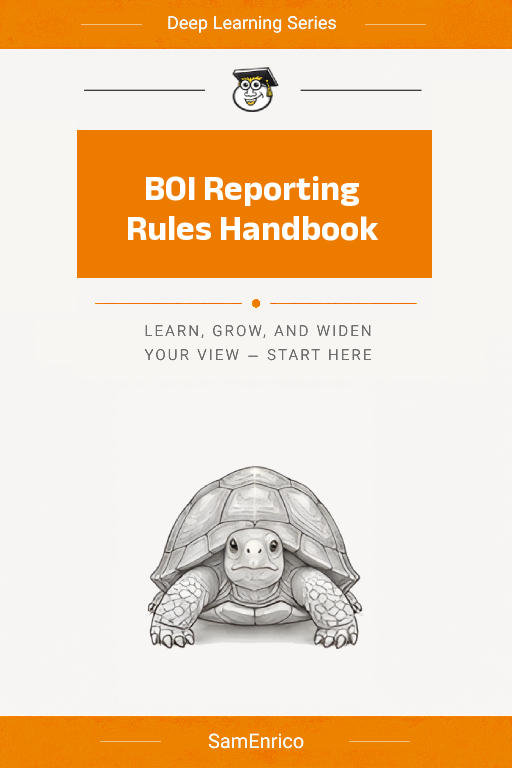
BOI Reporting Rules Handbook eBook
Explains Beneficial Ownership Information reportin
by Means Tiny
Explains Beneficial Ownership Information reporting requirements including who qualifies as beneficial owner and what information must be filed.
Formats
Free sample
Chapter 1: The Great Pivot...--When the clock struck midnight on March 26, 2025, approximately 32 million American business owners unknowingly became compliant with a law they had never heard of. Not because they filed anything. Not because they hired a lawyer. But because the federal government, in a stunning regulatory reversal, simply erased their obligation to exist. The Corporate Transparency Act, passed with bipartisan fanfare in 2021 as the crown jewel of anti-money laundering reform, had been gutted in a single afternoon.
And almost nobody noticed.For the foreign business owner reading this book—perhaps you are sitting in a glass office tower in Frankfurt, a manufacturing plant in Shenzhen, a trading desk in Singapore, or a family-owned vineyard in Bordeaux—that American regulatory earthquake probably seemed like a distant tremor. But it changed everything for you. Not because the rules went away. Because they shrank. And like water finding a new channel, the full force of U.S.
beneficial ownership enforcement now flows directly toward your company.This chapter is called The Great Pivot because that is exactly what happened. The U.S. Treasury's Financial Crimes Enforcement Network, known universally as Fin CEN, performed a strategic retreat. They pulled back from regulating America's 32 million small LLCs, corporations, and partnerships. And they doubled down on the one category of business that remained: foreign entities registered to do business in the United States.
That means you.Before we dive into the legal mechanics of who must report, what information to file, and how to avoid crushing penalties, you need to understand the story behind the rule. Because compliance is not just about checking boxes. It is about understanding why the government wants your data, what they will do with it, and how the political winds might shift again. This chapter provides that foundation. It answers the single most important question every foreign business owner asks when they first hear about BOI reporting: "Why should I care?"The Corporate Transparency Act: A Brief History of a Short-Lived Revolution To understand where we are, you must understand where we were.
In January 2021, Congress passed the Corporate Transparency Act as part of the National Defense Authorization Act. The stated goal was simple and politically unassailable: stop criminals from hiding money behind anonymous shell companies. For decades, anyone could form a limited liability company in Delaware, Wyoming, or Nevada without disclosing who actually owned it. Drug traffickers, fraudsters, tax evaders, and even foreign adversaries used this anonymity to launder billions of dollars through the U.S. financial system.The CTA was supposed to fix that.
Beginning January 1, 2024, most U.S. companies would have to file a Beneficial Ownership Information report with Fin CEN, disclosing the names, addresses, dates of birth, and identification documents of every individual who owned 25% or more or exercised substantial control. The penalty for non-compliance was up to $591 per day and two years in prison. Compliance professionals called it the biggest change to business entity regulation in a generation.Then the lawsuits began. Within weeks of the CTA's effective date, a coalition of small business owners, trade associations, and conservative legal groups filed challenges across the country.
Their argument was straightforward: the CTA exceeded Congress's constitutional authority. The federal government, they argued, had no business mandating that Main Street bakers and plumbers report their personal information to a Treasury database. The case that ultimately mattered was called Texas Top Cop Rule, Inc. v. Garland—named after a small Texas law enforcement trade association that had never filed a single BOI report.In March 2025, after months of conflicting injunctions and appellate stays, the Fifth Circuit Court of Appeals issued a ruling that effectively killed the CTA for domestic entities.
Rather than continue fighting a losing legal battle, Fin CEN issued an Interim Final Rule on March 26, 2025. The rule did two things. First, it removed all reporting requirements for U.S. companies and U.S. persons.
Second, it explicitly retained reporting requirements for foreign entities registered to do business in the United States. The Great Pivot was complete.Why Foreign Entities? The Government's Unanswered Question You might reasonably ask: if the CTA was unconstitutional for a mom-and-pop hardware store in Ohio, why is it constitutional for a German manufacturing company with a U.S. subsidiary? The government's answer, articulated in Fin CEN's public statements and legal briefs, rests on a distinction that sounds technical but matters enormously.The Constitution gives Congress broad power to regulate interstate and foreign commerce.
When a U.S. citizen forms an LLC that never leaves its home state, the connection to interstate commerce is thin. But when a foreign entity registers to do business in the United States—by filing a Certificate of Authority in Delaware, Texas, or California—that entity is explicitly availing itself of the protections and privileges of American commerce. It can sue in U.S. courts.
It can enforce contracts. It can open bank accounts. And with those privileges, the government argues, comes a reciprocal obligation: disclose who really owns and controls you.This is not a new legal theory. Banks have been required to identify their accountholders for decades under the Bank Secrecy Act. Securities brokers must know their customers.
The CTA simply extended that same "know your customer" principle to the entity registration process itself. And unlike a domestic LLC formed by an American citizen, a foreign entity operating in the U.S. is, by definition, engaged in international commerce—squarely within Congress's foreign commerce power.Whether this distinction will survive future legal challenges is an open question. As of 2026, no court has ruled directly on the constitutionality of applying BOI reporting exclusively to foreign entities. But Fin CEN is betting that the narrower scope makes the rule more defensible.
And until a court says otherwise, the rule stands.The Numbers That Matter: From 32 Million to 1.2 Million Let us put the Great Pivot in perspective using numbers that every foreign business owner should memorize.Before March 2025, approximately 32.6 million U.S. companies were potentially required to file BOI reports. This included every corporation, LLC, limited partnership, and similar entity formed under state law, unless specifically exempted. Compliance professionals called it a "tsunami of paperwork." Small business owners called it a nightmare. Fin CEN called it a necessary tool for national security.After March 2025, that universe collapsed to approximately 1.2 million foreign entities registered to do business in the United States.
The reduction is staggering: from 32 million filers to 1.2 million. That is a 96% decrease in the regulatory footprint.But here is what those numbers mean for you. With 96% of the administrative burden removed, Fin CEN can now focus its enforcement resources on the remaining 4% with surgical precision. Every examiner who used to triage millions of U.S. filings is now looking at a much smaller pool.
Every algorithm that scans for inconsistencies has more processing power per filing. Every referral from a suspicious bank or foreign regulator goes to an investigator who is not overwhelmed by volume.In plain English: you are now a big fish in a very small pond. Fin CEN knows it. Your competitors know it. And the law firms that send you compliance notices certainly know it.
The penalty for non-compliance did not decrease when the number of filers decreased. The $591-per-day fine and two-year prison sentence…
This is the end of the free sample. Get the eBook to keep going. Buy now
About this book
Details
- Author
- Means Tiny
- Publisher
- SamEnrico
- Language
- English
- Genre
- Non-Fiction, Annual Checkup, Corporate Compliance
- Released
- 2026-05-29
- Pages (approx.)
- 159
- Available as
- eBook, Audiobook

Read better in the ZLOADR app
Your eBooks on your phone or tablet. Sign in with your SamEnrico account and start reading.
More by Means Tiny
 The Brain Stress CircuitMeans Tiny$11.99
 PSA Velocity Monitoring GuideMeans Tiny$11.99
 Fear Of Failure In Language LearningMeans Tiny$11.99
 Boss Anger Management GuideMeans Tiny$11.99
 The Vanishing of the Lion of Palestine: The 1939 Escape of Izz ad-Din al-QassamMeans Tiny$11.99
 The Emotional Regulation for ADHDMeans Tiny$11.99
 Mulefoot Pig BreedingMeans Tiny$11.99
 How to Start a Accomplished Assistant Business (Beginners Guide)Means Tiny$11.99
 Invoice Factoring Mexico GuideMeans Tiny$12.99
 Understanding Romano–ward SyndromeMeans Tiny$17.99
You may also like
 Hong Kong Handover 1997Dunn Johnnie$11.99
 Zumba For Postnatal Recovery CourseNeal Christian$11.99
 Zumba for BeginnersLadner Nikia$11.99
 YouTube Comment Mining GuideHumes Pandora$12.99
 Worry Box MeditationCarlin Rudy$11.99
 Workplace Stress MeditationNguyen Lynn$11.99
 Workplace Stress and Sleep RepairHawley Ivory$11.99
 Workplace Perfectionism CureDelaney Jeffry$11.99
 Workplace Injustice Anger GuideWallen Isabelle$11.99
 Work Addiction and Burnout LinkGreenwood Ester$11.99
 Women in Yoga and WellnessBeattie Galina$11.99
 Women in Stand Up ComedyChun Evangeline$11.99