
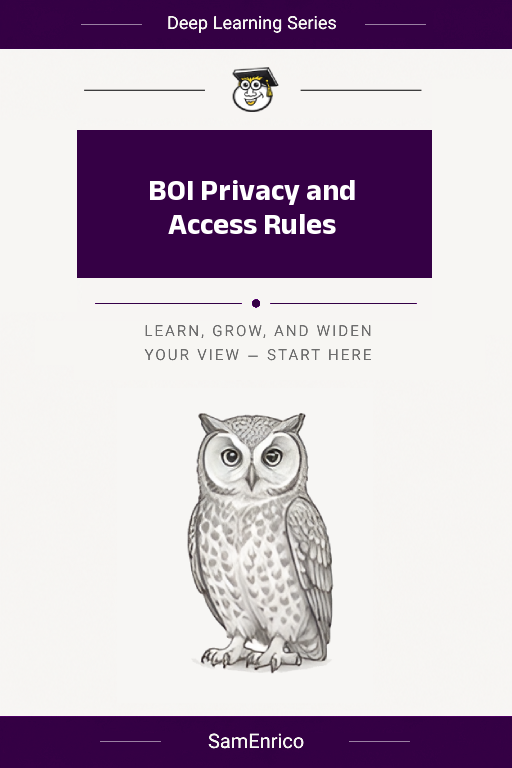
Non-FictionAnnual CheckupData Privacy
BOI Privacy and Access Rules
Understands who can access BOI information under C
by Lea Marcelo
Understands who can access BOI information under CTA including law enforcement, financial institutions, and federal agencies only.
Formats
About this book
Free sample
Chapter 1: The Invisible Registry...--–- The first thing you need to understand about Beneficial Ownership Information is that it does not exist anywhere you can look. Unlike a deed recorded at the county courthouse, a trademark registered with the USPTO, or a lien filed against commercial property, the database at the heart of the Corporate Transparency Act is deliberately, statutorily, and absolutely invisible to the public. This single fact—more than any other—explains why the debate over the CTA has generated more confusion than clarity. Most business owners have spent their entire professional lives operating under the assumption that corporate records are public records. They are not wrong about the past.
They are simply unprepared for the future.For more than two centuries, the American incorporation system operated on a simple principle: if you wanted to know who owned a company, you traveled to the state of incorporation, visited the Secretary of State's office, and pulled the file. In the digital age, that process became instantaneous. Today, anyone with an internet connection and a credit card can search the Delaware Division of Corporations database, pull up the certificate of incorporation for any of the 1.8 million entities registered in that state alone, and see the name of the registered agent, the incorporator, and sometimes the initial directors. What that public record will almost never show you, however, is who actually owns the company.The gap between "who filed the paperwork" and "who controls the money" has been the single most persistent vulnerability in the global financial system for decades. Anonymous shell companies have been used to launder billions of dollars, evade sanctions, finance terrorism, and conceal corruption at the highest levels of government.
The Panama Papers, the Paradise Papers, the Fin CEN Files—each major leak revealed the same structural weakness: the ability to form a legal entity without disclosing the human beings who ultimately own or control it. The Corporate Transparency Act was designed to close that gap, not by making ownership information public, but by creating something entirely new: a non-public, centralized, federally managed database of beneficial ownership…
This is the end of the free sample. Get the eBook to keep going. Buy now
Contents
- Chapter 1
- Chapter 2
- Chapter 3
- Chapter 4
- Chapter 5
- Chapter 6
- Chapter 7
- Chapter 8
- Chapter 9
- Chapter 10
- Chapter 11
- Chapter 12
Details
- Author
- Lea Marcelo
- Publisher
- SamEnrico
- Language
- English
- Genre
- Non-Fiction, Annual Checkup, Data Privacy
- Released
- 2026-06-01
- Pages (approx.)
- 159
- Available as
- eBook, Audiobook

Read better in the ZLOADR app
Your eBooks on your phone or tablet. Sign in with your SamEnrico account and start reading.
More by Lea Marcelo
 International Franchise Young Entrepreneur ProgramLea Marcelo$11.99
 Depression and Alcoholism GuideLea Marcelo$11.99
 Sports Nutrition JournalLea Marcelo$11.99
 Anger Management for TechLea Marcelo$11.99
 The Self Hypnosis for MRI ClaustrophobiaLea Marcelo$11.99
 Golden Fleece: The Laundromat Heist That Bankrupted a DynastyLea Marcelo$11.99
 How to Become a Standards EngineerLea Marcelo$11.99
 Cross Border Invoice FactoringLea Marcelo$12.99
 Understanding Rozin–hertz–goodman SyndromeLea Marcelo$17.99
 New Home Sales RepresentativeLea Marcelo$11.99
You may also like
 Hong Kong Handover 1997Dunn Johnnie$11.99
 Zumba For Postnatal Recovery CourseNeal Christian$11.99
 Zumba for BeginnersLadner Nikia$11.99
 YouTube Comment Mining GuideHumes Pandora$12.99
 Worry Box MeditationCarlin Rudy$11.99
 Workplace Stress MeditationNguyen Lynn$11.99
 Workplace Stress and Sleep RepairHawley Ivory$11.99
 Workplace Perfectionism CureDelaney Jeffry$11.99
 Workplace Injustice Anger GuideWallen Isabelle$11.99
 Work Addiction and Burnout LinkGreenwood Ester$11.99
 Women in Yoga and WellnessBeattie Galina$11.99
 Women in Stand Up ComedyChun Evangeline$11.99