
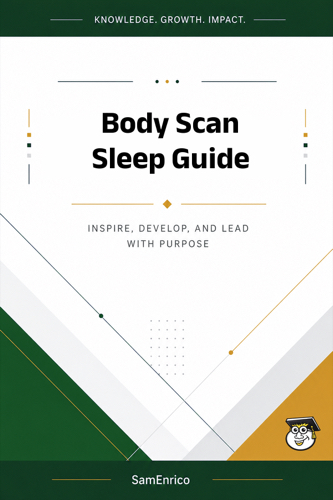
Non-FictionSelf-HelpBody ScanRelaxation
Body Scan Sleep Guide eBook
Release physical tension by moving attention syste
by Urban Kandra
Release physical tension by moving attention systematically through your body.
Formats
Free sample
Chapter 1: The Tension Trap--–- You are about to discover something that will reshape everything you thought you knew about sleep. For years, you have likely believed that insomnia is a problem of the mind. You have tried to quiet your racing thoughts, to meditate your way into calm, to breathe slowly and deliberately until your brain finally surrenders. Perhaps you have lain in the dark for hours, desperately instructing yourself to relax, only to feel your jaw clench tighter and your frustration mount with each passing minute. None of this is your fault.
You have been working with an incomplete map.The truth is startlingly simple and almost never discussed in mainstream sleep advice: your brain cannot fall asleep while your body is broadcasting danger signals. Every clenched muscle, every held breath, every raised eyebrow sends a specific electrical message traveling up through your spinal cord and into your brainstem. That message says one thing: "Not safe yet. Stay alert." And your brain, being a loyal servant of your survival, obeys.This is the Tension Trap. You believe you are trying to fall asleep, but your body believes you are trying to survive a threat.
And as long as those two goals conflict, sleep will remain just out of reach.The Body’s Secret Surveillance System To understand why tension blocks sleep, you need to meet a remarkable nerve that runs from your brainstem all the way down through your neck, chest, and abdomen. It is called the vagus nerve, from the Latin word for "wandering," because it wanders through nearly every major organ system in your body. Think of it as your body's internal surveillance system. Its job is to constantly monitor what is happening below your neck and report back to your brain.Here is what most people do not realize: the vagus nerve cannot distinguish between physical danger and physical tension. It reads muscle tightness as threat.
A clenched jaw? The vagus nerve reports "possible aggression in the area." A tight neck? "Preparing for impact." A held breath? "Oxygen may be scarce—activate emergency protocols."Every single night, millions of people lie in comfortable beds in perfectly safe homes, and their vagus nerves are filing reports that would be appropriate for someone hiding from a predator. The brain receives these reports and dutifully keeps the sympathetic nervous system—your fight-or-flight response—engaged.
Blood pressure stays elevated. Stress hormones like cortisol and adrenaline continue circulating. Heart rate remains slightly too fast. And sleep, which requires the opposite state of deep parasympathetic rest, never arrives.This is not a failure of willpower. It is a failure of communication between your body and your brain.
And it is happening right now, as you read these words, in ways you cannot consciously feel.The Micro-Tensions You Never Notice Most people believe they would know if their body was tense. They imagine tension as a dramatic phenomenon—a screaming headache, a knotted back, shoulders hunched up to the ears. But the tension that steals your sleep is almost invisible. It operates in the realm of the micro, the subtle, the barely perceptible.Close your eyes for a moment. Without moving any muscles, simply notice the space between your eyebrows.
Is it completely smooth, or is there the faintest hint of a furrow? Now notice your jaw. Are your teeth touching? In most people, they are. They do not need to be.
The resting position of the jaw involves a tiny gap between the upper and lower teeth, approximately two to three millimeters. But under chronic stress, that gap disappears. The teeth rest together, not clenching hard enough to hurt, but not relaxing either.Now notice your shoulders. Are they slightly lifted away from your ears? Not in a dramatic shrug, but just a centimeter or two above where gravity would naturally rest them.
Now your breath. Is your chest moving more than your belly? That is a sign that your intercostal muscles—the small muscles between your ribs—are splinted, ready for fast action rather than slow rest.These are micro-tensions. They cost you almost no conscious energy to maintain. They do not hurt.
They do not alarm you. But they are constantly, silently, reporting to your vagus nerve: "Still on guard. Still ready. Not yet safe."And your brain believes them.Why Your Mind Cannot Fix This Alone Perhaps you have tried meditation. Perhaps you have tried cognitive behavioral therapy for insomnia.
Perhaps you have tried repeating mantras, visualizing peaceful scenes, or counting breaths. These approaches share a common assumption: that sleep is a problem of the mind, and therefore the mind must be the solution.Here is the uncomfortable truth that almost no one tells you: cognitive efforts to quiet the mind often make insomnia worse. When you actively try to suppress thoughts, your brain’s monitoring systems actually become more sensitive to those thoughts. This is called ironic process theory—the harder you try not to think of a white bear, the more you think of a white bear. The same applies to sleep.
The harder you try to quiet your mind, the more your mind insists on chattering.But there is a deeper problem. Even if you could perfectly quiet your mind—even if you could achieve a state of complete mental stillness—your body might still be broadcasting tension signals. And as long as those signals continue, your brain cannot initiate the sleep cascade.Think of your body as a locked door and your brain as someone standing outside. Your mind can knock, whisper, plead, and reason with the door all night long. But the door will not open until the lock turns.
The lock is your body’s tension. The key is systematic, non-judgmental attention to physical sensation.This is why the body scan works when other methods fail. It bypasses the thinking mind entirely and speaks directly to the nervous system in its own language: the language of sensation.The Tension-First Rule Let me give you a rule that will serve as your compass throughout this book. I call it the Tension-First Rule: Muscles must surrender before the brain can power down.This rule inverts the common assumption. Most sleep advice suggests that you should calm your mind first, and your body will follow.
The Tension-First Rule says the opposite: release physical tension first, and mental quiet will follow automatically. This is not a philosophical preference. It is a physiological fact. The nerve pathways that carry tension signals upward into the brain are faster and more direct than the pathways that carry relaxation signals downward from the brain. Your body leads.
Your mind follows.To understand why, imagine two communication lines. The first line runs from your muscles and joints up to your brainstem via the spinothalamic tract. It is a high-speed express route, designed for survival. If you touch a hot stove, this line tells your brain to pull your hand back in milliseconds. The second line runs from your brain down to your muscles via the corticospinal tract.
It is important, but slower and more deliberate. It is the difference between an emergency broadcast system and a scheduled newsletter.When you try to…
This is the end of the free sample. Get the eBook to keep going. Buy now
About this book
Details
- Author
- Urban Kandra
- Publisher
- SamEnrico
- Language
- English
- Genre
- Non-Fiction, Self-Help, Body Scan, Relaxation
- Released
- 2026-06-08
- Pages (approx.)
- 151
- Available as
- eBook, Audiobook

Read better in the ZLOADR app
Your eBooks on your phone or tablet. Sign in with your SamEnrico account and start reading.
More by Urban Kandra
 Perineal Massage TechniqueUrban Kandra$11.99
 Career Milestone PressureUrban Kandra$11.99
 Bedtime Regularity For Long LifeUrban Kandra$11.99
 The CPAP Mask Fitting GuideUrban Kandra$11.99
 The Silk Road Gambit: Han Dynasty's War of Expansion (119 BC)Urban Kandra$11.99
 The Breeder's Guide to Chocolate TurkeysUrban Kandra$11.99
 How to Start a Body Building for Motor Vehicles Business (Beginners Guide)Urban Kandra$11.99
 Cape Town Fintech GuideUrban Kandra$12.99
 BOI Reporting for Foreign LLCUrban Kandra$12.99
 CounterintelligenceUrban Kandra$11.99
You may also like
 Hong Kong Handover 1997Dunn Johnnie$11.99
 Zumba For Postnatal Recovery CourseNeal Christian$11.99
 Zumba for BeginnersLadner Nikia$11.99
 YouTube Comment Mining GuideHumes Pandora$12.99
 Worry Box MeditationCarlin Rudy$11.99
 Workplace Stress MeditationNguyen Lynn$11.99
 Workplace Stress and Sleep RepairHawley Ivory$11.99
 Workplace Perfectionism CureDelaney Jeffry$11.99
 Workplace Injustice Anger GuideWallen Isabelle$11.99
 Work Addiction and Burnout LinkGreenwood Ester$11.99
 Women in Yoga and WellnessBeattie Galina$11.99
 Women in Stand Up ComedyChun Evangeline$11.99