
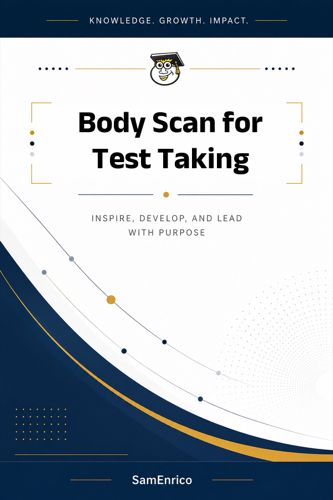
Non-FictionSelf-HelpTest Anxiety
Body Scan for Test Taking eBook
Reduce exam anxiety with seated, eyes-open body aw
Reduce exam anxiety with seated, eyes-open body awareness.
Formats
Free sample
Chapter 1: The Calming Trap--–- Maria had done everything right. For three months, she had attended every study group, completed every practice test, and reviewed every flashcard. The night before her graduate school entrance exam, she slept eight full hours. She ate a balanced breakfast. She arrived at the testing center forty-five minutes early.
When she sat down at the small plastic desk, she took a deep breath and whispered to herself the words every anxious test-taker has whispered since the beginning of time: "Just calm down."That was the moment everything fell apart.By the time she reached question seventeen, her heart was hammering against her ribs like a trapped bird. Her vision narrowed to a tunnel. The words on the screen blurred into a gray soup. She could feel the proctor’s footsteps behind her, could hear the relentless clicking of other students’ mice, could taste the metallic tang of adrenaline on her tongue. She tried again: "Calm down.
Just calm down." But the command only made things worse. Her breathing grew shallower. Her thoughts spiraled: Why can’t I calm down? What’s wrong with me? I’m going to fail.
Everyone else is fine. I’m the only one falling apart.She walked out of that exam certain she had failed. And the cruelest part? She knew the material cold. The answers were somewhere inside her, buried beneath an avalanche of physiological chaos that she had accidentally triggered by trying to do the very thing everyone had told her to do: calm down.This chapter is for every student who has ever sat in a testing room, felt their body betray them, and made the problem worse by fighting it.
You are about to learn why telling yourself to calm down is one of the most effective ways to stay anxious—and what to do instead.The Great Misunderstanding For decades, test-taking advice has been dominated by a single, seemingly reasonable assumption: anxiety is bad, calm is good, and the path to better scores is to replace the former with the latter. Breathe deeply. Relax your muscles. Think positive thoughts. These strategies appear in countless test-prep books, You Tube videos, and well-meaning parental lectures.
They are not wrong, exactly. But they are almost always incomplete, and for many students, they actively backfire.To understand why, we need to look at what happens inside your body when you sit down for a high-stakes exam. Your nervous system does not know the difference between a predator and a pop quiz. Evolution shaped your fight-or-flight response for physical threats: a tiger in the bush, a rival tribe, a fall from a cliff. When your brain perceives danger—and a test that will determine your future absolutely qualifies—it floods your bloodstream with adrenaline and cortisol.
Your heart rate increases to pump oxygen to your muscles. Your breathing quickens to take in more oxygen. Your pupils dilate to improve visual acuity. Your digestive system slows down to conserve energy. None of this is a mistake.
None of this is a bug. This is your body preparing to perform.Here is the radical reframe at the heart of this book: that activation is not your enemy. It is your engine. The problem is not that your engine is revving. The problem is that you keep interpreting the revving as a sign that the car is about to explode.The Yerkes-Dodson Curve: Your Performance Map In 1908, psychologists Robert Yerkes and John Dodson made a discovery that should be taught in every school but somehow is not.
They found that the relationship between arousal (physiological activation) and performance is not a straight line. It is an inverted U. Picture a hill. On the left side of the hill, arousal is very low—you are bored, drowsy, understimulated. Performance is poor because you do not care enough to focus.
As arousal increases, performance climbs. You become alert, engaged, sharp. At the very top of the hill, you are in the zone: fully activated but not overwhelmed. This is peak performance. But if arousal continues to increase past that optimal point, performance begins to fall.
You become jittery, distracted, overwhelmed. Your working memory starts to fail. At the far right of the curve, arousal is so high that you panic. Performance collapses entirely.Here is what most people get wrong about this curve. They assume that test anxiety means you are on the right side of the hill—overaroused to the point of impairment.
And sometimes that is true. But just as often, students are actually on the left side of the hill. They are underaroused. They are bored. They are sleepy.
And they mistake that low-energy state for calmness. Then they try to relax further, pushing themselves even further left, deeper into underperformance.This is the first crack in the Calming Trap. Relaxation is not always your friend during a test. Deep relaxation—the kind you would use before bed or during a massage—lowers your arousal level. If you are already on the left side of the curve, relaxation makes you worse.
If you are on the optimal part of the curve, relaxation knocks you off the peak. Only if you are on the far right side of the curve—genuinely panicking—does lowering arousal help. And even then, the goal is not to become deeply relaxed. The goal is to return to the moderate arousal zone.The Catastrophic Appraisal Problem But there is a second, even more insidious reason that telling yourself to calm down fails. It has to do with how your brain interprets bodily sensations.Let us return to Maria.
When her heart started racing during question seventeen, she did not simply notice the sensation. She appraised it. Her brain asked: What does this mean? And because she was in a testing situation she cared deeply about, because she had a history of anxiety, because she had been told that calmness was the only acceptable state, her brain answered: This means something is wrong. This means I am failing.
This means I am not good enough.Psychologists call this catastrophic appraisal. It is the process of misreading normal physiological signals as evidence of disaster. A racing heart becomes "I'm having a heart attack." A blank mind becomes "I have lost all my knowledge forever." A dry mouth becomes "Everyone can see how nervous I am." The sensation itself is neutral. The story you attach to it is what causes suffering.Here is the cruel irony: when you tell yourself to calm down, you are implicitly agreeing that the current state is unacceptable. You are validating the catastrophe.
Your brain hears "calm down" and thinks, Oh no, we really are in danger, because the conscious mind is trying to override the automatic nervous system. That never happens unless things are truly bad. The command to calm down becomes additional evidence of threat. Your arousal increases further. The spiral tightens.The Relaxation Paradox Researchers have documented this phenomenon for decades.
In one well-known study, participants with high test anxiety were instructed to "relax" before a difficult exam. Compared to a control group that received no instructions, the "relax" group performed worse. Their…
This is the end of the free sample. Get the eBook to keep going. Buy now
About this book
Details
- Author
- Brower Nancee
- Publisher
- SamEnrico
- Language
- English
- Genre
- Non-Fiction, Self-Help, Test Anxiety
- Released
- 2026-06-08
- Pages (approx.)
- 147
- Available as
- eBook, Audiobook

Read better in the ZLOADR app
Your eBooks on your phone or tablet. Sign in with your SamEnrico account and start reading.
More by Brower Nancee
 Active Recall Memory WorkbookBrower Nancee$11.99
 Cape Town B2B Sales PlaybookBrower Nancee$11.99
 Testosterone Therapy Cost GuideBrower Nancee$11.99
 Assertiveness Training for Quiet TeamsBrower Nancee$11.99
 The Last Transmission: How the Arecibo Telescope Fell SilentBrower Nancee$11.99
 The Last Patient of Dr. Barnard: A Heart Transplant RevolutionBrower Nancee$11.99
 How to Start a Motor Bike Taxi Service Business (Beginners Guide)Brower Nancee$11.99
 Finding PR Jobs In AustraliaBrower Nancee$12.99
 Dairy Cooperative Operations GuideBrower Nancee$12.99
 Understanding Charcot–Marie–tooth Disease, Intermediate FormBrower Nancee$17.99
 Fda Audit PreparationBrower Nancee$11.99
You may also like
 Hong Kong Handover 1997Dunn Johnnie$11.99
 Zumba For Postnatal Recovery CourseNeal Christian$11.99
 Zumba for BeginnersLadner Nikia$11.99
 YouTube Comment Mining GuideHumes Pandora$12.99
 Worry Box MeditationCarlin Rudy$11.99
 Workplace Stress MeditationNguyen Lynn$11.99
 Workplace Stress and Sleep RepairHawley Ivory$11.99
 Workplace Perfectionism CureDelaney Jeffry$11.99
 Workplace Injustice Anger GuideWallen Isabelle$11.99
 Work Addiction and Burnout LinkGreenwood Ester$11.99
 Women in Yoga and WellnessBeattie Galina$11.99
 Women in Stand Up ComedyChun Evangeline$11.99