
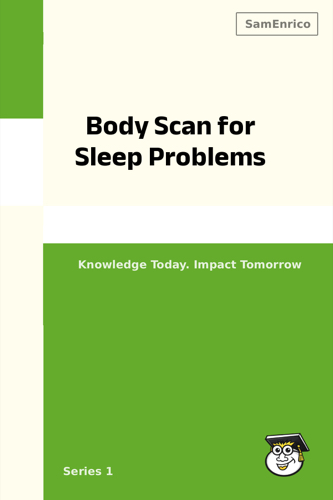
Body Scan for Sleep Problems eBook
Uses progressive body relaxation to quiet racing t
by Starr Yuette
Uses progressive body relaxation to quiet racing thoughts before bed.
Formats
Free sample
Chapter 1: The Insomnia Trap--–- You are lying in bed. The room is dark. The temperature is cool. Your pillow is perfectly fluffed. You have done everything right.
You avoided caffeine after 2 PM. You put away your phone an hour ago. You even tried that breathing app your friend recommended. And yet, here you are—staring at the ceiling, watching the minutes tick by on the alarm clock, feeling your heart beat a little faster each time you realize you are still awake.If this scenario feels familiar, you are not alone. Approximately 30 to 40 percent of adults report some degree of insomnia each year, and for about 10 percent, it becomes a chronic condition that lasts for months or even years.
But here is the paradox that most sleep books get wrong: you are not awake because you are alert. You are awake because you are trying to be asleep.This chapter will introduce you to the single most important concept in this entire book: the insomnia loop. Understanding this loop is not optional. If you skip this chapter and jump straight to the body scan techniques in Part 3, you will be practicing the right tool for the wrong reason. You will become someone who knows how to scan but not why the scan works.
And without the why, the how will fail the moment you face a bad night.So let us begin by dismantling everything you think you know about your racing mind.The Myth of the Tired Body Most people believe that sleep is a passive process—like a dimmer switch that slowly lowers until the lights go out. You get tired, you go to bed, and sleep arrives like a guest who knocks politely. When sleep does not arrive, the assumption is that you were not tired enough. You should have exercised more. You should have woken up earlier.
You should have skipped that afternoon coffee.This is wrong.Insomnia is not a disorder of tiredness. It is a disorder of hyperarousal. Hyperarousal means that your brain’s threat detection system—centered in a small, almond-shaped structure called the amygdala—remains active even when your body is exhausted. Your muscles ache for rest. Your eyelids are heavy.
Your brain, however, is acting as if a predator is hiding in the corner of the room.Here is what hyperarousal feels like in practice:You are exhausted all day, but the moment your head hits the pillow, your mind starts racing.You wake up in the middle of the night with your heart pounding for no apparent reason.You lie still, trying to relax, but you can feel your pulse in your temples, your neck, your wrists.The more you try to calm down, the more alert you become.This last point is the cruelest trick of insomnia. The effort to sleep generates the very wakefulness you are trying to eliminate. It is called paradoxical intention, and it is the engine that drives the insomnia loop.The Paradox of Trying to Sleep Let me ask you a question. Can you deliberately lower your own blood pressure by trying really, really hard? No.
In fact, trying hard to lower your blood pressure will raise it. The same principle applies to sleep. Sleep is an automatic physiological process, like digestion or wound healing. You cannot force it. You can only create the conditions for it to occur and then get out of the way.But here is where the paradox deepens.
When you have struggled with insomnia for weeks or months, you develop a powerful motivation to control sleep. You go to bed early to "catch up." You lie perfectly still to "save energy." You monitor every sensation in your body, looking for the first sign of drowsiness. Each of these behaviors is an act of effort. And each act of effort signals to your brain that something is wrong—that you are in danger of not sleeping, and therefore must take action.Your brain interprets effort as a sign of threat. When you are safe and relaxed, you do not need to try.
You simply rest. When you are trying, your sympathetic nervous system (the fight-or-flight branch) activates. Your heart rate increases. Your muscles tense. Your pupils dilate.
Your brain releases cortisol and adrenaline. You are now physiologically prepared to run from a tiger, not to fall asleep.This is the insomnia trap. You try to sleep. Trying wakes you up. Waking up makes you try harder.
Trying harder wakes you up more. The loop feeds itself.The Mind-Body Bridge: Where Anxiety Lives Now let us add one more layer of complexity. Hyperarousal is not purely physical. It has a cognitive component, which we usually call racing thoughts. You have experienced this: you lie down, and within minutes, your mind is rehearsing tomorrow’s presentation, replaying an argument from three years ago, or generating catastrophic predictions about your health, your relationships, or your career.Most approaches to insomnia focus exclusively on these thoughts.
They tell you to “think positive” or “challenge your negative beliefs” or “practice gratitude.” These strategies fail for a simple reason: during hyperarousal, the prefrontal cortex—the part of your brain responsible for logic, reasoning, and cognitive reappraisal—is partially offline. You cannot reason your way out of a state that has disabled your reasoning center.This book takes a different approach. We will not fight your thoughts directly. Instead, we will target the somatic expression of anxiety—the physical sensations that accompany every racing thought.Here is what I mean. Anxiety is cognitive, but it always expresses itself as somatic.
When you worry, your chest tightens. When you rehearse a stressful conversation, your jaw clenches. When you catastrophize about the future, your breathing becomes shallow. These physical changes are not side effects of anxiety. They are anxiety.
The thought and the sensation are two sides of the same coin.The body scan works because it addresses the somatic side of the coin. By directing your attention to physical sensations—the temperature of your feet, the pulse in your hands, the weight of your body against the mattress—you interrupt the loop at its most vulnerable point. You cannot think a racing thought and track a physical sensation at the same time. Attention is a single spotlight. Where you point it matters.The Three Layers of the Insomnia Loop Let me make this concrete.
The insomnia loop operates on three levels. Each level feeds the next. Understanding these levels is the first step toward breaking the loop.Level One: The Trigger The trigger is the initial event that prevents sleep. It could be external (a loud noise, a hot room, caffeine) or internal (a stressful thought, physical pain, hormonal changes). The trigger itself is often unavoidable and not necessarily problematic.
Everyone experiences triggers. The problem is not the trigger; it is what happens next.Level Two: The Response The response is your reaction to the trigger. For someone without chronic insomnia, the response might be a brief moment of wakefulness followed by a return to sleep. For someone with chronic insomnia, the response is hyperarousal: increased heart rate, muscle tension, shallow breathing, and a cascade of racing thoughts.…
This is the end of the free sample. Get the eBook to keep going. Buy now
About this book
Details
- Author
- Starr Yuette
- Publisher
- SamEnrico
- Language
- English
- Genre
- Non-Fiction, Self-Help, Insomnia
- Released
- 2026-06-09
- Pages (approx.)
- 138
- Available as
- eBook, Audiobook

Read better in the ZLOADR app
Your eBooks on your phone or tablet. Sign in with your SamEnrico account and start reading.
More by Starr Yuette
 Self Hypnosis for Prostatitis PainStarr Yuette$11.99
 Collaborative Sketching GuideStarr Yuette$11.99
 Shoulder Shrug MeaningStarr Yuette$11.99
 Small Talk for Farmers MarketsStarr Yuette$11.99
 Self Esteem for DoctorsStarr Yuette$11.99
 Parental Anger Self ForgivenessStarr Yuette$11.99
 Design Thinking for Product DesignStarr Yuette$11.99
 The Hollow Crown: When a King Refused to DieStarr Yuette$11.99
 The Iron Trail: Sandford Fleming and the Birth of Canada's Transcontinental RailwayStarr Yuette$11.99
 A Collector's Handbook to the Steyr 16Starr Yuette$11.99
 Launching A Youtube Channel For Your Brand ShortcutsStarr Yuette$12.99
 UNESCO Africa Scholarship GuideStarr Yuette$12.99
You may also like
 Insomnia and ForgetfulnessKeaton Briana$11.99
 Body Scan For Sleep InsomniaBrittain Mozell$11.99
 Metta For Sleep DifficultiesDelarosa Marlen$11.99
 Benzo Insomnia RecoveryDarnell Joselyn$11.99
 Mindfulness Meditation for Insomnia WorkbookCoronado Danette$11.99
 MBSR for InsomniaCisneros Heriberto$11.99
 Dream Journal For InsomniaLunsford Karan$11.99
 Nightmare Processing For Insomnia With Nightmares CourseHoughton Rosario$11.99
 Insomnia Relief MeditationStephens Hannah$11.99
 Guided Body Scan for SleepCoronado Annamaria$11.99
 Body Scan For Insomnia ReliefHayward Telma$11.99
 Sleep Meditation for Night AnxietyHedrick Vasiliki$11.99