
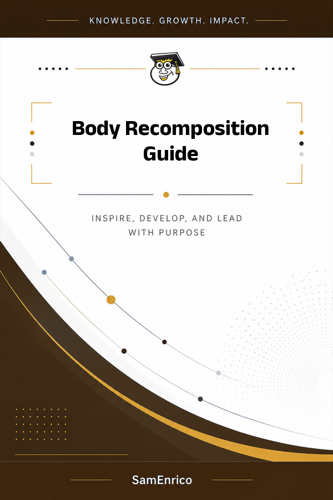
Non-FictionHealth & WellnessBody
Body Recomposition Guide eBook
Teaches simultaneous fat loss and muscle gain.
by Wooten Wen
Teaches simultaneous fat loss and muscle gain.
Formats
Free sample
Chapter 1: The Scale’s Deception--–- Step onto the scale. Look at the number. Now ask yourself: does that number tell you how much muscle you have? Does it reveal how much visceral fat surrounds your organs? Can it distinguish between a pound of adipose tissue and a pound of contractile, metabolically active muscle?
The answer, of course, is no. Yet for decades, the fitness and weight loss industries have conditioned you to believe that this single, crude measurement is the ultimate arbiter of your success or failure. You have been taught to celebrate when the number goes down and to despair when it goes up, all while remaining completely blind to the single most important metric of genuine health and physical transformation: your body composition.This chapter exists to liberate you from that deception. The scale is not your enemy, but it is a profoundly unreliable narrator. It tells a story of weight gain and weight loss, but it cannot tell the story of recomposition—the simultaneous process of shedding fat while building muscle.
And that process, as you will learn throughout this book, is the only sustainable path to a leaner, stronger, more resilient body. Before we dive into the how of nutrition timing, protein thresholds, progressive overload, and metabolic conditioning, we must first establish the why. Why does traditional weight loss almost always fail in the long term? Why do so many people lose twenty pounds only to gain back thirty? And most importantly, who is best positioned to achieve the holy grail of body transformation: losing fat and gaining muscle at the exact same time?The Weight Loss Paradigm: A Broken Promise For the better part of a century, the dominant narrative around changing your body has been remarkably simple: eat less, move more, and the scale will go down.
This is the Weight Loss Paradigm. It is built upon the calorie balance equation, which states that body weight changes when energy intake (calories consumed) does not equal energy expenditure (calories burned). On paper, this is thermodynamics. It is not wrong. But it is dangerously incomplete.Here is what the Weight Loss Paradigm does not tell you.
When you restrict calories aggressively—cutting 500, 800, or even 1,000 calories below your maintenance level—your body does not simply burn fat and disappear it into the ether. Your body is a survival machine, honed by millions of years of evolution to defend against starvation. When you create a large and sustained calorie deficit, your body responds by reducing its metabolic rate. It burns fewer calories at rest. It becomes more efficient at storing energy.
And crucially, it begins to break down muscle tissue for fuel. Muscle is metabolically expensive to maintain. From a survival perspective, your body would rather burn that expensive muscle and hold onto fat, which is your long-term energy reserve.This is the dirty secret of the Weight Loss Paradigm. Most people who lose significant weight through calorie restriction alone lose a substantial amount of muscle along with fat. They may look smaller on the outside, but their body composition has shifted toward a higher fat-to-muscle ratio.
Their resting metabolic rate drops. And when they eventually return to normal eating—as nearly everyone does, because severe restriction is not sustainable—they regain fat rapidly. But because their metabolic rate is now lower than it was before the diet, they often end up at a higher body fat percentage than when they started. This phenomenon is so common that it has a name: weight cycling, or more colloquially, yo-yo dieting.The Body Recomposition Paradigm: A Different Question Now consider an alternative. What if you stopped asking, "How do I lose weight?" and started asking, "How do I change what my body is made of?" This is the Body Recomposition Paradigm.
The goal is no longer a lower number on the scale. The goal is a lower body fat percentage and a higher lean muscle mass. The scale may stay exactly the same, yet you could be radically healthier, leaner, and more capable. Or the scale may go down slightly, but the change in your body composition could be dramatic. Or, in some cases, the scale may even go up as you build dense muscle while losing fat—a scenario that the Weight Loss Paradigm would incorrectly label as failure.Body recomposition is not magic.
It is biology. But it requires you to work with your body's hormonal and metabolic systems rather than against them. Instead of starving yourself into a metabolic slowdown, you will learn to manipulate nutrient timing, protein intake, training volume, and recovery to send a clear signal to your body: build muscle, burn fat, and do both simultaneously. This is harder than simply eating less. It requires more precision, more effort in the gym, and more attention to variables like sleep and stress.
But it is also the only approach that produces permanent, sustainable change.The Recomposition Zone: Who Can Build Muscle and Burn Fat at the Same Time?Not everyone is equally capable of simultaneous fat loss and muscle gain. The research literature identifies three specific populations that fall into what we will call the Recomposition Zone—the sweet spot where the body is most responsive to the dual signals of muscle-building and fat-burning.The first population is new trainees. If you have never followed a structured resistance training program, your body is highly sensitive to anabolic stimuli. The novice effect is real and powerful. In the first several months of proper training, beginners can often build significant muscle even while in a calorie deficit, because their muscles are responding to a completely new stimulus.
The body prioritizes adaptation to this new demand over energy conservation. This is why someone who starts lifting weights while eating at maintenance or a modest deficit can see dramatic changes in body composition without ever changing their body weight.The second population is de-trained individuals. If you previously trained consistently for months or years and then took an extended break (several months or longer), you retain something called muscle memory. The myonuclei that were added to your muscle fibers during your previous training do not disappear when you stop training. When you resume lifting, those existing myonuclei allow you to rebuild muscle far more quickly than a true beginner.
This accelerated re-building can occur even in a calorie deficit, making de-trained individuals excellent candidates for recomposition.The third population is individuals with moderately elevated body fat. Note the word moderately. This is a critical clarification that is often omitted in discussions of recomposition. If you carry excess body fat in the range of approximately 20-30% for men or 25-35% for women, you have ample stored energy that can theoretically be used to fuel muscle growth even while you are in a calorie deficit. Your body can draw upon fat stores to make up the energy shortfall while dietary protein provides the raw materials for muscle repair and growth.
However, a ceiling does exist. Individuals with very high body fat—obese range, approximately 35% or higher for men and 40% or higher for women—often have hormonal profiles that impede muscle growth. They may have poor insulin sensitivity, elevated cortisol, and…
This is the end of the free sample. Get the eBook to keep going. Buy now
About this book
Details
- Author
- Wooten Wen
- Publisher
- SamEnrico
- Language
- English
- Genre
- Non-Fiction, Health & Wellness, Body
- Released
- 2026-06-06
- Pages (approx.)
- 127
- Available as
- eBook, Audiobook

Read better in the ZLOADR app
Your eBooks on your phone or tablet. Sign in with your SamEnrico account and start reading.
More by Wooten Wen
 UAE Weekend Schedule AwarenessWooten Wen$11.99
 End Of Workday RitualWooten Wen$11.99
 Merit Scholarship Immigrant StoryWooten Wen$11.99
 Silent Brainstorming MethodWooten Wen$11.99
 Parental Anger After DivorceWooten Wen$11.99
 Dream Technology LogWooten Wen$11.99
 Small Talk for Sales ProfessionalsWooten Wen$11.99
 Frost and Ember: The Troll King’s Hidden HeartWooten Wen$11.99
 The Bone Orchard Rebellion: How a Forgotten Cult Defied an EmpireWooten Wen$11.99
 How to Produce Officiating UniformsWooten Wen$11.99
 How to Produce a Coa De JimaWooten Wen$11.99
 A Collector's Handbook to the Standard Avon (1935-37)Wooten Wen$11.99
You may also like
 Hong Kong Handover 1997Dunn Johnnie$11.99
 Zumba For Postnatal Recovery CourseNeal Christian$11.99
 Zumba for BeginnersLadner Nikia$11.99
 YouTube Comment Mining GuideHumes Pandora$12.99
 Worry Box MeditationCarlin Rudy$11.99
 Workplace Stress MeditationNguyen Lynn$11.99
 Workplace Stress and Sleep RepairHawley Ivory$11.99
 Workplace Perfectionism CureDelaney Jeffry$11.99
 Workplace Injustice Anger GuideWallen Isabelle$11.99
 Work Addiction and Burnout LinkGreenwood Ester$11.99
 Women in Yoga and WellnessBeattie Galina$11.99
 Women in Stand Up ComedyChun Evangeline$11.99