
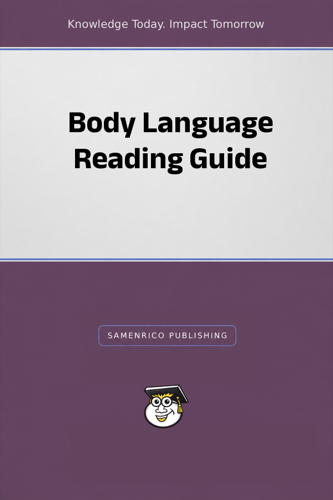
Non-FictionSelf-HelpBody Language
Body Language Reading Guide eBook
Teaches how to interpret gestures, posture, and fa
Teaches how to interpret gestures, posture, and facial expressions.
Formats
Free sample
Chapter 1: The Limbic Lighthouse--–- Every moment of every day, your brain is running two parallel conversations. The first is verbal, slow, deliberate, and easily manipulated. The second is nonverbal, lightning-fast, subconscious, and remarkably honest. You have been fluent in this second language since birth, yet no one ever taught you its grammar. This book will change that.Imagine standing on a rocky shoreline at midnight.
Far in the distance, a lighthouse beam sweeps across the dark water. That beam is your conscious mind—intermittent, narrow, only illuminating what you deliberately aim it at. But beneath the surface, invisible to you, the ocean’s currents move with unerring precision, responding to the moon’s gravitational pull. That is your limbic system: constant, powerful, and largely beyond your control. Every twitch of a finger, every shift in posture, every micro-expression that flickers across a face—these are the currents.
And once you learn to read them, you will see what people are actually feeling before their conscious mind has a chance to lie about it.This chapter establishes the biological and evolutionary foundation for everything that follows. You will learn why your body rarely lies, what the limbic brain actually does, how ancient survival mechanisms—freeze, flight, and fight—manifest in modern boardrooms and bedrooms, and why the single most important distinction you will ever make is between comfort and discomfort. Most critically, you will learn what this book cannot do: read minds, detect lies with absolute certainty, or turn you into a human polygraph machine. Nonverbal communication is probabilistic, not deterministic. That is not a weakness.
It is the beginning of wisdom.The Great Misconception: Why Pop Culture Lie Detection Is Dangerous Before we discuss what body language can do, we must first clear away the wreckage of what it cannot. Popular television shows, You Tube body language experts, and airport bookstore paperbacks have done tremendous damage to the public understanding of nonverbal communication. They promise a "Pinocchio gesture"—a nose touch, a gaze aversion, a crossed arm—that invariably signals deception. This is not merely oversimplified. It is dangerously wrong.Consider a 2019 meta-analysis published in the journal Psychological Bulletin, which reviewed over 200 studies on deception detection.
The authors concluded that no single nonverbal behavior is reliably associated with lying across more than a small fraction of the population. Some liars touch their faces. Others freeze completely. Still others become more expressive. The idea that "liars look up and to the left" or "liars touch their noses" has been thoroughly debunked by replication studies.Why does this myth persist?
Because it is comforting to believe that deception leaves an obvious, readable trace. It would be wonderful if every dishonest salesperson, unfaithful partner, or disingenuous politician gave themselves away with a tell-tale scratch. But human beings are far more complex than poker players, and real-world deception is far messier than television scripts.This book takes a different approach, one grounded in the actual science of the limbic brain and decades of field research by former FBI agents like Joe Navarro, neuropsychologists like Paul Ekman, and social psychologists like Peter Collett. We will not teach you a list of "lie signs." Instead, we will teach you to detect changes in emotional state—specifically, shifts from a person's baseline comfort to observable discomfort. Whether that discomfort signals deception, anxiety, disagreement, or simply a stomach ache is for you to determine through context and further questioning.
But the first step is always the same: learn to see the shift.The Limbic Brain: Your Honest Narrator To understand body language, you must understand the organ that produces it: the brain. Not the neocortex—the wrinkled outer layer responsible for language, logic, and conscious thought—but the older, deeper, more primitive limbic system.The limbic system is a set of structures located near the brain’s core, including the amygdala (emotional processing), the hippocampus (memory formation), and the hypothalamus (automatic bodily functions). Evolutionarily, it is ancient. Every mammal has one. Its job has not changed in a hundred million years: keep the organism alive by rapidly detecting threats and rewards, and by initiating survival behaviors before conscious thought has time to deliberate.Here is the critical insight for the body language reader: the limbic system reacts to stimuli approximately 200 to 300 milliseconds faster than the neocortex.
That is not much time—about the duration of a single heartbeat—but it is enough. It is enough for a micro-expression of fear to flash across a face before a neutral mask is applied. It is enough for a person to lean back in discomfort before they catch themselves and force a smile. It is enough for feet to point toward an exit before the conscious mind has decided to leave.This timing asymmetry is the entire foundation of nonverbal communication. The limbic system cannot lie because it does not know how.
It operates below the threshold of conscious control, responding directly to sensory input with ancient, hardwired programs. When you see a spider on your pillow, you do not think, "I shall now experience fear and consider withdrawing my hand." Your hand is already moving before the thought forms. That is the limbic system in action.In social interactions, the same process occurs. When your boss makes a passive-aggressive comment about your performance, your limbic system reacts instantly—perhaps with a micro-expression of contempt, perhaps with a sudden shallowing of breath, perhaps with a tensing of the jaw. Your conscious mind, meanwhile, is busy crafting a professional response: "Thank you for the feedback, I’ll work on that." The body told the truth.
The mouth lied. And you, as an observer, must learn to trust the body.The Survival Trinity: Freeze, Flight, Fight The limbic system’s survival programs can be grouped into three basic responses, which I call the Survival Trinity. Understanding these responses in their original evolutionary context—and then learning to recognize their modern, socially acceptable derivatives—is essential.Freeze. The oldest and most fundamental response. When a predator might have detected you, the best strategy was to stop moving entirely.
A frozen animal blends into the background and may be overlooked. In modern humans, freezing manifests as sudden stillness, shallow breathing, and reduced blinking. You see it when a child is caught stealing a cookie and stands motionless. You see it in job interviews when a candidate is asked a difficult question and their hands suddenly stop moving. You see it in negotiations when a surprising price is quoted and the other person goes rigid.
Freezing is the limbic system’s way of saying, "If I do not move, maybe this threat will not notice me."Flight. When freezing fails or is inappropriate, the next response is to create distance from the threat. In the wild, this meant running. In modern life, flight is often metaphorical or partial. A person may lean away from someone they dislike, turn their torso toward an exit, place a purse or briefcase as a barrier, or simply break eye contact and look toward the door.
Feet are particularly honest indicators of flight intention—a subject we will explore in depth in Chapter 5. When you see someone's body oriented away…
This is the end of the free sample. Get the eBook to keep going. Buy now
About this book
Details
- Author
- Mattison Lupe
- Publisher
- SamEnrico
- Language
- English
- Genre
- Non-Fiction, Self-Help, Body Language
- Released
- 2026-06-06
- Pages (approx.)
- 129
- Available as
- eBook, Audiobook

Read better in the ZLOADR app
Your eBooks on your phone or tablet. Sign in with your SamEnrico account and start reading.
More by Mattison Lupe
 Plan B Effectiveness TimelineMattison Lupe$11.99
 Reverse Scam DefenseMattison Lupe$11.99
 Compulsive Spending and MarriageMattison Lupe$11.99
 Shame and Guit Tracking LogMattison Lupe$11.99
 Anxiety Induced Menopause InsomniaMattison Lupe$11.99
 Emotional Intelligence for IntrovertsMattison Lupe$11.99
 Self Hypnosis for MigraineMattison Lupe$11.99
 Kabaddi Kings: The Untold Story of India's Ancient SportMattison Lupe$11.99
 The Blood Diamond Ransoms: The Slave Traders of the Congo RiverMattison Lupe$11.99
 How to Become a CookerMattison Lupe$11.99
 Money Avoidance FixMattison Lupe$12.99
 Jumia Seller Fee Structure GuideMattison Lupe$12.99
You may also like
 Hong Kong Handover 1997Dunn Johnnie$11.99
 Zumba For Postnatal Recovery CourseNeal Christian$11.99
 Zumba for BeginnersLadner Nikia$11.99
 YouTube Comment Mining GuideHumes Pandora$12.99
 Worry Box MeditationCarlin Rudy$11.99
 Workplace Stress MeditationNguyen Lynn$11.99
 Workplace Stress and Sleep RepairHawley Ivory$11.99
 Workplace Perfectionism CureDelaney Jeffry$11.99
 Workplace Injustice Anger GuideWallen Isabelle$11.99
 Work Addiction and Burnout LinkGreenwood Ester$11.99
 Women in Yoga and WellnessBeattie Galina$11.99
 Women in Stand Up ComedyChun Evangeline$11.99