
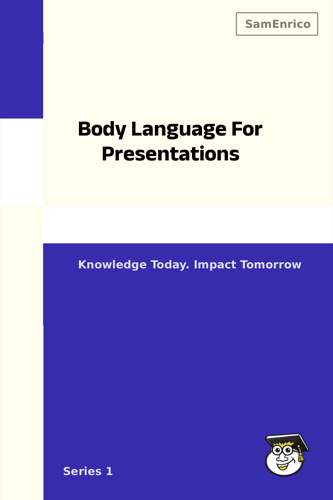
Non-FictionSelf-HelpNonverbal Communication
Body Language For Presentations eBook
Use posture, gestures, and eye contact to reinforc
Use posture, gestures, and eye contact to reinforce your message and build trust.
Formats
Free sample
Chapter 1: The Silent Handshake...--Before you speak a single word, your body has already shaken hands with every person in the room. That handshake is either firm and welcoming or weak and forgettable. You do not get to choose whether it happens. You only get to choose what it says.Imagine this scene. You are standing backstage at a conference.
The speaker before you has just finished to polite applause. You hear your name announced. You walk onto the stage, and for three full seconds before you reach the center, the audience is watching you. They are not listening to you yet, because you have not spoken. They are watching.
They are deciding. They are forming an opinion that will color every word you are about to utter.In those three seconds, your body has communicated more than the next ten minutes of your carefully prepared remarks ever will.This is not speculation. This is the science of first impressions, and it is the subject of this opening chapter. Before we can discuss the mechanics of posture, gesture, and eye contact, we must first understand the landscape in which those mechanics operate. We must understand that your body is not a vehicle for your message.
Your body is the message.Welcome to the invisible conversation.The Seven-Second Jury Research conducted at Princeton University and cited in numerous best-selling works on communication—including the foundational texts of Allan Pease and the social psychology frameworks of Peter Collett—has consistently demonstrated a startling fact. Within seven seconds of meeting a stranger, the human brain has made eleven distinct judgments about that person. These judgments include trustworthiness, competence, likeability, confidence, social status, and even education level. They are made unconsciously, automatically, and with alarming accuracy.Now consider what this means for a presenter. Your audience does not wait for your opening line.
They do not wait for your first slide. They do not wait for you to clear your throat and say, “Good morning, thank you for being here.” By the time you have walked from the edge of the stage to the center, by the time you have turned to face them, by the time you have taken your first breath, their seven-second jury has already reached a verdict.The remaining fifty-three minutes of your presentation are not an opportunity to change that verdict. They are an opportunity to confirm it.This is the single most important concept in this book, and it must be stated clearly: Your body language before you speak determines whether your audience will listen to what you say. If your pre-verbal communication signals confidence, openness, and authority, your words will land on fertile ground. If it signals anxiety, defensiveness, or arrogance, your words will fall on barren soil.
You cannot argue your way out of a bad first impression. You can only prevent it.The Three-Part Non-Verbal Contract Every presentation begins with an invisible contract. This contract is not written, not spoken, and rarely acknowledged. But it is real, and it is binding. The contract has three clauses, each communicated entirely through body language before the first word is spoken.Clause One: Safety.
The audience must know, at a primal level, that you are not a threat. This is not about physical danger. It is about psychological safety. Will you embarrass them? Will you waste their time?
Will you put them on the spot? Your body language answers these questions in the first three seconds. Open palms, visible hands, and a relaxed stance say, “You are safe here.” Closed postures, hidden hands, and a rigid stance say, “Be on your guard.”Clause Two: Competence. The audience must believe that you know what you are talking about. This is not about your credentials, which they do not yet know, or your slides, which they have not yet seen.
It is about your bearing. Do you stand like someone who belongs on this stage? Do you move like someone who has done this before? Do you occupy space like someone who deserves it? Your posture answers these questions.Clause Three: Connection.
The audience must feel that you see them. Not as an abstraction. Not as a crowd. But as individual human beings. This is communicated through eye contact, through facial expression, and through the subtle orienting of your body toward the people you are addressing.
A presenter who looks at the floor, the ceiling, or their notes is a presenter who has already broken the third clause of the contract.If you fulfill all three clauses in the first seven seconds, your audience will lean in. They will uncross their arms. They will make eye contact with you. They will be ready to listen. If you fail even one clause, you will spend the rest of your presentation trying, and likely failing, to win back what you lost before you began.The Myth of the Neutral Body Before we proceed, we must address a dangerous misconception.
Many presenters believe that if they simply avoid obvious mistakes—if they do not pace, do not fidget, do not cross their arms—their body language will be “neutral” and therefore harmless. This is false. There is no neutral body language.Your body is always communicating. When you stand perfectly still with your hands at your sides, you are communicating formality, restraint, or perhaps nervousness, depending on context. When you relax your posture and let your hands rest naturally, you are communicating ease and confidence.
When you shift your weight, you are communicating impatience or discomfort. Every position, every movement, every stillness carries meaning. You cannot opt out of body language. You can only choose whether to control it or let it control you.This is why this book exists. The chapters that follow will not teach you to “add” body language to your presentations, as if it were an optional accessory.
They will teach you to replace unconscious, destructive body language with conscious, constructive body language. You will not become a robot performing a script. You will become a presenter who has taken control of the silent conversation that was already happening.The Cost of Ignorance: Three Presenters Who Failed To understand what is at stake, let us examine three real-world presenters who learned the cost of ignoring pre-verbal communication the hard way.The First Presenter: The Speedy Walker. Sarah was a marketing director with impeccable credentials. She had data, she had strategy, and she had a brilliant new campaign to unveil.
But Sarah had a habit. When she was nervous, she walked fast. Not on stage, where it might have been noticed, but in those first three seconds after her name was called. She walked from the edge of the stage to the center at twice her normal speed, as if she were trying to outrun her own anxiety.What did the audience see? They saw someone who could not wait to get this over with.
They saw someone who was uncomfortable in her own skin. They saw someone who did not belong. By the time Sarah reached the center and turned to face them, the seven-second jury had already returned its verdict: nervous, inexperienced, untrustworthy. Her brilliant campaign fell flat.…
This is the end of the free sample. Get the eBook to keep going. Buy now
About this book
Details
- Author
- Lipscomb Marisha
- Publisher
- SamEnrico
- Language
- English
- Genre
- Non-Fiction, Self-Help, Nonverbal Communication
- Released
- 2026-06-06
- Pages (approx.)
- 148
- Available as
- eBook, Audiobook

Read better in the ZLOADR app
Your eBooks on your phone or tablet. Sign in with your SamEnrico account and start reading.
More by Lipscomb Marisha
 Teresas Book of FoundationsLipscomb Marisha$11.99
 Reframing Setbacks as DataLipscomb Marisha$11.99
 IBS And Histamine IntoleranceLipscomb Marisha$11.99
 Conflict Resolution ScriptsLipscomb Marisha$11.99
 Quit Buddies and AccountabilityLipscomb Marisha$11.99
 Benzodiazepine Detox ProtocolLipscomb Marisha$11.99
 Parent of Child with ADHDLipscomb Marisha$11.99
 Love Letters from the Southern Alps: The Daring Correspondence of New Zealand’s First Mountain GuidesLipscomb Marisha$11.99
 The Jade Phoenix and the Moonlit ScholarLipscomb Marisha$11.99
 How to Become a Power OperatorLipscomb Marisha$11.99
 How to Produce InterfacingLipscomb Marisha$11.99
 How to Produce a Tractor PTO AugerLipscomb Marisha$11.99
You may also like
 Hong Kong Handover 1997Dunn Johnnie$11.99
 Zumba For Postnatal Recovery CourseNeal Christian$11.99
 Zumba for BeginnersLadner Nikia$11.99
 YouTube Comment Mining GuideHumes Pandora$12.99
 Worry Box MeditationCarlin Rudy$11.99
 Workplace Stress MeditationNguyen Lynn$11.99
 Workplace Stress and Sleep RepairHawley Ivory$11.99
 Workplace Perfectionism CureDelaney Jeffry$11.99
 Workplace Injustice Anger GuideWallen Isabelle$11.99
 Work Addiction and Burnout LinkGreenwood Ester$11.99
 Women in Yoga and WellnessBeattie Galina$11.99
 Women in Stand Up ComedyChun Evangeline$11.99