
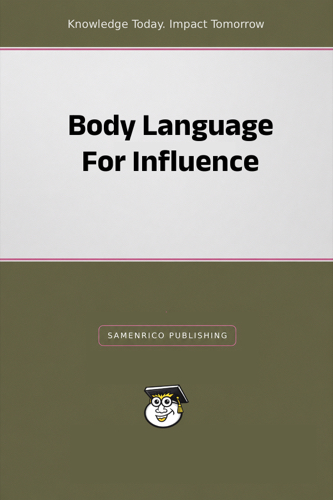
Non-FictionSelf-HelpNonverbal Communication
Body Language For Influence eBook
Uses non-verbal cues to reinforce persuasive messa
by Cole Alfred
Uses non-verbal cues to reinforce persuasive messages.
Formats
Free sample
Chapter 1: The 93% Lie--–- The statistic appears in every Power Point, every sales training, every Linked In post about communication. “Words are only 7% of the message.” You have quoted it. You have believed it. And for your entire career, you have been using it wrong.Not because the number is false. The research is real.
Albert Mehrabian’s 1971 studies at UCLA确实 found that in communications about feelings and attitudes, 7% of the message’s impact comes from words, 38% from tone of voice, and 55% from body language. The math is simple. The implication is seductive: if you just fix your posture, your gestures, your eye contact, you can become twice as persuasive without changing a single word.That is not the lie.The lie is what the self-help industry added to Mehrabian’s research. The lie is that you can “read” strangers like open books. The lie is that crossing arms always means defensiveness and that touching the nose always means deception.
The lie is that body language is a secret code that, once cracked, gives you X-ray vision into the minds of everyone you meet.You cannot read a stranger.Let me repeat that, because it is the single most important sentence in this book and the foundation upon which everything else will be built: You cannot read a stranger.You can observe. You can hypothesize. You can notice clusters of behavior. But the moment you believe you know what someone else is thinking because their foot is pointing toward the door, you have abandoned evidence for superstition. And superstition, in high-stakes communication, is expensive.I learned this lesson in a conference room in downtown Chicago, watching a two-million-dollar deal die in eleven seconds.The Deal That Died in Eleven Seconds The CEO was a man named Frank.
Fifty-three years old. Twenty years in logistics. He had flown in from Atlanta for this final negotiation. My client, a software vendor named Sarah, had been courting him for nine months. Nine months of demos, dinners, follow-up emails, reference calls.
The contract was on the table. Frank’s signature would mean a commission large enough to send Sarah’s daughter to the college of her choice.We were in a glass-walled conference room on the forty-second floor. Sarah sat across from Frank. I sat against the wall, observing—my role was to debrief her afterward, not to participate.Sarah opened strong. She recapped the value proposition.
She walked through the implementation timeline. She addressed the two objections Frank had raised in their previous call. Her words were flawless. She had rehearsed this presentation thirty-seven times. I know because she told me.Then she said the words every seller waits to say: “So Frank, with all of that in mind, I’d like to ask for your commitment today.”Frank said, “I think we’re aligned.
Let me just review the pricing section one more time.”His mouth said, “I think we’re aligned.”His hands were under the table, rubbing his knees.His feet—I could see them because the conference table had glass legs—were pointed at the exit door.He pulled at his collar twice in eleven seconds. The room was seventy-two degrees. He was not hot.Sarah, trained in “body language reading,” saw his hands moving under the table and thought, He’s nervous. I should reassure him. She leaned forward and started talking about the payment terms.Frank’s neck touched his collar a third time.Sarah talked faster.Frank’s feet pointed more directly at the door.Sarah talked even faster.Nine months of relationship building collapsed into eleven seconds of Congruence Gap.
Sarah was broadcasting “I am confident and this is a good deal.” Frank’s limbic brain was receiving “I am uncomfortable and I need to escape.” Sarah’s words said one thing. Her response to Frank’s anxiety—talking faster, leaning in harder—said another. She created a mismatch so severe that Frank eventually said, “Let me take this back to my team,” which is corporate for “no.”The deal closed two weeks later with Frank’s competitor. Sarah never figured out what went wrong. She thought Frank was lying about something.
She thought the price was too high. She blamed his “cold feet.”She never realized that her own body language—specifically, her inability to recognize that her response to his anxiety was increasing it—was the problem.That night, I wrote down a sentence that became the thesis of this book: Words are decoration. The body is the contract.And the contract was broken not by Frank’s body, but by Sarah’s misunderstanding of what her own body was doing in response to his.The Limbic Brain: Your Silent Co-Pilot To understand why body language is so powerful—and why most advice about it is so wrong—you need to understand a piece of anatomy you have never consciously controlled: the limbic system.The limbic brain is the ancient core of your neural architecture. It evolved hundreds of millions of years ago, long before the neocortex—the “thinking brain” that handles language, logic, and planning. Reptiles have limbic systems.
Birds have limbic systems. Mammals have highly developed limbic systems. Your limbic brain is responsible for survival: detecting threats, identifying rewards, and triggering automatic responses before you have time to think.Here is the critical fact for anyone who wants to influence others: The limbic brain processes non-verbal cues in 30 to 50 milliseconds. The neocortex takes 500 to 600 milliseconds to process language.That means when you walk into a room, the other person’s limbic brain has already decided whether you are a threat or a friend before you have said a single word. Before you have completed your first step.
Before you have even fully entered their peripheral vision.The philosopher William James once said, “There is no more miserable human being than one in whom nothing is habitual but indecision.” He was speaking about character. But he could have been speaking about the limbic brain, which has no capacity for indecision. It decides. Immediately. Automatically.
Unconsciously.And then it spends the rest of the interaction trying to confirm its initial decision.This is called confirmation bias, and it is one of the most well-replicated findings in cognitive psychology. Once the limbic brain tags you as “safe” or “threat,” the neocortex will selectively attend to evidence that supports that tag and ignore evidence that contradicts it. If the limbic brain decides you are safe, the other person will interpret your nervous fidgeting as “passionate.” If the limbic brain decides you are a threat, the same fidgeting will be interpreted as “shifty” or “untrustworthy.”You do not get a vote in this process. You cannot reason your way out of a limbic judgment. You cannot say, “Wait, let me explain why my crossed arms are just because I’m cold.” By the time you speak, the judgment has already been made.The only way to influence that judgment is to prevent it from being negative in the first place.
And the only way to do that is to close what I call the Congruence Gap.The Congruence Gap: Your Invisible Villain The Congruence Gap is the…
This is the end of the free sample. Get the eBook to keep going. Buy now
About this book
Details
- Author
- Cole Alfred
- Publisher
- SamEnrico
- Language
- English
- Genre
- Non-Fiction, Self-Help, Nonverbal Communication
- Released
- 2026-06-08
- Pages (approx.)
- 124
- Available as
- eBook, Audiobook

Read better in the ZLOADR app
Your eBooks on your phone or tablet. Sign in with your SamEnrico account and start reading.
More by Cole Alfred
 Laser Burn TreatmentCole Alfred$11.99
 Financial Status Social MediaCole Alfred$11.99
 Student Morning RoutineCole Alfred$11.99
 Lawyer Self Doubt GuideCole Alfred$11.99
 PAO System for CardsCole Alfred$11.99
 Loud Noise TriggersCole Alfred$11.99
 Boxing HIIT WorkoutCole Alfred$11.99
 The Mozart Code: A Musical RevolutionCole Alfred$11.99
 The Deluge: Poland's Last Stand Against the Swarm (1655-1660)Cole Alfred$11.99
 How to Produce Satellite PhonesCole Alfred$11.99
 How to Produce Fishing ToysCole Alfred$11.99
 Cavalier King Charles Spaniel: Sweet & EagerCole Alfred$11.99
You may also like
 Hong Kong Handover 1997Dunn Johnnie$11.99
 Zumba For Postnatal Recovery CourseNeal Christian$11.99
 Zumba for BeginnersLadner Nikia$11.99
 YouTube Comment Mining GuideHumes Pandora$12.99
 Worry Box MeditationCarlin Rudy$11.99
 Workplace Stress MeditationNguyen Lynn$11.99
 Workplace Stress and Sleep RepairHawley Ivory$11.99
 Workplace Perfectionism CureDelaney Jeffry$11.99
 Workplace Injustice Anger GuideWallen Isabelle$11.99
 Work Addiction and Burnout LinkGreenwood Ester$11.99
 Women in Yoga and WellnessBeattie Galina$11.99
 Women in Stand Up ComedyChun Evangeline$11.99