
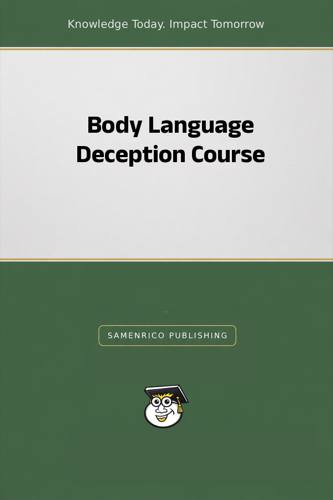
Non-FictionSelf-Help / Forensics
Body Language Deception Course eBook
Advanced training in detecting hidden emotions and
Advanced training in detecting hidden emotions and concealed information.
Formats
Free sample
Chapter 1: The Lie Detector’s Paradox--–- In 1984, a man walked into a police station in Illinois and confessed to a murder he did not commit. He described the weapon in detail. He knew where the body had been found. He cried during the confession. The detectives believed him completely.
Seventeen years later, DNA evidence proved he had been in another state on the day of the murder. The real killer was never found.–- That man was not mentally ill. He was not coerced. He was not protecting anyone. He simply believed—because the detectives had convinced him through their questioning techniques—that he must have done it.
His memory had been rewritten in real time.–- Here is the paradox that will define everything you learn in this book: the very people trained to detect lies are often the easiest to fool. Police officers, judges, FBI agents, and therapists all perform at or near chance levels when trying to distinguish a liar from a truth-teller. In some studies, their accuracy dips below fifty percent—worse than a coin flip.–- You are about to learn why. And more importantly, you are about to learn how to escape the trap that catches almost everyone else.The Average Human Is a Terrible Lie Detector–- Let us start with an uncomfortable truth. You are probably bad at spotting lies.
Not because you are unintelligent or unobservant. Because your brain was not designed for deception detection. It was designed for social survival.–- Think about it. For most of human history, the ability to trust group members quickly was more valuable than the ability to detect occasional lies. Assuming someone was telling the truth—even when they were not—kept social bonds intact.
The suspicious person who constantly accused others of lying was exiled from the tribe. Natural selection favored trust, not skepticism.–- That evolutionary legacy remains wired into your nervous system today. Psychologists call it the truth bias. You default to believing. And that default works well enough most of the time because most people are honest most of the time.
But when you encounter a skilled liar—someone who knows exactly how to exploit your trust—your brain hands them the keys.–- The research is sobering. In a meta-analysis of over two hundred studies involving more than twenty-four thousand participants, the average lie detection accuracy was just fifty-four percent. Professional groups fared no better. Secret Service agents, who spend their careers assessing threat and credibility, achieved only fifty-six percent accuracy in controlled experiments. Police officers actually performed worse than college students, largely because their confidence outpaced their competence.–- Here is what these numbers mean in real terms.
If you interview ten people and five are lying, you will correctly identify approximately three of the liars. You will also incorrectly accuse two honest people. In high-stakes environments—criminal interrogations, hiring decisions, relationship confrontations—those errors devastate lives.Why Your Intuition Is Lying to You–- Most people believe they can spot a liar because they have heard the signs. Liars avoid eye contact. Liars fidget.
Liars touch their faces. Liars sound nervous.–- Every single one of these beliefs is false.–- Eye contact is the most pervasive myth. Research consistently shows no reliable correlation between deception and gaze aversion. In fact, some liars increase eye contact deliberately, having learned that honest people look you in the eye. Others look away because they are thinking—not because they are lying.
Truth-tellers and liars behave identically on this measure.–- Fidgeting is equally useless. Nervous movements occur in both liars and honest people who fear being disbelieved. An innocent person accused of a crime they did not commit experiences physiological arousal that can exceed that of the guilty party. The difference is not the presence of nervousness but its relationship to the question asked—a distinction most observers miss entirely.–- The belief that liars touch their faces has some basis in research but is wildly overgeneralized. Face touching increases under cognitive load—when the brain is working hard.
Lying creates cognitive load. But so does remembering complex information, doing mental math, or being asked an unexpected question. Face touching tells you someone is thinking hard. It does not tell you they are lying.–- These myths persist because they feel true. When you catch someone in a lie after noticing they avoided eye contact, your brain creates a false association.
You forget the dozens of times honest people avoided eye contact and the dozens of times liars stared directly at you. Your memory is not a recording device. It is a story you tell yourself after the fact.The Othello Error: The Mistake That Ends Careers–- In Shakespeare’s play, Othello accuses his wife Desdemona of infidelity. She responds with fear—fear that her husband, whom she loves, no longer believes her. Othello misreads her fear as proof of guilt.
He kills her. Later, he learns she was innocent.–- This is the Othello Error in forensic psychology: mistaking an innocent person’s emotional distress for evidence of deception.–- Here is why this error is so common and so dangerous. When you accuse someone of something they did not do, several things happen simultaneously. They feel the threat of punishment or social ruin. They feel the injustice of being disbelieved.
They feel the terror that you, someone they trusted, now sees them as a liar. Their heart rate spikes. Their palms sweat. Their voice may tremble. Their face may flush.–- Every one of these signs is identical to the signs of guilt.–- The interrogator or interviewer sees these signs and thinks, Aha.
Guilty. In reality, they have just created the very reaction they are misinterpreting. The Othello Error is not a failure of observation. It is a failure of inference. You observe arousal correctly.
You infer deception incorrectly. And because your inference feels confirmed by the person’s behavior, you never doubt yourself.–- This error destroys lives in police interrogations, where innocent people have been convicted based on the “behavioral evidence” of their own terror. It destroys relationships, where one partner’s fear of being disbelieved is read as proof of betrayal. It destroys careers, where an employee’s nervousness during a performance review is interpreted as hidden misconduct.–- Avoiding the Othello Error requires one radical shift in thinking. You must separate arousal from deception.
Arousal tells you something matters to the person. It does not tell you why. Until you know why, you know nothing.The Seven-Second Myth and the Sixty-Second Solution–- You have probably heard some version of the claim that people form lasting impressions within the first seven seconds of meeting someone. This is true. It is also a disaster for lie detection.–- The brain’s rapid judgment system—technically called System 1 in cognitive psychology—operates automatically, unconsciously, and almost instantly.
Within milliseconds, it assesses threat, trustworthiness, and social status. It generates a feeling: This person seems honest. Or Something feels wrong.–- These rapid judgments are not entirely useless. They draw on genuine pattern recognition. But they are also wildly overconfident and easily manipulated.
A skilled liar knows exactly how to trigger your trust response. A warm smile. A firm handshake. Direct eye contact.…
This is the end of the free sample. Get the eBook to keep going. Buy now
About this book
Details
- Author
- Pinkerton Blaine
- Publisher
- SamEnrico
- Language
- English
- Genre
- Non-Fiction, Self-Help / Forensics
- Released
- 2026-06-09
- Pages (approx.)
- 142
- Available as
- eBook, Audiobook

Read better in the ZLOADR app
Your eBooks on your phone or tablet. Sign in with your SamEnrico account and start reading.
More by Pinkerton Blaine
 Drug Addiction in PilotsPinkerton Blaine$11.99
 Body Language for PresentersPinkerton Blaine$11.99
 Water Aerobics For SeniorsPinkerton Blaine$11.99
 The River of Blood: The Fall of the Taira Clan at Dan-no-uraPinkerton Blaine$11.99
 How to Become a Hoisting EngineerPinkerton Blaine$11.99
 How to Produce Canopy WeightsPinkerton Blaine$11.99
 Price Matching Guarantee StrategyPinkerton Blaine$12.99
 Lead Cost ManagerPinkerton Blaine$11.99
You may also like
 Hong Kong Handover 1997Dunn Johnnie$11.99
 Zumba For Postnatal Recovery CourseNeal Christian$11.99
 Zumba for BeginnersLadner Nikia$11.99
 YouTube Comment Mining GuideHumes Pandora$12.99
 Worry Box MeditationCarlin Rudy$11.99
 Workplace Stress MeditationNguyen Lynn$11.99
 Workplace Stress and Sleep RepairHawley Ivory$11.99
 Workplace Perfectionism CureDelaney Jeffry$11.99
 Workplace Injustice Anger GuideWallen Isabelle$11.99
 Work Addiction and Burnout LinkGreenwood Ester$11.99
 Women in Yoga and WellnessBeattie Galina$11.99
 Women in Stand Up ComedyChun Evangeline$11.99