
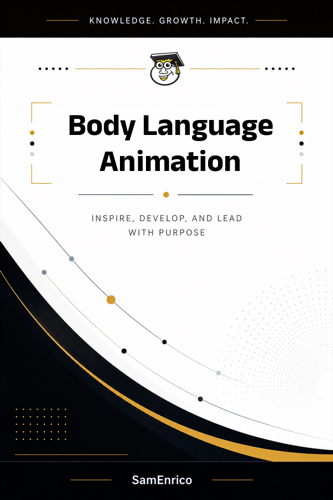
Free sample
Chapter 1: The Silent Performance...--–- Every animator remembers the moment they realized that dialogue was lying to them. For some, it comes during a student film screening when an audience laughs at a dramatic scene meant to be tragic. For others, it happens while watching a big-budget CG film where the characters speak eloquently about their feelings but somehow feel dead inside. And for the truly observant, it arrives while watching live-action reference footage—a clip of two people arguing where the words are angry but the hands are trembling, the shoulders are curled forward in protection, and the eyes are wet with suppressed tears. The dialogue shouts "I don't care," but the body whispers, "This is destroying me."That whisper is body language.
And in animation, it is not a supplement to dialogue. It is the primary text.This book exists because of a fundamental misunderstanding that has plagued character animation since the advent of synchronized sound. Animators have been trained to believe that dialogue carries the story—that if the lip-sync is tight, the emotional beats land on the right words, and the mouth shapes match the phonemes, the audience will feel the intended emotion. This is a catastrophic error. The science is unambiguous: in face-to-face communication, only 7% of emotional meaning comes from the literal words spoken.
Thirty-eight percent comes from tone of voice—the pitch, pace, and volume of the delivery. And a staggering 55% comes from body language: posture, gesture, facial expression, proximity, and movement quality.This is known as the 7-38-55 rule, derived from psychologist Albert Mehrabian's groundbreaking studies on communication in the 1970s. Mehrabian was not studying animation. He was studying how humans detect lies, sincerity, and emotional truth in everyday conversation. His finding was simple and devastating: when words and body language conflict, humans believe the body every time.
If someone says "I'm fine" while their arms are crossed, their shoulders are tensed, and their body is turned toward the exit, no one believes the words. The body is the truth-teller. The mouth is the liar.Now consider what this means for animation. The average student animator spends approximately 80 to 90 percent of their production time on dialogue-related tasks: lip-sync, jaw movement, tongue placement, and matching mouth shapes to audio tracks. The remaining 10 to 20 percent is split between posing, timing, spacing, and all other aspects of character performance.
This is the inverse of what the science demands. If body language carries 55 percent of emotional meaning, then animators should be spending at least half of their time—if not more—on posture, gesture, torso mechanics, and movement quality. Instead, they create beautifully lip-synced mannequins: characters whose mouths move perfectly but whose bodies are dead, still, or generic. The result is the hollow, unsatisfying animation that fills student reels and low-budget productions: technically competent but emotionally vacant.This chapter will dismantle the primacy of dialogue in animation and replace it with a more truthful hierarchy. You will learn why CG characters fall into the uncanny valley not because of rendering errors but because of gestural omissions.
You will analyze two masterclasses in silent storytelling—the first ten minutes of Pixar's Wall-E and the married life montage from Up—to see how body language alone can build character, establish relationships, and break hearts. And you will adopt a new rule for your own work: before you open any lip-sync tool, before you lay down a single mouth shape keyframe, you will mute your animation and watch it in silence. If you cannot understand the character's emotional state without dialogue, you have failed regardless of how perfect the lip-sync is.The Silent Majority: Why Words Are Only 7% of the Story Let us begin with a thought experiment. Imagine two animated scenes. In Scene A, a character says, "I am so happy to see you," in a bright, cheerful tone while standing with arms crossed, shoulders hunched, feet pointed toward the door, and eyes darting to the exit every few seconds.
In Scene B, the same character says the same words in a flat, monotone voice while standing with arms open, chest expanded, feet planted toward the other character, and a genuine smile that reaches the eyes. Which character do you believe?If you are a normally functioning human, you believe Scene B. The words say happiness, but the body says something else. The audience does not consciously analyze this—they simply feel that Scene A is "creepy," "fake," or "off." This is the uncanny valley operating at the level of gesture rather than rendering. Most discussions of the uncanny valley focus on visual fidelity: skin texture, eye shininess, subsurface scattering, and the precise rendering of hair.
But a perfectly rendered character with dead body language is far more disturbing than a stylized character with truthful movement. The uncanny valley of gesture is wider and deeper than the uncanny valley of graphics, and it is almost entirely ignored by animators who are obsessed with technical polish.Consider the specific gestural errors that trigger this response. In real human interaction, a sigh is never just a breath. It is preceded by a subtle lifting of the shoulders—a micro-moment of tension that releases as the air leaves the lungs. A weight shift from one foot to the other is never instantaneous.
It involves a slight dip of the hip, a bending of the weight-bearing knee, and a small lateral movement of the head to maintain balance. A hand gesture is never isolated. It originates in the shoulder, travels through the elbow, and ends with a subtle rotation of the wrist and curl of the fingers.When these micro-movements are missing—when a character sighs without the shoulder lift, shifts weight without the hip dip, or gestures with a frozen wrist—the human brain detects the absence. You may not know why a character feels "fake," but your limbic system does. It has evolved over millions of years to read the bodies of other humans for threat, safety, and truth.
A body that moves like a mannequin triggers the same alarm as a body that is hiding something. The animation becomes uncanny not because it looks like a robot, but because it moves like a liar.This is why the 7-38-55 rule is not merely a statistical curiosity. It is a survival mechanism. And as animators, we must either work with it or be destroyed by it.Silent Storytelling: What Wall-E and Up Teach Us About Bodies That Speak No modern films demonstrate the power of silent body language better than Pixar's Wall-E and Up. Both films open with extended sequences containing little to no dialogue—and both sequences are considered among the most emotionally devastating in animation history.
This is not a coincidence. When dialogue is removed, animators are forced to rely entirely on body language, and the results are revelatory.Let us begin with Wall-E. The first ten minutes of the film contain no human dialogue. The only sounds are robotic beeps, whirs, and a single recorded song ("Put On Your Sunday Clothes") from the musical Hello, Dolly!. And yet, in those ten minutes, the audience learns everything they need to know about Wall-E: his loneliness, his curiosity…
This is the end of the free sample. Get the eBook to keep going. Buy now
About this book
Details
- Author
- Macias Rueben
- Publisher
- SamEnrico
- Language
- English
- Genre
- Non-Fiction, Self-Help / Animation
- Released
- 2026-06-07
- Pages (approx.)
- 158
- Available as
- eBook, Audiobook

Read better in the ZLOADR app
Your eBooks on your phone or tablet. Sign in with your SamEnrico account and start reading.
More by Macias Rueben
 Senior Motivation HandbookMacias Rueben$11.99
 Audience Reframing WorkbookMacias Rueben$11.99
 Overcoming Vocal Fry and FillersMacias Rueben$11.99
 The Phantom Heist: Australia's Unsolved Armored Car Robberies and the UFO ConnectionMacias Rueben$11.99
 How to Produce Cardio EquipmentMacias Rueben$11.99
 Price Increase Grandfathering PolicyMacias Rueben$12.99
 How to Start a Oil Trading (commodity Broking) (commission Agent) Business (Beginners Guide)Macias Rueben$11.99
 Logistics AssistantMacias Rueben$11.99
You may also like
 Hong Kong Handover 1997Dunn Johnnie$11.99
 Zumba For Postnatal Recovery CourseNeal Christian$11.99
 Zumba for BeginnersLadner Nikia$11.99
 YouTube Comment Mining GuideHumes Pandora$12.99
 Worry Box MeditationCarlin Rudy$11.99
 Workplace Stress MeditationNguyen Lynn$11.99
 Workplace Stress and Sleep RepairHawley Ivory$11.99
 Workplace Perfectionism CureDelaney Jeffry$11.99
 Workplace Injustice Anger GuideWallen Isabelle$11.99
 Work Addiction and Burnout LinkGreenwood Ester$11.99
 Women in Yoga and WellnessBeattie Galina$11.99
 Women in Stand Up ComedyChun Evangeline$11.99