
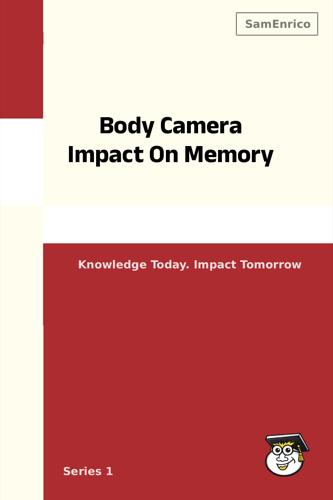
Non-FictionTrue CrimeTechnology
Body Camera Impact On Memory Audiobook
Explores how recording changes witness attention.
Explores how recording changes witness attention.
Formats
Free sample
Chapter 1: The Broken Lens...--The first bullet point of the officer’s report was clear, confident, and specific. “The suspect raised a black semiautomatic handgun in a two-handed grip, pointed directly at my chest, from a distance of approximately ten feet. I perceived an immediate, lethal threat and discharged my service weapon.” The report went on to describe the weapon’s make—a Glock—the suspect’s finger position inside the trigger guard, and the angle of the muzzle relative to the officer’s torso. Every detail was crisp, vivid, and damning. The officer had written this account within twenty minutes of the shooting, before watching any body camera footage, while the adrenaline was still fading from his bloodstream.
He was certain of what he had seen. He would have sworn on his life that the suspect had a gun.Then the body camera footage was released.The video showed the suspect holding a black cellular phone, not a firearm. His hands were raised at chest level, and the object he held was flat, rectangular, and entirely consistent with a smartphone. There was no gun. There never had been.
The officer had not lied. He had not fabricated evidence. He had experienced one of the most well-documented, terrifying, and deeply counterintuitive phenomena in cognitive psychology: under extreme stress, the human brain does not record reality. It constructs a story based on fragments, expectations, and survival instincts. The officer saw a gun because he expected a gun, because his training had primed him to see threats, because the silhouette of a phone at chest level in low light shares just enough features with a firearm to trigger a lethal misidentification.
And then, after the fact, his memory solidified that error into an unshakable certainty.This case—which the reader will encounter in full later in this chapter—is not an outlier. It is the rule. And it exposes the first and most dangerous lie that body-worn cameras have sold to the public, to police departments, to prosecutors, and to judges. The lie is this: that the camera captures objective truth, and that human memory is a flawed but secondary record that the camera can correct. In reality, the opposite is often closer to the truth.
The camera captures a distorted, third-person, physically limited perspective. Human memory, for all its well-documented fragility, captures the only perspective that matters under the law: the…
This is the end of the free sample. Get the Audiobook to keep going. Buy now
About this book
Details
- Author
- Franco Harriette
- Publisher
- SamEnrico
- Language
- English
- Genre
- Non-Fiction, True Crime, Technology
- Released
- 2026-06-05
- Pages (approx.)
- 151
- Available as
- eBook, Audiobook

Listen in the VoxFlicks app
Audiobooks and audio dramas wherever you go. Sign in with your SamEnrico account and press play.
More by Franco Harriette
 Immigrant Parent ExpectationsFranco Harriette$11.99
 Angelversary TraditionsFranco Harriette$11.99
 Stimulant Relapse PreventionFranco Harriette$11.99
 Low Carb Convenience Food SwapsFranco Harriette$11.99
 Hotel Booking PersuasionFranco Harriette$11.99
 Digital Boundaries GuideFranco Harriette$11.99
 The Siege of Constantinople: The Last Stand of the Byzantines (1453)Franco Harriette$11.99
 The Hong Kong Improv Revolution: How a Handful of Rebels Changed Comedy in AsiaFranco Harriette$11.99
 How to Become a Roller RepairerFranco Harriette$11.99
 How to Produce Golf TowelsFranco Harriette$11.99
 A Collector's Handbook to the Daimler Double Six Series IiFranco Harriette$11.99
 Freemium Models Low Broadband GuideFranco Harriette$12.99
You may also like
 Hong Kong Handover 1997Dunn Johnnie$11.99
 Zumba For Postnatal Recovery CourseNeal Christian$11.99
 Zumba for BeginnersLadner Nikia$11.99
 YouTube Comment Mining GuideHumes Pandora$12.99
 Worry Box MeditationCarlin Rudy$11.99
 Workplace Stress MeditationNguyen Lynn$11.99
 Workplace Stress and Sleep RepairHawley Ivory$11.99
 Workplace Perfectionism CureDelaney Jeffry$11.99
 Workplace Injustice Anger GuideWallen Isabelle$11.99
 Work Addiction and Burnout LinkGreenwood Ester$11.99
 Women in Yoga and WellnessBeattie Galina$11.99
 Women in Stand Up ComedyChun Evangeline$11.99