
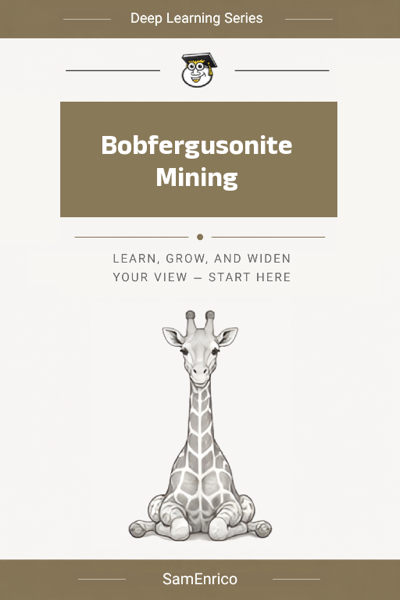
Non-FictionInformativeEducational
Bobfergusonite Mining eBook
A Coursebook on Bobfergusonite Mining
A Coursebook on Bobfergusonite Mining
Formats
Free sample
Chapter 1: The Million-Dollar Nothing...--It is the strangest thing in the world to write a textbook about mining a mineral that has never been mined. Stranger still to hold a specimen of bobfergusonite in your palm—a dark green-brown crystal, no larger than a thumbnail, extracted from the Canadian Shield at enormous effort—and to know that this tiny object represents nearly the entire known global supply of its kind available for study. This is not hyperbole. The total mass of bobfergusonite ever collected, documented, and stored in museum drawers and university cabinets around the world would fit inside a single shipping crate. And yet, for the past four decades, a handful of mineralogists, geochemists, and exploration geologists have devoted entire careers to understanding this obscure phosphate, publishing dozens of peer-reviewed papers, refining its crystal structure to atomic precision, and tracing its occurrence across four continents.
Why? Why would anyone spend a lifetime studying a mineral that will never make anyone rich?The answer reveals something essential about how modern critical mineral exploration actually works—and it has very little to do with getting rich quick.Bobfergusonite belongs to a class of minerals that geologists politely call "accessory phases" and privately call "headaches." It appears only in the most chemically extreme granitic pegmatites, those freak geological accidents where a granite magma has undergone such intense fractionation that ordinary mineral-forming rules no longer apply. In these environments, common elements like silicon and aluminum step aside to make room for rare alkalis, exotic phosphates, and transition metals in combinations that violate everything you learned in introductory petrology. Bobfergusonite is the geological equivalent of a mathematical anomaly: a solution that exists only at the far edge of the equation, where most variables have been pushed to their theoretical limits.Here is the first hard truth of this book: You will never make money mining bobfergusonite. Not because you lack skill or capital, but because the mineral does not occur in sufficient abundance anywhere on Earth to justify a commercial operation.
The total global resource, if one could somehow gather every crystal from every known locality, would not fill a dump truck. The grade, tonnage, and continuity required for industrial mining simply do not exist. By any reasonable economic measure, bobfergusonite is worthless.And that is precisely why it matters.Consider the history of critical mineral discovery. Almost every economically significant deposit of lithium, cesium, tantalum, beryllium, or rare earth elements was found by geologists who were not looking for those commodities directly. They were looking for something else—something smaller, stranger, and scientifically interesting enough to warrant a second look.
They were following anomalies. The great Tanco pegmatite in Manitoba, one of the world's richest sources of cesium and tantalum, was discovered in the 1920s by prospectors looking for mica. The Greenbushes lithium deposit in Australia, the largest hard-rock lithium source on the planet, was first mined for tin in the 1880s. The rare earth deposits of Mountain Pass, California, were found by uranium prospectors in the 1940s. In every case, the economic giant was discovered because someone was paying attention to the geological oddities—the weird minerals, the unusual assemblages, the things that did not fit the expected pattern.Bobfergusonite is one of those oddities.
It is a flag, a marker, a geological canary in the pegmatite coal mine. When you find bobfergusonite, you have found something far more important than the mineral itself: you have found evidence of extreme fractionation, of fluorine enrichment, of phosphate saturation, of deep crustal manganese sources. You have found a pegmatite that has undergone the kind of chemical processing that also produces lithium, cesium, tantalum, and beryllium in economic quantities. Bobfergusonite is not the treasure. It is the treasure map.This book, therefore, is not a mining textbook in the conventional sense.
It will not teach you how to blast tunnel, operate a haul truck, or negotiate a offtake agreement. Those skills are covered in countless other volumes. Rather, this is a textbook about exploration intelligence—about how to recognize the subtle signatures of extreme chemical systems, how to trace those signatures from stream sediments to outcrops, how to evaluate a pegmatite's fractionation state using mineral assemblages, and how to avoid the expensive mistake of drilling a barren pegmatite that looks promising but lacks the critical chemical credentials.If that sounds abstract, consider the stakes. A single exploration drilling program for a pegmatite-hosted lithium deposit can cost five to ten million dollars. A full feasibility study, including metallurgical testing and engineering design, can run fifty million or more.
Mining companies write these checks on the basis of geological models—models that are only as good as the data and interpretations that support them. Misinterpreting a pegmatite's fractionation state, or mistaking a low-grade occurrence for a high-grade system, can destroy hundreds of millions in shareholder value and end careers. The geologists who succeed in this industry are not necessarily the ones with the fanciest degrees or the most expensive instruments. They are the ones who understand mineralogy at a deep enough level to read the stories written in the rocks.Bobfergusonite tells a very specific story. It says: this pegmatite crystallized from a melt that was enriched in phosphorus, manganese, fluorine, and sodium.
It says: the melt underwent extreme fractionation, concentrating incompatible elements into the final residual liquid. It says: the temperature and pressure conditions were just right for complex phosphates to form. And it says, most importantly: other rare elements likely concentrated alongside these components—lithium in spodumene or lepidolite, cesium in pollucite, tantalum in columbite-tantalite, beryllium in beryl.But the mineral does not speak directly. You have to learn its language.The Discovery That Started Everything The story of bobfergusonite begins in 1977, in the boreal forests of central Manitoba, about 300 kilometers north of Winnipeg. The Cross Lake area, part of the ancient Superior Province of the Canadian Shield, had long been known to host granitic pegmatites.
Some of those pegmatites had been explored for mica and feldspar in the early twentieth century, but most had never been systematically studied. The region was remote, the outcrops were weathered, and there was little economic incentive to spend time on small pegmatites when larger deposits existed elsewhere.Enter Robert Bury Ferguson, a Canadian mineralogist with a specialty in pegmatite phosphates. Ferguson had cut his teeth on the complex phosphate minerals of the Tanco pegmatite, a world-class deposit that had already yielded dozens of new mineral species. He understood something that most exploration geologists of his era did not: phosphate minerals in pegmatites are not random curiosities. They are systematic indicators of fractionation state, chemical environment, and rare-element enrichment.
A pegmatite that produces complex manganese-iron phosphates is a pegmatite that has undergone extreme chemical differentiation. And extreme differentiation is exactly what creates economic concentrations of lithium, cesium, tantalum, and beryllium.Working with colleagues from the University of Manitoba and the Canadian Museum of Nature, Ferguson began sampling the pegmatites around Cross Lake. In one particular pegmatite, on a claim called Gottcha (the spelling reflects the prospector's whimsy), he found something unusual: small, dark green-brown crystals embedded in a matrix of quartz, feldspar, and apatite. The crystals had a hardness of…
This is the end of the free sample. Get the eBook to keep going. Buy now
About this book
Details
- Author
- Frantz Blaine
- Publisher
- SamEnrico
- Language
- English
- Genre
- Non-Fiction, Informative, Educational
- Released
- 2026-05-09
- Pages (approx.)
- 158
- Available as
- eBook, Audiobook

Read better in the ZLOADR app
Your eBooks on your phone or tablet. Sign in with your SamEnrico account and start reading.
More by Frantz Blaine
 Acrophobia Height Fear GuideFrantz Blaine$11.99
 Healthcare Professional Burnout GuideFrantz Blaine$11.99
 SEC Enforcement ManualFrantz Blaine$11.99
 Digital Shadows Stalking CasebookFrantz Blaine$11.99
 Senior Housing Contract LawFrantz Blaine$11.99
 Voyager and the Golden Record: A Message to the CosmosFrantz Blaine$11.99
 The CRISPR Chronicles: Editing Humanity's FutureFrantz Blaine$11.99
 How to Start a Parts for Electric Lamps and Electronic Valves Made of Glass Business (Beginners GuidFrantz Blaine$11.99
 Understanding Dissociative Identity DisorderFrantz Blaine$17.99
 Medical School Brazil GuideFrantz Blaine$12.99
 Amazon Union Drive HistoryFrantz Blaine$12.99
You may also like
 Hong Kong Handover 1997Dunn Johnnie$11.99
 Zumba For Postnatal Recovery CourseNeal Christian$11.99
 Zumba for BeginnersLadner Nikia$11.99
 YouTube Comment Mining GuideHumes Pandora$12.99
 Worry Box MeditationCarlin Rudy$11.99
 Workplace Stress MeditationNguyen Lynn$11.99
 Workplace Stress and Sleep RepairHawley Ivory$11.99
 Workplace Perfectionism CureDelaney Jeffry$11.99
 Workplace Injustice Anger GuideWallen Isabelle$11.99
 Work Addiction and Burnout LinkGreenwood Ester$11.99
 Women in Yoga and WellnessBeattie Galina$11.99
 Women in Stand Up ComedyChun Evangeline$11.99