
Non-FictionMental WealthExecutive Presence
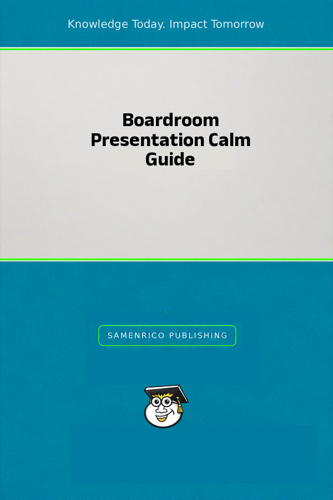
Boardroom Presentation Calm Guide eBook
Speak confidently to executives with tailored exec
by Stein Dalia
Speak confidently to executives with tailored executive presence protocols.
Formats
Free sample
Chapter 1: The Hierarchy Codex--Every boardroom has a ghost. Not the supernatural kind—the kind that sits in the corner office, speaks rarely, and yet somehow controls the temperature of every conversation. You cannot see them on the org chart. Their title might be “Director” or “Partner” or simply the same “Vice President” they have held for eight years. But when a hard question lands, every head in the room turns slightly in their direction.
That is the Alpha Listener. And until you learn to see them, your presentation is already failing.Most professionals prepare for boardroom presentations as if they are delivering a report to peers. They polish their slides, rehearse their transitions, and memorize their data. Then they walk into the room and wonder why the CEO is scrolling through emails, why the Chair keeps interrupting, why the room feels cold despite the expensive heating. The answer is not in your content.
The answer is in the executive brain—an organ wired so differently from your own that presenting to it without a protocol is like speaking fluent Mandarin to someone who only understands math.This chapter is not about public speaking tips. It is about neuroscience, organizational psychology, and the hidden architecture of power that exists in every boardroom on earth. By the time you finish reading, you will understand why your most detailed slides trigger the opposite of engagement, how to identify the one person who actually decides the outcome before the vote is called, and why “calm” is not something you feel—it is something you build, protocol by protocol.The Executive Filter: Three Silent Questions Imagine you are a chief executive. You arrived at the office at 6:15 AM after four hours of sleep. You have already approved two budget variances, fired a vendor, listened to a legal update about a potential lawsuit, and exchanged tense texts with a major shareholder.
It is now 9:30 AM. Your inbox contains 147 new emails. A director is about to walk into the boardroom and show you thirty-seven slides about a software update.What happens inside your brain?Neuroscience offers a clear answer. The executive brain operates in what cognitive psychologists call “pattern recognition mode” rather than “analytic processing mode.” When you are overloaded—and every executive is chronically overloaded—your brain conserves energy by looking for familiar patterns, threat signals, and immediate decisions. You do not read carefully.
You scan. You do not analyze deeply. You pattern-match.This means that every piece of information presented to an executive is silently filtered through three questions, asked in less than three seconds:Question One: Is this a threat?The executive brain is a risk-detection machine. Before it registers opportunity, before it appreciates nuance, it asks: “Will this hurt the company, my reputation, my bonus, or my career?” If the answer is yes, attention spikes—but not in a good way. Threat attention is defensive, skeptical, and exhausting.
If your presentation triggers threat without offering immediate mitigation, you lose the room.Question Two: Is this an opportunity?If the information is not a threat, the brain asks: “Can this make us money, save us time, or improve our position?” Opportunity triggers a different kind of attention: curious, forward-looking, and collaborative. But note the sequence. Threat comes first. If your presentation does not explicitly rule out threat in the first few seconds, the executive brain will keep looking for it.Question Three: Can I decide this in under thirty seconds?This is the most brutal filter. Executives have hundreds of decisions to make each day.
They cannot afford to deliberate deeply on every topic. So they unconsciously ask: “Is this decision simple enough that I can make it now, or does it require work I do not have time for?” If the answer is “requires work,” the executive disengages—not because they are lazy, but because they are protecting their cognitive bandwidth.Let us pause here because this is where most presenters make their first fatal mistake. They assume that executives disengage because the content is unimportant. In reality, executives disengage because the content is not packaged for their filter. A $10 million decision is critically important.
But if you present it as thirty slides of background, context, methodology, and assumptions—with the actual decision buried on slide twenty-seven—the executive brain will have filtered you out long before you get there.The solution is not to dumb down your content. The solution is to pre-filter your content through the three silent questions before you ever write a slide. Ask yourself: “Is this point a threat or an opportunity? Can I state the decision in one sentence? Will they know how to answer in under thirty seconds?” If the answer to any of these is no, the point does not belong in the boardroom.The Curse of Knowledge: Why Detail Destroys Trust There is a painful irony at the heart of boardroom presentations.
The more you know about a subject, the harder you find it to explain it simply. This is called the Curse of Knowledge—a cognitive bias discovered by economists Robin Hogarth and later popularized by Chip and Dan Heath. Once you know something, you cannot easily imagine what it was like not to know it. You assume your audience shares your context, your vocabulary, and your sense of urgency. They do not.Consider a typical operational update: “We migrated the customer database to the new cloud environment last night.
The transition was smooth, but we identified three minor data integrity issues that we resolved within two hours. The team is monitoring latency metrics today.”To a product manager, this is a reassuring update. To an executive, it is noise. Why? Because it does not map to any of the four strategic levers that actually occupy executive attention: revenue, cost, risk, and reputation.Let us translate the same update through the Curse of Knowledge antidote: “We completed the cloud migration without customer impact.
This reduces our annual hosting costs by $180,000 and eliminates a compliance risk we flagged in last quarter’s audit. Latency is tracking 12% better than our old system.”Now the executive hears: cost reduction (good), risk elimination (good), performance improvement (good). The data is the same. The framing is different. The curse has been broken.The boardroom is not a place for showing your work.
It is a place for showing your conclusions and your confidence in those conclusions. Every detailed operational point you include signals one of two things to an executive: either you do not trust your own analysis, or you do not trust them to understand it. Neither is a good look.The protocol is brutal but effective. Before you add any piece of information to your presentation, ask: “Does this map to revenue, cost, risk, or reputation?” If the answer is no, delete it. If the answer is yes, ask: “Can I state it in one sentence without jargon?” If you cannot, you do not understand it well enough to present it.The Alpha Listener: Finding the Real Decision Maker In every boardroom, there is one person who holds informal authority.
Their title may not be the highest. They may not speak first or most often. But when a controversial question…
This is the end of the free sample. Get the eBook to keep going. Buy now
About this book
Details
- Author
- Stein Dalia
- Publisher
- SamEnrico
- Language
- English
- Genre
- Non-Fiction, Mental Wealth, Executive Presence
- Released
- 2026-06-09
- Pages (approx.)
- 145
- Available as
- eBook, Audiobook

Read better in the ZLOADR app
Your eBooks on your phone or tablet. Sign in with your SamEnrico account and start reading.
More by Stein Dalia
 The Emotion Diary Card CourseStein Dalia$11.99
 Plane Hijacking SurvivorStein Dalia$11.99
 Digital Age Parental Anger TriggersStein Dalia$11.99
 Panic Disorder Medication ManualStein Dalia$11.99
 The Last Broadcast: The Mysterious Case of the War of the Worlds PanicStein Dalia$11.99
 Neon Oracle: The AI That Dreamed the FutureStein Dalia$11.99
 Understanding Brachioskeletogenital SyndromeStein Dalia$17.99
 Workday Remote HR Intern GuideStein Dalia$12.99
 Executive Summary Ask ArticulatorStein Dalia$12.99
 Community Manager (Games)Stein Dalia$11.99
 How to Start a Sailing Club without Marinas BusinessStein Dalia$11.99
You may also like
 Hong Kong Handover 1997Dunn Johnnie$11.99
 Zumba For Postnatal Recovery CourseNeal Christian$11.99
 Zumba for BeginnersLadner Nikia$11.99
 YouTube Comment Mining GuideHumes Pandora$12.99
 Worry Box MeditationCarlin Rudy$11.99
 Workplace Stress MeditationNguyen Lynn$11.99
 Workplace Stress and Sleep RepairHawley Ivory$11.99
 Workplace Perfectionism CureDelaney Jeffry$11.99
 Workplace Injustice Anger GuideWallen Isabelle$11.99
 Work Addiction and Burnout LinkGreenwood Ester$11.99
 Women in Yoga and WellnessBeattie Galina$11.99
 Women in Stand Up ComedyChun Evangeline$11.99