
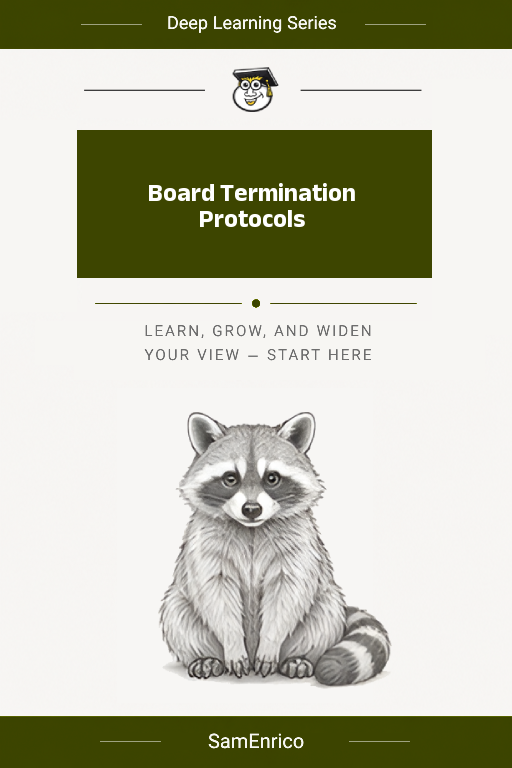
Board Termination Protocols eBook
End advisory relationships gracefully when members
End advisory relationships gracefully when members move, change capacities, or no longer fit your needs.
Formats
Free sample
Chapter 1: The Rotting Apple--–- On a rainy Tuesday in Portland, the executive director of a respected youth literacy nonprofit sat in her parked car outside the board meeting, gripping the steering wheel so hard her knuckles were white. Inside that conference room waited a board member who had, three months earlier, called her a "bureaucratic idiot" in front of the entire staff. Three other board members had quietly told her they were considering resigning because of this same person. The organization had lost two major donors who witnessed the board's dysfunction during a site visit. And yet, for eighteen months, no one had done anything.
The board chair, a kind-hearted retired banker, kept saying, "Let's give him another chance. He means well."She did not go inside that night. She went home, updated her resume, and within six weeks accepted a position at a different organization. The literacy nonprofit replaced her, then replaced her replacement eighteen months later. The board member never left.
The organization never recovered its donor base. Three years after that rainy Tuesday, it quietly closed its doors.This is not a story about a toxic board member. It is a story about a board that lacked the courage to fire one.The Silence That Kills The literature on board governance is vast and, in many ways, excellent. Best-selling authors like William Bowen in The Board Book and Peter Banko in The Necessary Goodbye have written incisively about CEO succession, board structure, strategic planning, and even how to fire employees. Walk into any business bookstore, and you will find dozens of titles on terminating underperforming staff members.
There are scripts, checklists, legal guides, and HR templates for every imaginable employment scenario.But find a book about firing a board member—a volunteer, a peer, a donor, perhaps even a founder—and the shelves fall silent.This is The Coverage Gap, and it is dangerous. Board members occupy a unique legal and social position. They are not employees; employment law does not protect them in the same way. But they are also not merely volunteers in the traditional sense; they carry fiduciary duties that can expose the entire organization to liability. And unlike employees, board members are often powerful community figures, major donors, or long-standing friends of the founding family.
They feel, in the worst sense of the word, unfireable.So boards do nothing. They tolerate. They accommodate. They "give another chance." They wait for the problem to solve itself through resignation or, failing that, death. And while they wait, the organization decays.The Cost of Inaction: Three Lenses The decision to avoid a difficult termination is rarely made through explicit, rational calculation.
It is made through a thousand small acts of avoidance: the agenda item that never gets added, the conversation that never happens, the evaluation that never gets written. But avoidance has a cost, and that cost can be measured.Lens One: Staff Morale Board members do not manage staff directly, but they set the cultural tone for the entire organization. A board member who bullies the executive director, berates a development associate, or publicly humiliates a program manager does not need a supervisory role to inflict damage. They need only a seat at the table.Consider the case of a community health clinic in the Midwest. A board member with a background in finance took it upon himself to "audit" the executive director's expense reports, questioning every coffee purchase and mileage reimbursement.
He did this not through formal channels but by cornering the executive director in hallways and sending accusatory late-night emails. The executive director, a high-performing leader with fifteen years of experience, began suffering from insomnia and anxiety. Within eight months, she resigned. The board member remained.The cost of that departure rippled outward. The next executive director lasted fourteen months.
The development director quit after a single encounter with the same board member. The clinic's grant applications suffered from the leadership instability, and two major foundation grants were not renewed. All of this traced back to one board member whose behavior was never addressed.When staff witness board dysfunction, they learn a powerful lesson: this organization does not protect its people. High performers, who have options, leave. Low performers, who have fewer options, stay and disengage.
Quiet quitting is not an employee failure; it is an organizational failure to create a safe and functional environment.Lens Two: Donor Confidence Donors give to missions, but they also give to leadership. A donor who sits in on a board meeting and witnesses infighting, personal attacks, or obvious disengagement will think twice before writing a large check. Major donors, in particular, conduct their own due diligence. They talk to board members. They ask about governance.
They notice when a board is dysfunctional.A national survey cited in the Stanford Social Innovation Review found that 40 percent of major donors listed "board instability or dysfunction" as a red flag that would cause them to pause or redirect giving. Forty percent. That is not a minor concern; it is a structural vulnerability.The literacy nonprofit in Portland learned this lesson the hard way. A family foundation that had given $50,000 annually for a decade sent a program officer to observe a board meeting. The program officer witnessed the toxic board member interrupt the executive director seven times in ninety minutes, dismiss the finance committee's report as "incompetent," and then suggest that the board chair was "asleep at the wheel." The program officer wrote a single sentence in her internal memo: "Governance concerns." The grant was not renewed.The board never knew why the funding stopped.
They assumed the foundation had changed its priorities. They were wrong.Lens Three: Strategic Momentum Board members have one primary job: to govern. That means making strategic decisions about mission, leadership, finance, and risk. A disengaged board member—the Ghost, as we will explore in Chapter 3—who misses meetings, fails to read materials, and votes randomly does not merely fail to contribute. They actively undermine the board's ability to function.Imagine a board deliberating a merger with a smaller organization.
The proposal has been vetted by a committee, reviewed by legal counsel, and discussed across three meetings. At the moment of the vote, a member who has attended none of those meetings and read none of the materials asks, "What is this about again?" Then they vote no. The merger fails. The smaller organization shuts down two years later. The cost is measured not in dollars but in lives disrupted, services lost, missions abandoned.A board that tolerates disengagement cannot execute strategic decisions with confidence.
Every vote is a gamble. Every discussion is diluted by the need to re-explain what should already be known. The organization moves at the speed of its least engaged member, and in a competitive environment, that speed is fatal.The Rotting Apple Theory There is an old metaphor in organizational psychology: one rotten apple spoils the barrel. It is not merely that the rotten apple is bad; it is that the rot spreads. The same is true in governance.A single problematic board member changes the behavior of everyone around them.
Other board members become resentful, watching the dysfunction while feeling powerless to stop it. Meetings become performative, with members choosing…
This is the end of the free sample. Get the eBook to keep going. Buy now
About this book
Details
- Author
- Eubanks Malisa
- Publisher
- SamEnrico
- Language
- English
- Genre
- Non-Fiction, Mental Wealth, Transition Management
- Released
- 2026-06-01
- Pages (approx.)
- 118
- Available as
- eBook, Audiobook

Read better in the ZLOADR app
Your eBooks on your phone or tablet. Sign in with your SamEnrico account and start reading.
More by Eubanks Malisa
 Deep Work Metrics and TrackingEubanks Malisa$11.99
 Moving Labor Cost Comparison GuideEubanks Malisa$11.99
 Foreign Language Vocab AcquisitionEubanks Malisa$11.99
 Digital Planner Etsy Star Seller GuideEubanks Malisa$11.99
 Sleep and TBI MemoryEubanks Malisa$11.99
 The Star-Spangled Sky: How the American Revolution Ignited a Cosmic AwakeningEubanks Malisa$11.99
 Hops & Hope: The Untold Story of Sierra Nevada’s Craft Beer RevolutionEubanks Malisa$11.99
 Global Comms Approval WorkflowEubanks Malisa$12.99
 Understanding Cholestatic Jaundice Renal Tubular InsufficiencyEubanks Malisa$17.99
 LocksmithEubanks Malisa$11.99
 Ultimate Handbook Guide to Palikir : (Federated States of Micronesia) Travel GuideEubanks Malisa$11.99