
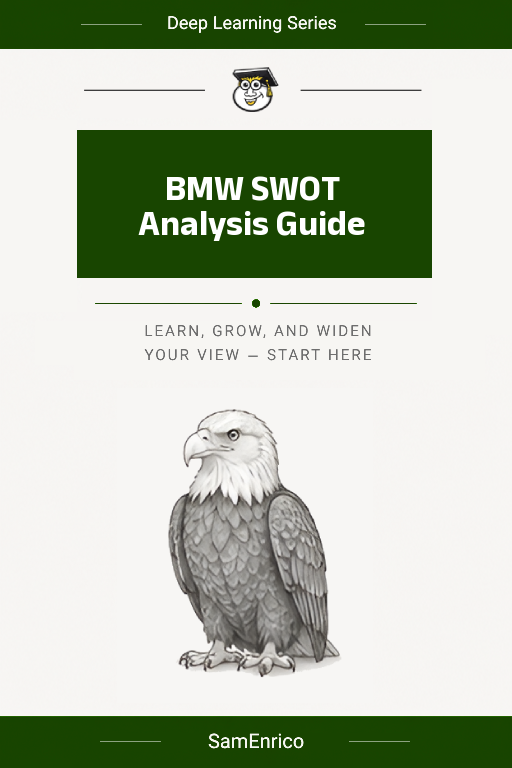
Non-FictionStrategic AtlasAuto Analysis
BMW SWOT Analysis Guide eBook
Analyze luxury positioning, EV transition (i brand
by Foote Bruno
Analyze luxury positioning, EV transition (i brand), Chinese market exposure, and premium tech costs.
Formats
Free sample
Chapter 1: Beyond the Badge...--The last time BMW truly surprised the world was 2013. That year, in a leased building tucked away from Munich’s gleaming headquarters, a small team of engineers unveiled a car that should have defined the next decade. The BMW i3 was a spaceship disguised as a city car—a carbon-fiber passenger cell glued to an aluminum chassis, powered by a range-extender engine that sounded like a nervous sewing machine. It had rear-hinged doors, a dashboard made of renewable eucalyptus, and a turning circle that embarrassed Smart cars. Reviewers called it visionary.
Environmentalists called it proof. BMW’s own dealers called it impossible to sell.The i3 was too expensive, too weird, and too early. BMW sold just over 250,000 of them across a decade—a rounding error compared to the 3 Series. By 2020, the company quietly wound down production, blamed the car’s complexity, and returned to what it knew best: building beautiful, powerful, profitable internal combustion sedans that drove like nothing else. The i3 became a museum piece, a footnote in BMW’s centenary history books.But here is the uncomfortable question this chapter forces every reader to confront: Was the i3 a failure, or was BMW’s willingness to learn from it the failure?In the decade between the i3’s launch and today, the definition of automotive luxury has been rewritten not by Germans but by Americans and Chinese.
Tesla proved that software could be more valuable than horsepower. Nio proved that a smartphone-like user experience could command premium prices. Xiaomi, the phone maker, proved that an outsider could build an EV that made legacy automakers look like mainframe computer companies in an i Phone world. And BMW, for all its engineering excellence, has been playing catch-up ever since.This chapter establishes the baseline that the entire SWOT analysis depends upon. It answers one question: What does “premium” even mean in 2026, and where does BMW stand?
The answer will determine whether Neue Klasse—BMW’s €10 billion bet on the future—becomes the second coming of the 3 Series or the second coming of the i3.The Old Gospel: Horsepower, Leather, and the Ultimate Driving Machine To understand how far the goalposts have moved, we must first understand where they used to stand. For most of BMW’s history—from the 1962 Neue Klasse sedans that saved the company from bankruptcy to the E30 M3 that became a cult object to the F30 3 Series that dominated global sales charts—luxury meant a specific set of tangible, measurable attributes.Mechanical superiority was the first pillar. BMW engines revved higher, responded faster, and produced more power per liter than Mercedes or Audi equivalents. The straight-six was a symphony; the V8 was a thunderstorm. Compressors, turbochargers, and eventually twin-power turbo technology kept BMW ahead of the curve.
When a customer paid a premium for a BMW, they were paying for engineering that could be felt through the accelerator pedal and heard through the exhaust note.Chassis dynamics were the second pillar. BMW popularized the phrase “Sheer Driving Pleasure” not as marketing fluff but as a literal description. The 50/50 weight distribution, the rear-wheel-drive architecture, the precise steering feel—these created a connection between driver and road that rivals spent decades trying to copy. A BMW cornered like no other sedan in its class. That was the point.Heritage and status formed the third pillar.
The blue-and-white roundel, supposedly representing a spinning propeller (though former BMW archivist Fred Jakobs has convincingly argued it actually derives from the Bavarian flag), carried a century of racing victories, cinematic appearances, and cultural cachet. Driving a BMW signaled taste, success, and an appreciation for the finer things—without the ostentation of a Mercedes or the flash of a Porsche.Interior craftsmanship was the fourth pillar, though less celebrated. BMW’s cabins used high-grade leather, real wood trim, and switchgear that clicked with satisfying precision. The i Drive controller, introduced in 2001, was derided at first but eventually became the gold standard for infotainment interfaces—a single knob that controlled navigation, audio, climate, and vehicle settings without requiring the driver to look away from the road.In 2016, these four pillars still held. Tesla’s Model S was a curiosity for Silicon Valley millionaires.
Chinese brands were cheap, unreliable, and irrelevant outside their home market. BMW sold 2.3 million vehicles globally, posted record profits, and watched its stock price climb. The future looked like more of the same, only faster and more efficient.Then everything changed.The New Paradigm: Software, Intelligence, and the Smartphone on Wheels The shift from mechanical luxury to digital luxury did not happen overnight, but it happened faster than any legacy automaker anticipated. Three forces converged to redefine what customers expect when they spend €60,000 or more on a vehicle.First, the Tesla effect. Tesla proved that a car could improve after purchase through over-the-air software updates.
A 2018 Model 3 gained features—sentry mode, dashcam functionality, enhanced autopilot—that did not exist when the owner drove it off the lot. This turned the automotive business model on its head. For a century, cars depreciated the moment they left the showroom; Tesla demonstrated that a well-written piece of code could actually increase a car’s value and functionality over time. Legacy automakers, including BMW, were caught flat-footed. Their electronic architectures were designed for the factory, not the cloud.
Updating a BMW’s software often required a dealer visit, a USB stick, and a prayer.Second, the Chinese innovation engine. While German automakers debated the merits of electric powertrains, Chinese brands like Nio, Xpeng, and Li Auto raced ahead not on battery chemistry but on user experience. These companies understood that their customers—young, wealthy, tech-native—did not care about horsepower or ring lap times. They cared about whether the voice assistant understood their accent, whether the rear-seat entertainment system could stream Netflix, and whether the car could learn their preferences over time. The result was a new category: “Luxury Intelligence.” A Nio ET7 does not just drive you; it greets you by name, adjusts the seat based on your height, suggests restaurants based on your calendar, and plays your podcast exactly where you left off.
BMW’s i Drive, by comparison, felt like a Black Berry in an i Phone world.Third, the democratization of performance. Electric motors produce instant torque without the complexity of multi-speed transmissions. A €40,000 BYD Seal can accelerate from 0-60 km/h in 3.8 seconds—faster than a 1990s Ferrari. This erased the performance gap that luxury brands had relied upon for decades. If a mass-market EV can out-accelerate a BMW M3 in stoplight grand prix, what are you really paying for when you buy the BMW?
The answer, increasingly, is not speed. It is the totality of the experience—which now includes software, connectivity, and intelligence.The 2026 Snapshot: BMW’s Precarious Position Based on Q1 2026 sales data from Automotive News Europe, the China Automobile Dealers Association, and Kelley Blue Book, BMW’s global position reveals a company caught between two eras.In mature markets—Germany, the United Kingdom, the United States—BMW remains strong but not dominant. Sales of the X5 and 3 Series remain healthy, particularly among buyers aged 50 and above. These customers grew up with BMW, remember the…
This is the end of the free sample. Get the eBook to keep going. Buy now
About this book
Details
- Author
- Foote Bruno
- Publisher
- SamEnrico
- Language
- English
- Genre
- Non-Fiction, Strategic Atlas, Auto Analysis
- Released
- 2026-05-29
- Pages (approx.)
- 148
- Available as
- eBook, Audiobook

Read better in the ZLOADR app
Your eBooks on your phone or tablet. Sign in with your SamEnrico account and start reading.
More by Foote Bruno
 Gratitude Letters GuideFoote Bruno$11.99
 Senior Incontinence EsteemFoote Bruno$11.99
 Food Stamps and DignityFoote Bruno$11.99
 Real Estate EQ NegotiationFoote Bruno$11.99
 Self Esteem for Second Marriage PartnersFoote Bruno$11.99
 The Plague Doctors of the Spanish Empire: Science and Sovereignty in the Golden AgeFoote Bruno$11.99
 Accounting Formula Field ManualFoote Bruno$12.99
 Understanding Mycosis Fungoides LymphomaFoote Bruno$17.99
 The 30-Day Cleanse with a 12-Day Reintroduction ProtocolFoote Bruno$11.99
 How to Become a Dog LicenserFoote Bruno$11.99
You may also like
 Hong Kong Handover 1997Dunn Johnnie$11.99
 Zumba For Postnatal Recovery CourseNeal Christian$11.99
 Zumba for BeginnersLadner Nikia$11.99
 YouTube Comment Mining GuideHumes Pandora$12.99
 Worry Box MeditationCarlin Rudy$11.99
 Workplace Stress MeditationNguyen Lynn$11.99
 Workplace Stress and Sleep RepairHawley Ivory$11.99
 Workplace Perfectionism CureDelaney Jeffry$11.99
 Workplace Injustice Anger GuideWallen Isabelle$11.99
 Work Addiction and Burnout LinkGreenwood Ester$11.99
 Women in Yoga and WellnessBeattie Galina$11.99
 Women in Stand Up ComedyChun Evangeline$11.99