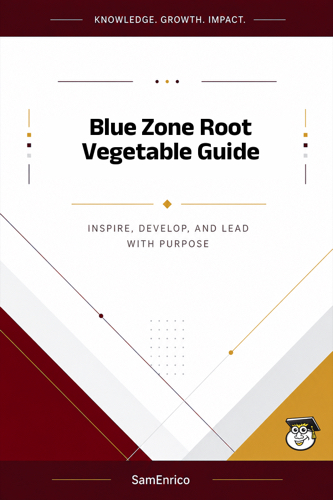
Blue Zone Root Vegetable Guide eBook
Eats potatoes, yams, and carrots.
Eats potatoes, yams, and carrots.
Formats
Free sample
Chapter 1: The Underground Paradox--–- On a small island in the Pacific Ocean, thousands of miles from the nearest American supermarket, a 104-year-old woman named Ushi Okushima rises before dawn. She walks slowly but steadily to her small garden, where she digs into the dark soil with a hand trowel. What she pulls from the ground is not a gleaming superfood packaged in biodegradable cardboard, nor is it a powder shipped from a Silicon Valley startup. It is a knobby, dirt-crusted, unremarkable-looking purple sweet potato. She will eat this potato for breakfast, steamed and cooled, without butter, without sugar, without fanfare.
She has eaten this potato nearly every morning for more than eight decades. She is not worried about carbohydrates. She is not counting macros. She is, quite simply, outliving almost everyone on the planet.This is the underground paradox.The foods that grow beneath the soil—potatoes, yams, carrots, sweet potatoes, and their starchy kin—have been systematically demonized by the modern American diet industry. They are called "high glycemic." They are blamed for obesity epidemics.
They are stripped from keto menus, erased from paleo shopping lists, and hidden away as guilty pleasures reserved for Thanksgiving dinners drowned in butter and brown sugar. Meanwhile, in the five regions of the world with the highest concentrations of centenarians—places Dan Buettner and his team of demographers and anthropologists identified as Blue Zones—these same underground foods are dietary pillars, consumed daily, sometimes multiple times per day, by people who rarely develop diabetes, almost never become obese, and routinely live to 100 in good health.How can the same food be poison in one culture and medicine in another?The answer, as this chapter will demonstrate, has almost nothing to do with the potato itself and almost everything to do with what we have done to it, what we have paired with it, and how we have chosen to process it. The difference between a Blue Zone root vegetable and a Standard American Root Vegetable is not botanical. It is behavioral. And understanding that difference is the first step toward reclaiming one of the most affordable, accessible, nutritionally dense, and satisfying food categories on earth.This book is not a diet.
It is a reeducation. And it begins in the dirt.The Geography of Longevity: A Brief History of Blue Zones Before we can understand why roots matter, we must understand the Blue Zones themselves. The term was coined by National Geographic Fellow Dan Buettner, who assembled a team of leading demographers to identify geographic regions where people lived measurably longer than average—not just longer lives, but longer healthspans, meaning they remained free of chronic disease and disability well into their final years. After cross-referencing birth certificates, death records, and census data, the team identified five regions that met the criteria for Blue Zones:Okinawa, Japan: Home to the world's longest-lived women, Okinawa's traditional diet was built around the purple sweet potato (imo), which arrived via trade routes from the Americas and saved the island from multiple famines. Okinawan centenarians typically ate sweet potatoes daily, often at multiple meals, alongside bitter melon, tofu, and small amounts of fish.Sardinia, Italy: In the mountainous highlands of this Mediterranean island, researchers found the world's highest concentration of male centenarians.
The Sardinian diet featured whole-grain bread, pecorino cheese made from grass-fed sheep, and notably, the common white potato—eaten boiled or roasted, always with olive oil and vegetables.Nicoya, Costa Rica: The Nicoya Peninsula produced some of the lowest rates of middle-age mortality in the world. Its traditional diet centered on yams, pejibaye (a starchy peach palm fruit), beans, corn tortillas, and tropical fruits. Nicoyan centenarians typically ate a yam-based soup or stew for lunch, the largest meal of the day.Ikaria, Greece: This small Aegean island was found to have some of the lowest rates of dementia and middle-age mortality globally. The Ikarian diet emphasized potatoes, wild greens, goat's milk, and small amounts of fish. Ikarians famously drank herbal teas—rosemary, sage, and dandelion—but also ate potatoes at almost every meal, often stewed with olive oil and tomatoes.Loma Linda, California: Unlike the other four, Loma Linda is not a geographic region defined by isolation or ancestry.
It is a community of Seventh-day Adventists who, for religious reasons, follow a predominantly plant-based diet. Their diet includes significant quantities of potatoes, carrots, sweet potatoes, and legumes. Adventist centenarians eat potatoes as a base for nutrient-dense toppings—beans, broccoli, nutritional yeast—rather than as a vehicle for butter, cheese, or sour cream.What these five remarkably different cultures share is not a single food, not a specific macronutrient ratio, not a supplement regimen, and certainly not a diet book. What they share is a pattern of eating that treats root vegetables as everyday staples, prepared simply, eaten in moderation, and almost never deep-fried or loaded with processed toppings.The Great American Paradox: Why We Fear What Centenarians Love If root vegetables are so healthful, why have Americans been taught to fear them?The answer is a story of industrial agriculture, marketing, nutrition science simplified beyond usefulness, and a catastrophic conflation of food with product.Consider the potato. In the United States, the vast majority of potatoes are consumed not as boiled, steamed, or roasted whole foods, but as processed products: French fries (consumed at an average rate of 30 pounds per person per year), potato chips (another 15 pounds per person), and instant mashed potatoes (made from dehydrated flakes and often loaded with sodium and preservatives).
According to the USDA, approximately 65% of all potatoes grown in the United States are processed into frozen, fried, or dehydrated forms before reaching consumers. A very small fraction—less than 20%—are purchased fresh and cooked at home in simple preparations.This is not a potato problem. This is a processing problem.When a potato is deep-fried in industrially processed seed oil (soybean, canola, sunflower), it absorbs large quantities of oxidized fats and develops acrylamides—compounds formed when starchy foods are cooked at very high temperatures, which have been classified as probable human carcinogens. When that fried potato is then coated in salt, served with ketchup (high in sugar), or topped with processed cheese sauce (high in sodium, saturated fat, and preservatives), the resulting "meal" bears almost no nutritional resemblance to the root that came out of the ground.The same transformation occurs with sweet potatoes. In the American context, sweet potatoes are most famously consumed as "candied yams"—a dish that involves boiling or baking sweet potatoes, then coating them in butter, brown sugar, marshmallows, or maple syrup.
A single serving of candied yams contains more added sugar than a can of soda. The sweet potato has become a dessert, not a vegetable.Carrots have fared somewhat better, but even here, the American food system has intervened. Most carrots consumed in the United States are "baby carrots"—actually full-sized carrots mechanically shaved down into uniform, snackable shapes. They are often washed in a solution containing small amounts of chlorine (to prevent bacterial growth) and stored for months in controlled atmospheres. While still nutritionally decent, they are a far cry from the full-length, soil-flecked, greens-attached carrots that Nicoyan and Loma Linda centenarians pull…
This is the end of the free sample. Get the eBook to keep going. Buy now
About this book
Details
- Author
- Branham Tanisha
- Publisher
- SamEnrico
- Language
- English
- Genre
- Non-Fiction, Health & Wellness, Vegetables
- Released
- 2026-06-06
- Pages (approx.)
- 135
- Available as
- eBook, Audiobook

Read better in the ZLOADR app
Your eBooks on your phone or tablet. Sign in with your SamEnrico account and start reading.
More by Branham Tanisha
 Parent Fitness Time FinderBranham Tanisha$11.99
 Anger Restructuring FlashcardsBranham Tanisha$11.99
 Withdrawal Medication TaperingBranham Tanisha$11.99
 Empathy Validation GuideBranham Tanisha$11.99
 MDD in Urban PopulationsBranham Tanisha$11.99
 Riding the Wave DBTBranham Tanisha$11.99
 Managing Remote Work HoursBranham Tanisha$11.99
 The Resurrectionists: Europe's Darkest Trade in CorpsesBranham Tanisha$11.99
 The Gold of the Vandals: How a Treasure Funded a War That Shaped EuropeBranham Tanisha$11.99
 A Collector's Handbook to the Healey 2.4-litre Elliot SaloonBranham Tanisha$11.99
 Service Providers Guide to Auto AlarmsBranham Tanisha$11.99
 How to Produce Hydroponics Equipment and SuppliesBranham Tanisha$11.99