
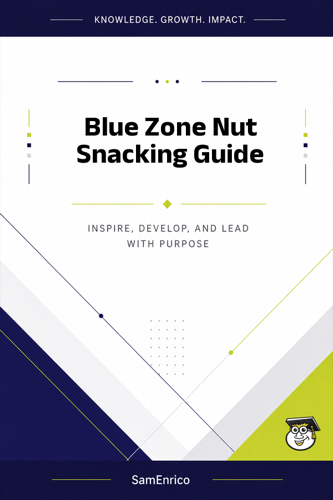
Blue Zone Nut Snacking Guide eBook
Eat handful of almonds walnuts or pistachios betwe
Eat handful of almonds walnuts or pistachios between meals.
Formats
Free sample
Chapter 1: The Longevity Handful...--The first time I watched a 102-year-old woman crack open a pistachio with her teeth, I felt like an idiot.I had spent the previous decade chasing longevity. I had tried intermittent fasting, ketogenic diets, plant-based protocols, collagen peptides, NAD boosters, and a half-dozen supplements whose names I could not pronounce. I had spent thousands of dollars on powders that tasted like dirt and promised to turn back my biological clock. And yet here, in a sun-baked village on the Greek island of Ikaria, a woman who had lived through two world wars was doing something so simple, so ordinary, so laughably cheap that I had overlooked it for ten full years.She was eating a handful of nuts between meals.Not organic, not artisanal, not cold-pressed or lab-tested. Just nuts.
Almonds she had picked from a tree behind her house. Walnuts she had cracked open with a stone. Pistachios she had shelled one by one while talking to her neighbor. She did this every day, twice a day, for perhaps ninety of her one hundred and two years. And she was not the exception.
She was the rule.The Question That Changed Everything Let me ask you something. If I told you there was a single food—available in every grocery store, requiring no preparation, costing less than a dollar per serving, backed by decades of peer-reviewed research—that could reduce your risk of heart disease by thirty percent, slash your inflammation markers by twenty-five percent, and add an average of two to three years to your life expectancy, would you eat it?Of course you would. Anyone would.Now let me ask you a harder question. If that food has been sitting in plain sight for your entire life, and the diet industry has systematically hidden it from you because it is too cheap to brand and too simple to sell, how does that make you feel?Because that is exactly what has happened with nuts.The Five Places Where People Forget to Die Before we go any further, I need to introduce you to five very specific places on earth. Demographers and epidemiologists call them Blue Zones, a term coined by National Geographic fellow Dan Buettner.
The rest of us might call them the places where people forget to die.Ikaria, Greece. A small island in the Aegean Sea where one in three residents lives into their nineties. Dementia is so rare that the local word for "forgetfulness" is rarely used. People here do not retire—they garden, walk to neighbors' houses, and drink herbal tea until their final days.Sardinia, Italy. A mountainous region in the center of the Mediterranean island where the highest concentration of male centenarians in the world lives.
Sardinian shepherds walk miles every day, eat cheese from grass-fed sheep, and drink red wine with friends every afternoon.Nicoya, Costa Rica. A peninsula on the Pacific coast where residents have the lowest rate of middle-age mortality in the world. Nicoyans drink hard water rich in calcium and magnesium, eat a diet built around beans and corn, and maintain a strong sense of life purpose well into old age.Okinawa, Japan. A chain of islands in the East China Sea where women live longer than anywhere else on earth. Okinawans practice "hara hachi bu"—eating until they are eighty percent full—and maintain lifelong social circles called "moai" that provide financial and emotional support for decades.Loma Linda, California.
A small city east of Los Angeles where a community of Seventh-day Adventists outlives the average American by seven to ten years. Adventists do not smoke, drink minimally or not at all, and follow a plant-based diet rooted in the Book of Genesis.Five different cultures. Five different climates. Five different diets. And yet, when researchers analyzed everything these communities ate, one food appeared in every single one of them.Nuts.Not the same nuts, necessarily.
Sardinians eat almonds and walnuts. Nicoyans eat pistachios. Ikarians eat walnuts from the trees that line their roads. Okinawans eat very few nuts historically but have adopted them in modern times. Adventists eat almonds by the handful and peanuts by the jar.
The specific nut varied. The habit did not.Every single Blue Zone community ate nuts between meals, every single day, as a deliberate and non-negotiable part of their eating pattern.The Study That Should Have Changed Everything In 2001, researchers at Loma Linda University began analyzing data from the Adventist Health Study 2. This was not a small survey. It followed ninety-six thousand men and women across North America for nearly a decade. It controlled for income, education, exercise, smoking, alcohol use, and every other variable you can imagine.The question was simple: what do people who live a long time eat?The answer was published in the American Journal of Clinical Nutrition in 2015.
And the answer was so inconvenient for the food industry that it barely made the news.People who ate nuts at least five times per week outlived those who rarely ate nuts by an average of two to three years. They had lower rates of heart disease, lower rates of cancer, lower rates of respiratory disease, and lower rates of cognitive decline. The relationship was dose-dependent—the more nuts people ate, up to a point, the longer they lived.But here is what made the study truly remarkable. The researchers ran every possible sensitivity analysis. They excluded anyone with pre-existing conditions.
They adjusted for exercise (Adventists are active but not extreme athletes). They adjusted for other dietary factors (vegetarian Adventists live longer than non-vegetarian Adventists, but both groups benefited from nuts). They even ran a separate analysis comparing nut-eaters to non-nut-eaters within the same family.The nut effect held.When the researchers calculated the actual number, it came out to approximately two hundred and fifty thousand additional days of life for the average nut-eater. That is not a typo. Two hundred and fifty thousand extra days.
Granted, spread across a population, but still—the magnitude was staggering.The Great Fat Lie Now, if nuts are so healthy, you might be wondering why your doctor did not tell you to eat them twenty years ago. The answer is not incompetence. The answer is a fifty-year campaign of misinformation funded by the sugar industry.Let me take you back to 1965. A group of Harvard scientists, funded by the Sugar Research Foundation, published a review article in the New England Journal of Medicine that shifted the blame for heart disease away from sugar and onto saturated fat. The sugar industry had paid the equivalent of fifty thousand dollars in today's money to make sure that fat—not sugar—became the villain.The result was a dietary panic that lasted three decades.
Americans stopped eating eggs, stopped eating butter, stopped eating nuts. We replaced those foods with low-fat, high-sugar alternatives that made us fatter and sicker than ever before. The low-fat muffin, the fat-free yogurt, the reduced-fat peanut butter—all of these were products of the Great Fat Lie.And nuts were caught in the crossfire. Because nuts contain fat. Quite a lot of fat, actually.
About fourteen grams per serving, mostly unsaturated. But in the low-fat hysterical era, a handful of almonds looked the same…
This is the end of the free sample. Get the eBook to keep going. Buy now
About this book
Details
- Author
- Michael Renata
- Publisher
- SamEnrico
- Language
- English
- Genre
- Non-Fiction, Health & Wellness, Snacking
- Released
- 2026-06-11
- Pages (approx.)
- 137
- Available as
- eBook, Audiobook

Read better in the ZLOADR app
Your eBooks on your phone or tablet. Sign in with your SamEnrico account and start reading.
More by Michael Renata
 Cooling Bedding Materials GuideMichael Renata$11.99
 Gut Health for HormonesMichael Renata$11.99
 Chronic Pain MeditationMichael Renata$11.99
 The Moonlit Pact: A Yokai's Forbidden LoveMichael Renata$11.99
 Fireworks PhotographyMichael Renata$11.99
 State Franchise Tax for Non Resident LLCsMichael Renata$12.99
 How to Produce Bungee CordsMichael Renata$11.99
 How to Start a Paper and Paperboard Production Machinery (wholesale) Business (Beginners Guide)Michael Renata$11.99
You may also like
 PCOS Snack List GuidePetersen Ila$11.99
 Gut Health Snack GuideAdler Alyson$11.99
 Mediterranean Snack GuideWilbanks Eartha$11.99
 Macro Friendly SnacksMedlock Leota$11.99
 Keto Snacks On The GoFonseca Sherrill$11.99
 Blue Zones Snacking RulesBravo Lonnie$11.99
 Vegan Snack Nutrition GuideWheatley Linette$11.99
 Low Carb Snacks HandbookMoreland Herlinda$11.99
 Blue Zone Snack GuideDeleon Robbi$11.99