

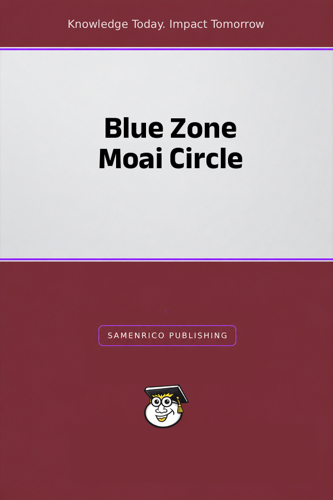
Non-FictionHealth & WellnessSocial
Blue Zone Moai Circle eBook
Create your own committed social support group for
by Reyes Sergio
Create your own committed social support group for life.
Formats
Free sample
Chapter 1: The Loneliness Epidemic--The call came at 11:47 PM. Sarah’s phone buzzed against her nightstand, and she jolted awake, heart pounding. It was her sister. Their mother had fallen. Again.
This was the third time in six months. Sarah threw on jeans, grabbed her keys, and drove forty-five minutes to the hospital. She sat alone in the waiting room until 4 AM, scrolling through her phone. Three hundred Facebook friends. Forty-seven Instagram followers who liked her vacation photos.
Fourteen colleagues who had her cell number. Not one person she felt comfortable calling at midnight to say, “I’m scared. Can you sit with me?”She wasn’t alone in that waiting room. She was surrounded by families—couples holding hands, adult children conferring with doctors, friends bringing coffee. Sarah had none of that.
At forty-two years old, freshly divorced, with two kids away at college, she had built a life that looked successful on paper: a Director title, a mortgage she could afford, a Peloton she used twice a week, and a phone full of contacts she hadn’t spoken to in months. She was, by every objective measure, winning at adulthood. And she had never felt more alone.The next morning, her mother was stable. Sarah drove home, walked into her kitchen, and stood there for ten minutes trying to remember the last time someone had cooked her a meal. Not a restaurant.
Not takeout. A meal made by hands that cared about her. She couldn’t remember. She opened her calendar. The next three weeks were full of meetings, webinars, and a dentist appointment.
Not a single coffee date. Not one dinner with friends. Not even a text thread that went deeper than “we should catch up soon.”Sarah is not a tragedy. She is not an outlier. She is the average American adult in the twenty-first century.
And her story is the reason this book exists.The Quiet Catastrophe No One Is Talking About In 1938, Harvard researchers began a study that would last longer than any other in the history of psychology. They recruited 268 male undergraduates and set out to answer a simple question: What makes a good life? The researchers tracked these men for seventy-five years, through war and peace, marriage and divorce, success and failure, health and illness. They measured everything: career trajectories, cholesterol levels, political beliefs, family dynamics, alcohol consumption, IQ scores, and social connections. They watched these men grow old, and they watched their children grow up.
They buried most of the original participants.When the fourth director of the study, Dr. Robert Waldinger, stood on a TED stage in 2015 to reveal the study’s most important finding, he didn’t talk about money, fame, or career achievement. He didn’t talk about genetics, diet, or exercise. He said this: “The clearest message from the seventy-five-year Harvard Study of Adult Development is this: Good relationships keep us happier and healthier. Period.”The study found that people who were most satisfied in their relationships at age fifty were the healthiest at age eighty.
Loneliness, the study revealed, was as toxic as smoking fifteen cigarettes a day. It was more dangerous than obesity. It was as corrosive to long-term health as alcoholism. And here is the part that should terrify you: loneliness doesn’t just feel bad. It changes your biology.
It raises cortisol levels, which increases inflammation, which leads to heart disease, dementia, and a weakened immune system. Lonely people have higher blood pressure. They have more trouble sleeping. They recover from illness more slowly. Their telomeres—the protective caps at the ends of their chromosomes—shorten faster, which means they age faster at a cellular level.Sarah didn’t know any of this as she stood in her kitchen that morning.
She only knew that she felt hollow. But the science is unambiguous: her loneliness was not just an emotional problem. It was a medical emergency.The Contrarian Claim This Book Will Prove The loneliness industry—a sprawling, multi-billion dollar ecosystem of apps, workshops, self-help books, and wellness retreats—wants you to believe that the solution to your isolation is something you can buy. Download this app. Take this course.
Attend this summit. Journal your way to connection. The implicit promise is that you can fix loneliness the same way you fix a leaky faucet: with the right tool and enough effort.Here is the truth that industry does not want you to hear: You don’t have a connection deficit. You have a commitment deficit.Think about the language we use around friendship. “Let’s grab coffee sometime.” “We should get together.” “I’ll text you.” These are not plans.
They are polite placeholders for nothing. They are linguistic smoke screens we deploy to avoid the terrifying prospect of actually committing to another human being. We have replaced the word “yes” with “maybe” and the word “maybe” with “sounds great, let me check my calendar.” And we have convinced ourselves that this is just how adult friendship works.It is not how adult friendship works. It is how adult friendship dies.The Blue Zones—five regions around the world where people live measurably longer, healthier lives—do not have a loneliness problem. In Okinawa, Japan, elderly women gather in Moais, committed circles of five friends who support each other financially, emotionally, and spiritually from childhood until death.
In Sardinia, Italy, male shepherds laugh together daily, and that laughter—not their diet, not their genetics—is the primary reason Sardinian men live as long as Sardinian women, a statistical anomaly found almost nowhere else on earth. In Loma Linda, California, Seventh-day Adventists gather weekly for a “Sanctuary in Time,” a twenty-four-hour period of rest, reflection, and community that resets their stress levels and reminds them they belong.These people are not richer than you. They are not more disciplined. They do not have better genetics or more willpower. They have one thing you do not: a committed, structured, lifelong social support system.
They have a tribe that expects them to show up. And that expectation—not the desire for connection, but the obligation of it—is what keeps them alive.The Moai: Your Five-Person Lifeline The word “Moai” comes from the Japanese word for “meeting.” But in Okinawa, it means something deeper. A Moai is a circle of approximately five people who make a lifelong commitment to each other. The commitment is not emotional. It is structural.
Members contribute a small amount of money each month, and the pooled funds are given to one member in turn for a major purchase or emergency. Over time, the financial structure evolved into something more profound: an emotional safety net. When a member of a Moai gets sick, the others cook meals. When a member loses a job, the others help with expenses. When a member dies, the others raise the children.The Moai is not a friend group.
It is not a book club. It is not a support group you attend when you feel like it. It is a covenant. And the covenant is not based on convenience or proximity or shared hobbies. It is based on a single, non-negotiable principle: we show up for…
This is the end of the free sample. Get the eBook to keep going. Buy now
About this book
Details
- Author
- Reyes Sergio
- Publisher
- SamEnrico
- Language
- English
- Genre
- Non-Fiction, Health & Wellness, Social
- Released
- 2026-06-07
- Pages (approx.)
- 139
- Available as
- eBook, Audiobook

Read better in the ZLOADR app
Your eBooks on your phone or tablet. Sign in with your SamEnrico account and start reading.
More by Reyes Sergio
 Team Mind Mapping GuideReyes Sergio$11.99
 Processed Food AddictionReyes Sergio$11.99
 Logical Fallacy Avoidance GuideReyes Sergio$11.99
 NVC for CaregiversReyes Sergio$11.99
 Monotasking MethodReyes Sergio$11.99
 Nap for Exam PerformanceReyes Sergio$11.99
 The Stress Erectile Dysfunction GuideReyes Sergio$11.99
 Memrise Creator StoryReyes Sergio$11.99
 The Phantom of the Pacific: The Unsolved Murder on the Grandeur of the SeasReyes Sergio$11.99
 Soulful Struggle: The Unseen Battles of Diana Ross’s Rise to StardomReyes Sergio$11.99
 Nefertiti's Vanishing: The Lost Queen of the NileReyes Sergio$11.99
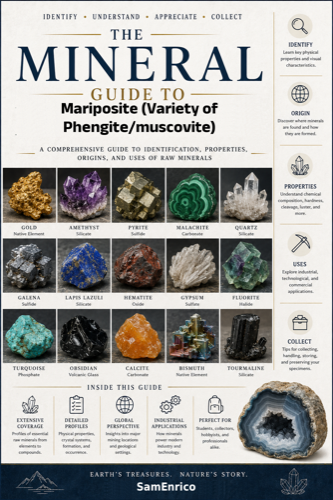 The Mineral Guide to Mariposite (Variety of Phengite/muscovite)Reyes Sergio$11.99
You may also like
 Hong Kong Handover 1997Dunn Johnnie$11.99
 Zumba For Postnatal Recovery CourseNeal Christian$11.99
 Zumba for BeginnersLadner Nikia$11.99
 YouTube Comment Mining GuideHumes Pandora$12.99
 Worry Box MeditationCarlin Rudy$11.99
 Workplace Stress MeditationNguyen Lynn$11.99
 Workplace Stress and Sleep RepairHawley Ivory$11.99
 Workplace Perfectionism CureDelaney Jeffry$11.99
 Workplace Injustice Anger GuideWallen Isabelle$11.99
 Work Addiction and Burnout LinkGreenwood Ester$11.99
 Women in Yoga and WellnessBeattie Galina$11.99
 Women in Stand Up ComedyChun Evangeline$11.99