
Non-FictionHealth & WellnessMeat Reduction
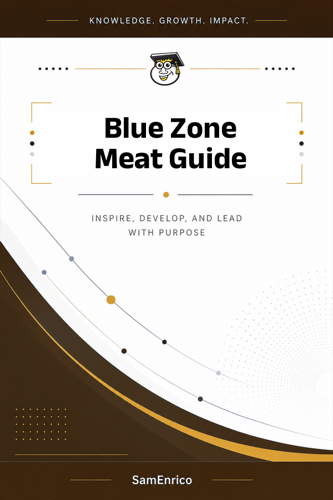
Blue Zone Meat Guide eBook
Eat meat only five times per month.
by Laney Torri
Eat meat only five times per month.
Formats
Free sample
Chapter 1: The 240-Pound Elephant–- Most people believe they know what a healthy diet looks like. They can recite the food pyramid from memory, or at least its modern replacement, the My Plate model. They know they should eat more vegetables, drink more water, and probably cut back on sugar. But ask them about meat, and suddenly the certainty evaporates. Is red meat dangerous or nutritious?
Should we eat like our cave-dwelling ancestors or like modern hunter-gatherers? Do we need animal protein to build muscle, or is tofu just as good? The confusion is so thick you could cut it with a dull steak knife.This book exists because that confusion has a cost. And the cost is measured not in confusion alone, but in years. Decades, actually.
The difference between the average American diet and the diet of the world’s longest-lived people is approximately ten to twelve additional years of life, free from chronic disease, dementia, and disability. That is not an exaggeration or a marketing gimmick. It is the conclusion of decades of demographic research, epidemiological studies, and on-the-ground investigation by teams from National Geographic, the National Institutes of Health, and universities around the world.The key difference between these two diets—the standard American diet and the Blue Zones diet—can be summarized in a single, shocking comparison. Are you ready for it? Here it is.The average American consumes approximately 240 pounds of meat per year.
That is roughly the weight of a professional football player’s offensive lineman. Every twelve months, the typical person in the United States eats the equivalent of a 300-pound human being in chicken, beef, pork, turkey, and processed meats. Let that sink in for a moment. Two hundred and forty pounds. That is not a typo.
According to the USDA Economic Research Service, the United States consistently ranks among the top meat-consuming nations on earth, with annual per capita consumption hovering between 220 and 270 pounds depending on the year and the specific categories included.Now consider the opposite end of the spectrum. A centenarian from Okinawa, Japan, or Sardinia, Italy, or Nicoya, Costa Rica, or Ikaria, Greece, or Loma Linda, California—the five authenticated Blue Zones where people regularly live to one hundred without dementia, disability, or chronic disease—consumes approximately 20 pounds of meat per year. That is roughly the weight of a small toddler. Twenty pounds annually means less than two pounds per month. Less than half a pound per week.
Less than two ounces per day, though in practice, Blue Zones centenarians do not eat meat daily at all. They eat it in bursts, in celebrations, as a condiment, as a flavoring agent, as a rare treat rather than a daily expectation.Twenty pounds versus 240 pounds. A toddler versus a lineman. That is the difference between a population that routinely reaches one hundred in good health and a population that spends its final decade battling heart disease, cancer, diabetes, and Alzheimer’s. That is the elephant in the room that the meat industry, the supplement industry, and the high-protein diet industry do not want you to see.But this book is not about shame, and it is not about vegetarian absolutism.
If you are a meat lover—and many readers of this book will be—you are about to receive some of the best news of your life. Because the research shows that you do not need to become a vegetarian or a vegan to achieve nearly all the longevity benefits of the Blue Zones diet. You do not need to give up bacon forever, or swear off burgers, or become the person at the barbecue who eats only the sad veggie patty while everyone else enjoys the ribs.What you need to do is change the frequency, the portion size, and the quality of the meat you eat. That is it. The science is remarkably clear on this point.
When researchers from Loma Linda University analyzed the health outcomes of 96,000 Seventh-day Adventists—a population that includes vegans, vegetarians, pescatarians, low-meat eaters, and regular meat eaters—they found that the low-meat eaters (those who consumed meat approximately once per week) lived nearly as long as the strict vegetarians. Both groups lived about a decade longer than the regular meat eaters who consumed meat daily or near-daily.Let me repeat that because it is the entire premise of this book. People who eat meat once per week live approximately ten years longer than people who eat meat daily. And they live almost as long as people who eat no meat at all. The difference between the once-weekly meat eater and the strict vegetarian was statistically significant but small.
The difference between the once-weekly meat eater and the daily meat eater was enormous.That means you can have your steak and eat it too. Just not every day. Not even every other day. About once a week. Five times per month.
That is the sweet spot. That is the number that emerges from the data when you look at all five Blue Zones, control for other lifestyle factors, and ask a simple question: How often do the world’s longest-lived people eat meat, and how much do they eat when they do?The answer, distilled into a practical protocol for the modern American, is this: five meat meals per month, with portions ranging from two to five ounces depending on the type of meal, for a total monthly meat consumption of approximately sixteen to eighteen ounces. That is one pound of meat per month. One pound. The average American eats twenty pounds of meat per month.
We are asking you to reduce from twenty pounds to one pound. That is a 95% reduction in meat consumption.I can feel your resistance already. That is too extreme, you are thinking. That is unrealistic. I could never do that.
My family would mutiny. My body needs protein. I will be hungry all the time. I will lose muscle. I will feel weak.
I will crave meat constantly and then binge on a weekend and undo all my progress.These are all valid concerns. And they are all addressed in the chapters ahead. But for now, I want you to notice something about your reaction. You just imagined reducing your meat consumption to five meals per month, and your brain immediately sounded an alarm. That alarm is not the voice of biological necessity.
It is the voice of habit, culture, marketing, and addiction. Because here is the truth that the meat industry has spent a hundred billion dollars to hide from you: humans do not need nearly as much meat as we have been told.Let us examine the evidence. The average adult male needs approximately 56 grams of protein per day. The average adult female needs approximately 46 grams per day. These are the official recommendations from the National Academy of Medicine, based on decades of nitrogen balance studies.
Now let us do some simple math. A single three-ounce serving of chicken breast contains about 26 grams of protein. A three-ounce serving of beef contains about 22 grams. A cup of cooked lentils contains about 18 grams. A cup of black beans contains about 15 grams.
A quarter-cup of almonds contains about 8 grams. A single egg contains about 6 grams. A cup of cooked quinoa…
This is the end of the free sample. Get the eBook to keep going. Buy now
About this book
Details
- Author
- Laney Torri
- Publisher
- SamEnrico
- Language
- English
- Genre
- Non-Fiction, Health & Wellness, Meat Reduction
- Released
- 2026-06-07
- Pages (approx.)
- 119
- Available as
- eBook, Audiobook

Read better in the ZLOADR app
Your eBooks on your phone or tablet. Sign in with your SamEnrico account and start reading.
More by Laney Torri
 Spinal Cord Injury PainLaney Torri$11.99
 Database Design CreativityLaney Torri$11.99
 Chemical Pregnancy SupportLaney Torri$11.99
 Wholesaling Purchase AgreementLaney Torri$11.99
 Quick Ratio Acid Test GuideLaney Torri$12.99
 Anger Restructuring for DepressionLaney Torri$11.99
 Gaming and AnxietyLaney Torri$11.99
 Freelance Portfolio ProtectionLaney Torri$11.99
 The Gentleman Surgeon: John Hunter and the Birth of Modern MedicineLaney Torri$11.99
 Marcus Aurelius: The Philosopher-Emperor's LegacyLaney Torri$11.99
 How to Produce Fabric SoftenerLaney Torri$11.99
 The Essential Guide to FranceLaney Torri$11.99
You may also like
 Hong Kong Handover 1997Dunn Johnnie$11.99
 Zumba For Postnatal Recovery CourseNeal Christian$11.99
 Zumba for BeginnersLadner Nikia$11.99
 YouTube Comment Mining GuideHumes Pandora$12.99
 Worry Box MeditationCarlin Rudy$11.99
 Workplace Stress MeditationNguyen Lynn$11.99
 Workplace Stress and Sleep RepairHawley Ivory$11.99
 Workplace Perfectionism CureDelaney Jeffry$11.99
 Workplace Injustice Anger GuideWallen Isabelle$11.99
 Work Addiction and Burnout LinkGreenwood Ester$11.99
 Women in Yoga and WellnessBeattie Galina$11.99
 Women in Stand Up ComedyChun Evangeline$11.99