
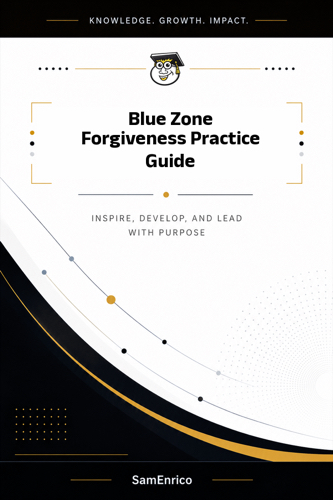
Non-FictionHealth & WellnessForgiveness
Blue Zone Forgiveness Practice Guide eBook
Let go of grudges as Ikarians do, reducing stress-
Let go of grudges as Ikarians do, reducing stress-induced inflammation and disease.
Formats
Free sample
Chapter 1: The Secret in the Aegean...--–- The old man's hands were shaking, but not from age. Nikos had been dead for three hours, and still his nephew could not close the old man's eyes. They remained frozen open, wide and accusing, as if the corpse itself was still holding onto something. The village doctor of Ikaria, a woman named Eleni who had delivered half the centenarians on the island, had seen this before. She leaned close to the deceased and whispered something in Greek.
Then she turned to the family and said what she always said when a person died with a grudge still burning: "He did not lose his life to disease. He lost it to a debt he refused to cancel."The room fell silent. Nikos had been ninety-seven years old, healthy enough to walk to his goat pen every morning until his final week. His blood pressure was perfect. His heart, by all medical measures, was strong.
But for forty years, he had refused to speak to his nephew over a dispute about a fig orchard—a few trees, a few thousand euros, a lifetime of silence. When the nephew finally tried to apologize at the hospital bed, Nikos turned his face to the wall. He died twelve hours later. The autopsy showed no cancer, no clot, no failure of any organ. The official cause of death was listed as "acute myocardial infarction"—a heart attack.
But Eleni knew better. She had watched Nikos's inflammation markers climb every time his nephew's name was mentioned. She had watched his blood pressure spike during family arguments. She had watched a healthy man die by the inch, one un-forgiven slight at a time.This is not a story about morality. It is not a story about being "the bigger person" or turning the other cheek or any of the gentle, passive, spiritual platitudes that have made the word "forgiveness" feel like a burden rather than a gift.
This is a story about biology. This is a story about inflammation, cortisol, and the silent, invisible way that holding onto anger ages your cells faster than smoking a pack of cigarettes a day. And this is the story of how one small island in the Aegean Sea—a place called Ikaria, where people live to one hundred without dementia, without depression, and without the chronic diseases that kill the rest of the world—has accidentally stumbled upon the most effective anti-inflammatory medicine ever discovered.The name of that medicine is not a drug. It is not a supplement. It is not a diet or an exercise routine or a meditation app.
The name of that medicine is the daily, deliberate, almost boring practice of letting go of grudges before they have a chance to settle into your bones.The Island Where People Forget to Die Ikaria is one of the world's five Blue Zones—regions identified by National Geographic fellow Dan Buettner where people live measurably longer, healthier lives than anywhere else on earth. The other Blue Zones are Okinawa (Japan), Sardinia (Italy), Nicoya (Costa Rica), and Loma Linda (California). Each has its signature longevity secret: Okinawa has sweet potatoes and purpose (ikigai); Sardinia has red wine and goat's milk; Nicoya has beans and corn; Loma Linda has plant-based diets and Sabbath rest. But Ikaria is different. Ikaria's secret has been harder to see because it is invisible.
It is not a food or a drink or a physical activity. It is the absence of something. Specifically, it is the absence of sustained, unresolved interpersonal conflict.Researchers Foltz and Mac Neil, a husband-and-wife team of anthropologists and behavioral neuroscientists, spent five years on the island trying to understand why Ikarian men are four times as likely to reach age ninety as American men, and why Ikarian women over eighty have half the rate of dementia as their European peers. They measured blood, tracked sleep, analyzed diets, and mapped social networks. What they found surprised them.
The Ikarian diet is healthy but not extraordinary—greens, legumes, olive oil, goat's milk, wine. The Ikarian lifestyle involves walking and gardening but not marathons or Cross Fit. The Ikarian social structure is close-knit but not unique among Mediterranean cultures.What set Ikarians apart was their relationship to conflict. Specifically, they had a culturally ingrained, almost reflexive habit of not letting disagreements fester. In Ikaria, if two neighbors argue, they do not stop speaking for years.
They argue, they shout, they gesticulate wildly—and then, within hours or days, they share a meal. The offense is not forgotten, but it is also not stored. It is processed and released, like the steam from a boiling pot rather than the pressure building inside a sealed container.The researchers called this "low grudge reactivity." When an Ikarian is wronged, their cortisol spikes—the normal biological response. But unlike most people, whose cortisol stays elevated for hours, days, or even years as they replay the offense, the Ikarian cortisol returns to baseline within a remarkably short window. Their bodies respond to the threat and then, just as quickly, stand down.
This is not because Ikarians are morally superior or spiritually enlightened. It is because they have a set of daily, low-effort practices that sweep emotional debris out of the body before it can calcify into chronic inflammation.The Western Forgiveness Trap Let me tell you what forgiveness has become in the West, because it is almost the opposite of what happens in Ikaria. In our culture, forgiveness has been framed as a heavy, dramatic, morally heroic act. It requires the offender to apologize. It requires the offended to "find it in their heart" to let go.
It is often tied to religion—"forgive as the Lord forgave you"—which adds a layer of guilt to an already difficult process. If you cannot forgive, you are not only hurting yourself; you are sinning. This framing has created a population of people who either:Forgive too early (performative forgiveness), saying "it's fine" when it is not fine, swallowing their anger and converting it into depression or autoimmune disease, or Never forgive (righteous resentment), wearing their grudges like medals, convinced that letting go would be a betrayal of their own dignity, or Try to forgive but fail (exhausted forgiveness seekers), buying books, attending workshops, and spending years in therapy trying to "release" a wound that refuses to close.None of these paths work. Performative forgiveness leads to physical illness. Righteous resentment leads to loneliness and, eventually, the same physical illness.
Exhausted forgiveness seeking leads to burnout and self-blame—"What is wrong with me that I cannot let this go?"The Ikarian way offers a fourth path, and it is radically different. In Ikaria, forgiveness is not a moral act. It is a hygiene act. It is not something you do for the other person. It is something you do for your own body, like brushing your teeth or taking a nap or drinking a glass of water.
You do not brush your teeth because you love your teeth. You brush your teeth because you know what happens if you do not. Forgiveness, in the Ikarian view, is exactly the same. You…
This is the end of the free sample. Get the eBook to keep going. Buy now
About this book
Details
- Author
- Hutto Georgina
- Publisher
- SamEnrico
- Language
- English
- Genre
- Non-Fiction, Health & Wellness, Forgiveness
- Released
- 2026-06-10
- Pages (approx.)
- 149
- Available as
- eBook, Audiobook

Read better in the ZLOADR app
Your eBooks on your phone or tablet. Sign in with your SamEnrico account and start reading.
More by Hutto Georgina
 The High Achiever Hydration HabitHutto Georgina$11.99
 Immigrant Rights Nonprofit Fraud HandbookHutto Georgina$11.99
 Comfortable Mattress SelectionHutto Georgina$11.99
 Burnout Warning Signs HandbookHutto Georgina$11.99
 The Velvet Noose: The Enigma of Madame PopovaHutto Georgina$11.99
 Blood BondsHutto Georgina$11.99
 Founder Depression Meditation GuideHutto Georgina$12.99
 Mobile App CAC TacticsHutto Georgina$12.99
 Understanding Woods–leversha–Rogers SyndromeHutto Georgina$17.99
 How to Start a Basalt Mine Business (Beginners Guide)Hutto Georgina$11.99
You may also like
 Hong Kong Handover 1997Dunn Johnnie$11.99
 Zumba For Postnatal Recovery CourseNeal Christian$11.99
 Zumba for BeginnersLadner Nikia$11.99
 YouTube Comment Mining GuideHumes Pandora$12.99
 Worry Box MeditationCarlin Rudy$11.99
 Workplace Stress MeditationNguyen Lynn$11.99
 Workplace Stress and Sleep RepairHawley Ivory$11.99
 Workplace Perfectionism CureDelaney Jeffry$11.99
 Workplace Injustice Anger GuideWallen Isabelle$11.99
 Work Addiction and Burnout LinkGreenwood Ester$11.99
 Women in Yoga and WellnessBeattie Galina$11.99
 Women in Stand Up ComedyChun Evangeline$11.99