
Non-FictionHealth & WellnessLongevity Science
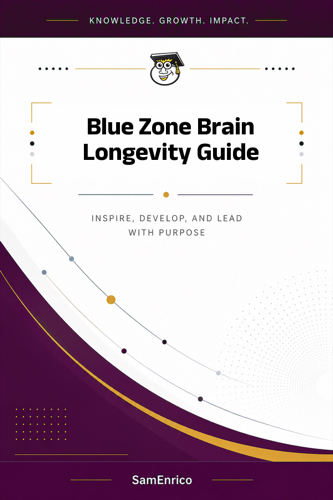
Blue Zone Brain Longevity Guide eBook
Adopt habits from longevity hotspots to reduce dem
Adopt habits from longevity hotspots to reduce dementia risk.
Formats
Free sample
Chapter 1: The 90% Lie--–- You have been told a lie. Not a small lie, not a harmless exaggeration, but a profound and deeply damaging deception that has shaped how you think about aging, memory, and your own future. The lie whispers that dementia is a genetic lottery—that if your mother had Alzheimer's, you are merely waiting for your number to come up. The lie masquerades as wisdom: "It's just old age," "There's nothing you can do," "Everyone in our family gets it." This lie has been repeated by well-meaning doctors, accepted by terrified patients, and reinforced by a culture that treats cognitive decline as an inevitable price of living long enough.The truth is far more radical, far more hopeful, and far more demanding. The truth is that up to 90 percent of dementia risk is modifiable.
The truth is that your daily choices—what you put on your fork, how you move your body, whom you spend time with, when you close your eyes at night—are more powerful than your DNA. And the truth is that the world's longest-lived people have known this for generations, not through sophisticated medical technology, but through simple, daily habits that protect their brains as effectively as any drug in development.This book is about that truth. It is about the five places on Earth where people live the longest and the sharpest—the Blue Zones of Okinawa, Sardinia, Nicoya, Ikaria, and Loma Linda. And it is about translating their ancient wisdom into a modern, science-backed protocol for preserving your most precious asset: your mind.But before we travel to those distant shores, we must first dismantle the lie. We must understand exactly what dementia is, what it is not, and why the difference between normal aging and pathological decline could save your life.
We must confront the terrifying statistics with clear eyes, not to paralyze us, but to mobilize us. And we must introduce the central promise of this book: that neuroplasticity—the brain's lifelong ability to rewire itself—is the most underutilized tool in all of medicine.The Silver Tsunami: Why This Matters Right Now Every sixty seconds, somewhere in the United States, a person develops Alzheimer's disease. Before you finish reading this chapter, another person will join them. Before you finish this book, more than a thousand families will receive a diagnosis that will change everything—the missed appointments, the lost car keys, the forgotten grandchild's name, the bewildered stare in the eyes of someone who once knew your birthday.Alzheimer's disease is the sixth leading cause of death in America, but that statistic understates its true toll. Unlike heart disease or cancer, where survival is measured in months or years, Alzheimer's steals its victims slowly, over an average of eight to ten years.
It is the only cause of death among the top ten that cannot be prevented, cured, or even slowed by any available medication. The drugs on the market—the ones you see advertised during evening news programs—offer modest symptom management at best, often at the cost of brain swelling and bleeding. They do not stop the disease. They do not reverse it. They barely slow it.The economic cost is staggering.
In 2024, Alzheimer's and other dementias will cost the United States more than $360 billion dollars. By 2050, unless something changes, that figure will exceed $1 trillion annually—more than the entire defense budget, more than the GDP of most countries. But the human cost is incalculable. Families are destroyed by the slow disappearance of a parent, a spouse, a sibling. Caregivers—over eleven million of them, unpaid—suffer from depression, anxiety, and physical illness at rates far higher than the general population.
One in three dementia caregivers dies before the patient, felled by the stress of watching someone they love vanish piece by piece.This is the backdrop against which we must understand the lie. If dementia were truly an inevitable genetic fate, we could accept this suffering as a tragic but unavoidable part of life. But it is not. And that makes the suffering all the more unforgivable.Normal Aging versus Pathological Decline: A Critical Distinction Let us be absolutely clear about what is normal and what is not. As you age, your brain changes.
Processing speed slows down—that frustrating moment when a name sits on the tip of your tongue but refuses to leap off. Multitasking becomes more difficult. You might forget where you put your reading glasses or walk into a room and momentarily forget why you came there. These experiences are normal. They are not signs of dementia.
They are signs of a brain that has accumulated decades of memories and is now slightly slower at retrieving them.Pathological cognitive decline is different in kind, not just in degree. It is not forgetting where you put your keys; it is finding your keys in the refrigerator. It is not struggling to recall a name; it is looking at your own child and not recognizing their face. It is not walking into a room and forgetting why; it is getting into your car and forgetting how to drive. It is losing the ability to manage finances, to follow a recipe, to hold a conversation, to navigate a familiar route home.This distinction matters because fear of normal aging leads many people to ignore real warning signs.
"Oh, everyone forgets things," they say, dismissing the early symptoms that could prompt intervention. Conversely, misunderstanding dementia leads others to panic at every misplaced wallet, assuming the worst when no pathology exists.The medical community uses specific criteria to distinguish between mild cognitive impairment (MCI) and dementia. MCI involves cognitive changes noticeable to the individual or their family but not severe enough to interfere with daily independence. Dementia, by contrast, involves deficits serious enough to require assistance with basic activities of daily living—eating, bathing, dressing, toileting.Approximately 10 to 20 percent of people over 65 have MCI. Of those, roughly 10 to 15 percent progress to dementia each year.
But here is the hopeful news: many people with MCI never progress, and some even revert to normal cognition. Their brains heal. Their brains rewire. Their brains defy the expected trajectory because of lifestyle changes—exactly the kind of changes this book will teach you.The APOE4 Gene: Risk Is Not Destiny Perhaps the most pernicious aspect of the dementia lie is the belief that genetics are destiny. This belief is strongest among those who carry a gene variant called apolipoprotein E4, or APOE4.
Approximately 25 percent of the population carries one copy of this gene, and about 2 percent carry two copies. Having one copy increases your lifetime risk of Alzheimer's by approximately threefold. Having two copies increases your risk by tenfold or more.If you carry APOE4, you have likely been told—perhaps by a direct-to-consumer genetic test or by a concerned physician—that you are "predisposed" to Alzheimer's. You may have spent sleepless nights wondering if every forgotten name is the beginning of the end. You may have felt a sense of fatalism, a creeping resignation that no matter what you do, the disease will find you.Let me tell you about a study that should change how you think about APOE4.…
This is the end of the free sample. Get the eBook to keep going. Buy now
About this book
Details
- Author
- Leighton Jerica
- Publisher
- SamEnrico
- Language
- English
- Genre
- Non-Fiction, Health & Wellness, Longevity Science
- Released
- 2026-06-06
- Pages (approx.)
- 148
- Available as
- eBook, Audiobook

Read better in the ZLOADR app
Your eBooks on your phone or tablet. Sign in with your SamEnrico account and start reading.
More by Leighton Jerica
 Thunberg Greenwashing Exposé Technique GuideLeighton Jerica$11.99
 Failure Fear for High AchieversLeighton Jerica$11.99
 Women In Science DNA Race GuideLeighton Jerica$11.99
 Willie Nelson Outlaw Country GuideLeighton Jerica$11.99
 The Last Unbroken: The Myth of the Perfect MarathonLeighton Jerica$11.99
 The Velvet Conspiracy: How a Secret Society of Spies Shaped the Cold WarLeighton Jerica$11.99
 Wash Bay AttendantLeighton Jerica$11.99
 Understanding Fowler's SyndromeLeighton Jerica$17.99
 How to Become a Script ReaderLeighton Jerica$11.99
 AI Presentation Design HandbookLeighton Jerica$12.99
 AI Vendor Payment GuideLeighton Jerica$12.99
You may also like
 Hong Kong Handover 1997Dunn Johnnie$11.99
 Zumba For Postnatal Recovery CourseNeal Christian$11.99
 Zumba for BeginnersLadner Nikia$11.99
 YouTube Comment Mining GuideHumes Pandora$12.99
 Worry Box MeditationCarlin Rudy$11.99
 Workplace Stress MeditationNguyen Lynn$11.99
 Workplace Stress and Sleep RepairHawley Ivory$11.99
 Workplace Perfectionism CureDelaney Jeffry$11.99
 Workplace Injustice Anger GuideWallen Isabelle$11.99
 Work Addiction and Burnout LinkGreenwood Ester$11.99
 Women in Yoga and WellnessBeattie Galina$11.99
 Women in Stand Up ComedyChun Evangeline$11.99