
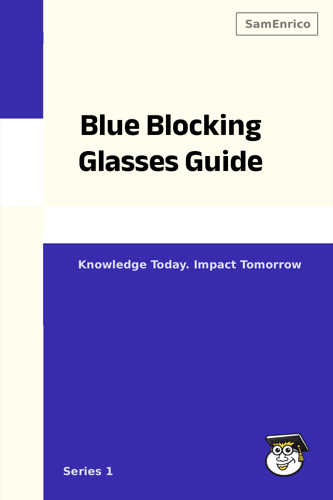
Non-FictionHealth & WellnessLight Filtering
Blue Blocking Glasses Guide Audiobook
Select and use amber lenses to filter evening blue
by Watson Melba
Select and use amber lenses to filter evening blue light effectively.
Formats
Free sample
Chapter 1: The Sunset Theft--–- It begins, as these things often do, not with a dramatic collapse but with a quiet erosion. You lie in bed, exhausted, having done everything “right.” You avoided caffeine after noon. You put your phone on “night mode.” You even tried that melatonin gummy from the drugstore. And yet, here you are: staring at the ceiling at 1:47 AM, your mind racing with tomorrow’s to-do list, your body feeling heavy but utterly awake. You are not broken.
You are not anxious in some deep, mysterious way. You are simply a biological organism living in an environment that is lying to you.This is not a metaphor. Your body contains a clock—a real, physical cluster of neurons called the suprachiasmatic nucleus, located just above the optic chiasm in your hypothalamus. For 200,000 years, this clock was set by a single, reliable signal: the rising and setting of the sun. Then, in the span of a single human lifetime, we replaced the sun with screens, LEDs, and overhead lighting that never dims.
And we are only now beginning to understand the price of that replacement.The Most Important Photoreceptor You’ve Never Heard Of Before we can understand why a pair of orange-tinted glasses might be the single most effective sleep intervention available to you, we have to meet a character that your high school biology textbook omitted entirely. You have heard of rods (for low-light vision) and cones (for color). But in 2002, a team led by neuroscientist David Berson at Brown University made a discovery that rewrote the basic architecture of the human eye: a third type of photoreceptor, entirely separate from rods and cones, called the intrinsically photosensitive retinal ganglion cell—ip RGC for short.Here is what makes the ip RGC extraordinary and, for our purposes, absolutely essential to understand. Unlike rods and cones, which send signals to your visual cortex (the part of your brain that creates images), ip RGCs send signals directly to your suprachiasmatic nucleus—your master clock. They do not help you “see” in any conventional sense.
You cannot perceive their activity. Instead, they perform a single, relentless task: they detect the presence of blue light and report back to your brain whether it is day or night.Let me repeat that, because it is the foundational idea of this entire book. Your eyes contain a dedicated set of cells whose…
This is the end of the free sample. Get the Audiobook to keep going. Buy now
About this book
Details
- Author
- Watson Melba
- Publisher
- SamEnrico
- Language
- English
- Genre
- Non-Fiction, Health & Wellness, Light Filtering
- Released
- 2026-06-07
- Pages (approx.)
- 142
- Available as
- eBook, Audiobook

Listen in the VoxFlicks app
Audiobooks and audio dramas wherever you go. Sign in with your SamEnrico account and press play.
More by Watson Melba
 Press Release For StartupsWatson Melba$11.99
 Polydrug Dependency Treatment GuideWatson Melba$11.99
 Uber Pet Driver GuideWatson Melba$11.99
 The Recovery Altitude SicknessWatson Melba$11.99
 Sweaty Palms FixWatson Melba$11.99
 Foreign Merger Review FinesWatson Melba$11.99
 Breath Noting Technique PrimerWatson Melba$11.99
 Usain Bolt: Lightning Strikes TwiceWatson Melba$11.99
 The Last Waltz: How a Ballroom Scandal Ended a CrownWatson Melba$11.99
 The Empress Who Ruled in Silence: The Untold Power of Empress Wu ZetianWatson Melba$11.99
 How to Start a Hobby in GlassblowingWatson Melba$11.99
 NYC Pop-Up Legal RequirementsWatson Melba$12.99
You may also like
 Hong Kong Handover 1997Dunn Johnnie$11.99
 Zumba For Postnatal Recovery CourseNeal Christian$11.99
 Zumba for BeginnersLadner Nikia$11.99
 YouTube Comment Mining GuideHumes Pandora$12.99
 Worry Box MeditationCarlin Rudy$11.99
 Workplace Stress MeditationNguyen Lynn$11.99
 Workplace Stress and Sleep RepairHawley Ivory$11.99
 Workplace Perfectionism CureDelaney Jeffry$11.99
 Workplace Injustice Anger GuideWallen Isabelle$11.99
 Work Addiction and Burnout LinkGreenwood Ester$11.99
 Women in Yoga and WellnessBeattie Galina$11.99
 Women in Stand Up ComedyChun Evangeline$11.99